



KBr Pellet Preparation
A KBr pellet is the classic transmission sample format for FTIR analysis. The workflow is short but sensitive: grind the sample finely, mix it with dry potassium bromide powder at the right ratio, press it in a 13 mm die and inspect the resulting disc. This page collects the equipment and the procedures Hench supplies for each step.
Step 1: Grinding
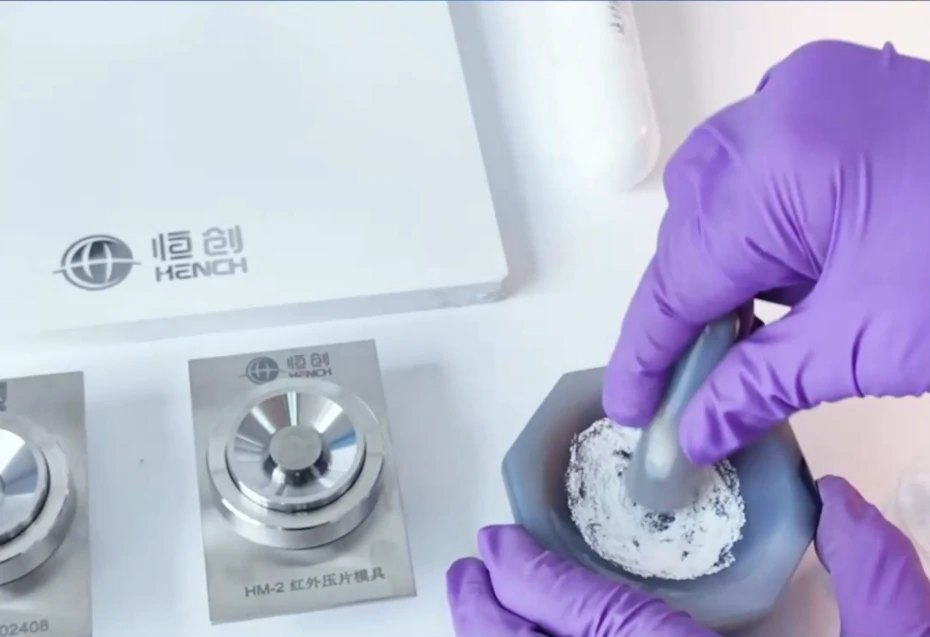
The sample is ground to a fine, uniform powder so that it disperses evenly in the KBr matrix. The HW-3 agate mortar provides a clean grinding surface that does not introduce contamination.

Step 2: Potassium Bromide Powder
Hench supplies KBr-F spectral pure potassium bromide powder and KBr-S crystalline potassium bromide. Both must be kept dry: moisture in the powder produces the characteristic water bands in the spectrum.
Step 3: Pressing the Pellet
13 mm is the standard pellet diameter. Use the HM-12 13 mm demoulding die for standard pellets or the HM-2 no-demould die when the pellet is measured in place. Presses are listed on the KBr pellet press page, and the complete die range is on the KBr pellet die page.
Step 4: Drying and Storage
The HK-3 IR laboratory oven is used for drying powder and accessories, and a moisture-proof cabinet keeps the optics and consumables dry between measurements — see why a dedicated moisture-proof box matters.
Standard Operating Procedure
The detailed procedure, including grinding, mixing, pressing and inspection, is published in our KBr pellet preparation guide and in how to prepare KBr pellets for accurate FTIR analysis.
Troubleshooting
- Cloudy pellet: insufficient grinding, moisture or too little pressure.
- Cracked pellet: pressure released too quickly or an uneven die surface.
- Water bands in the spectrum: wet powder, wet die or humid laboratory air.
- Weak sample bands: too little sample in the mixture or an overly thick pellet.
Frequently Asked Questions
Process Parameters
| Step | Parameter | Value |
|---|---|---|
| Grinding | Sample state | Fine, uniform powder |
| Mixing | Sample-to-KBr ratio | A small amount of sample in a much larger volume of KBr |
| Pressing | Die diameter | 13 mm |
| Pressing | Load | 8-10 tons |
| Pressing | Hold time | 60-90 seconds after a 1-2 minute vacuum step |
| Storage | Conditions | Dry cabinet with fresh desiccant |
Quality Checks After Pressing
Check the pellet before it goes into the spectrometer: it should be transparent, flat and free of cracks. A cloudy disc usually points to insufficient grinding, moisture or too little pressure, while a cracked one points to a fast pressure release or an uneven die surface.
Record the load, the hold time and the die diameter together with the sample-to-KBr ratio so that the method can be repeated. The complete procedure is published in our KBr pellet SOP.
What ratio of sample to KBr is used?
The ratio depends on the sample’s absorption; typical laboratory practice is a small amount of sample dispersed in a much larger volume of KBr. Start from the procedure in our preparation guide.
Can I reuse a die for other samples?
Yes, but the die must be cleaned and dried between samples to avoid cross-contamination and water bands.
Which press should I use?
A 15-ton bench press such as the HYP-15 is sufficient for 13 mm pellets; automatic presses are used when many pellets are prepared per day.
Need help choosing KBr consumables? Request a quote with your pellet diameter and spectrometer model.