



KBr Pellet Press
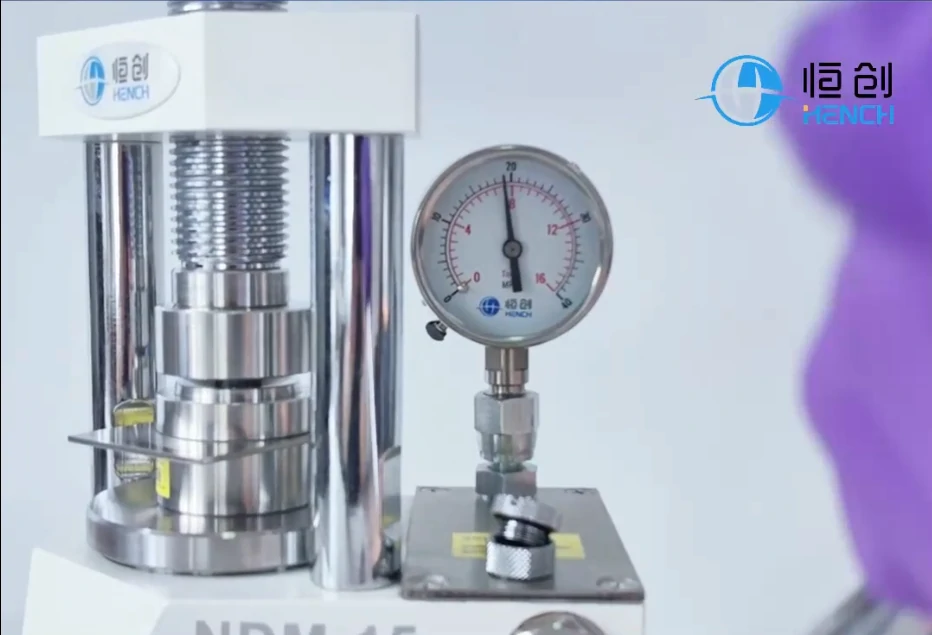
A KBr pellet press compacts a mixture of sample and potassium bromide powder into a transparent disc for transmission FTIR analysis. Hench supplies manual, digital and automatic laboratory presses together with the dies, mortars and KBr powder needed for reproducible pellets.
What a KBr Pellet Press Does
The press applies a controlled load to the powder inside a die. Under pressure the KBr flows and forms a transparent disc that transmits infrared light, allowing the sample’s absorption spectrum to be measured. Pellet quality depends on grinding, the sample-to-KBr ratio, the applied load and the die surface.
Manual and Digital Presses
The HYP-15 15-ton manual IR tablet press is a compact bench press for IR pellets. The YP-S digital hydraulic press and the 15/24/30/40-ton YP-S press display pressure digitally, which makes it easier to repeat a method.

Automatic Presses
For series work the SAT-2A/10A automatic IR tablet press and the HAP-S automatic powder tablet press run programmable pressing cycles. The HDP-S electric press provides electric pressure control at a lower tonnage.
Matched Dies
KBr pellets are normally pressed in a 13 mm die. Hench supplies the HM-12 13 mm demoulding die and the HM-2 no-demould die, plus a wider range in the KBr pellet die and pellet molding die pages.

Consumables
Pellet preparation also requires KBr-F spectral pure powder or KBr-S crystalline potassium bromide, and a clean grinding tool such as the HW-3 agate mortar. The full procedure is described in our KBr pellet preparation guide.
Frequently Asked Questions
Press and Die Selection
| Pellet format | Press | Die |
|---|---|---|
| 13 mm KBr pellet | 15-ton manual or digital press | HM-12 13 mm demoulding die |
| 13 mm, series work | SAT-2A/10A automatic IR tablet press | HM-12 13 mm demoulding die |
| In-situ measurement | manual or digital press | HM-2 no-demould die |
| Larger pellets | 15/24/30/40-ton YP press | die matched to the target diameter |
Pellet Fault Diagnosis
| Symptom | What to check |
|---|---|
| Cloudy pellet: | insufficient grinding, moisture or too little pressure. |
| Cracked pellet: | pressure released too quickly or an uneven die surface. |
| Water bands in the spectrum: | wet powder, wet die or humid laboratory air. |
| Weak sample bands: | too little sample in the mixture or an overly thick pellet. |
Method Notes for KBr Pellets
For routine transmission work we document a 13 mm die, 8-10 tons of load, a hold of 60-90 seconds and a 1-2 minute vacuum step before pressing. The full sequence is published in our KBr pellet SOP, and the grinding and mixing steps are covered in the KBr pellet preparation guide.
Press selection follows the workload: a single 15-ton bench press covers most 13 mm pellets, while automatic presses are used when several pellets are prepared each day and the same load and hold time has to be repeated.
What tonnage is used for a 13 mm KBr pellet?
13 mm pellets are pressed at a small fraction of the press capacity; the exact load depends on the sample. The procedure, including pressure and hold time, is described in the preparation guide.
Can the same press be used for other samples?
Yes. Laboratory presses are used for KBr pellets, XRF pellets and general powder compaction by changing the die.
Why is my pellet cloudy?
Cloudiness usually comes from insufficient grinding, moisture or too little pressure. See how to prepare KBr pellets for the corrective steps.
Need help choosing the right configuration? Request a quote and include your sample type, required pellet or die size and the press you are using.