What Can FTIR Detect? A Complete Guide to Fourier Transform Infrared Spectroscopy
7月 25, 2026
Fourier Transform Infrared (FTIR) spectrometers detect organic molecules, select inorganic compounds, and chemical functional groups across solid, liquid, and gas samples. By measuring how molecular bonds absorb infrared light waves, FTIR instruments capture unique spectral signatures. These “molecular fingerprints” allow laboratory researchers and industrial technicians to identify unknown substances, verify material purity, and measure component concentrations.
Compared to traditional infrared devices, FTIR offers superior optical resolution, rapid scan speeds, and low signal noise. Consequently, FTIR spectroscopy serves as a core analytical tool in materials science, chemical engineering, food safety, pharmaceutical quality control, and environmental monitoring.
Qualitative Identification and Molecular Structure Analysis
Qualitative identification represents the primary capability of FTIR spectroscopy. Most organic compounds and several inorganic materials contain specific functional groups—such as hydroxyl (-OH), carbonyl (C=O), amino (-NH2), and aromatic benzene rings. These bonds absorb infrared radiation at characteristic frequencies, producing a unique spectral pattern.
FTIR spectrometers compare these acquired spectra against digital reference libraries to identify unknown chemical compositions rapidly. This capability enables laboratories to distinguish between structurally similar or visually identical compounds.
Polymer and Plastics Classification
The polymer industry relies heavily on FTIR to identify resins, rubbers, and synthetic fibers. The instrument accurately differentiates common polymers, including polyethylene (PE), polypropylene (PP), and polyvinyl chloride (PVC).
Material Modification Verification
FTIR measures changes in chemical structures resulting from polymer grafting, blending, or heat degradation. Quality control teams use this data to confirm whether modification processes meet strict manufacturing specifications.
Raw Material Authentication
Fast spectral matching prevents raw material mixing, contamination, and substandard material substitution in high-volume production lines.
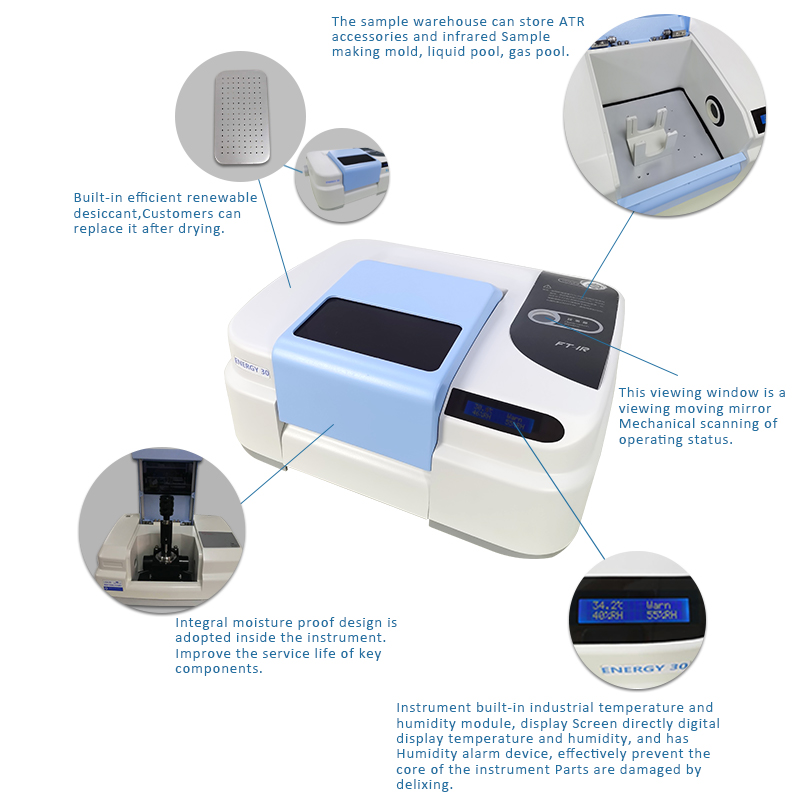
Instruments such as the Matrix-50 Fourier Transform Infrared (FTIR) Spectrometer deliver high optical throughput to ensure precise spectral matching for complex material characterization.
Precise Quantitative Analysis and Trace Impurity Detection
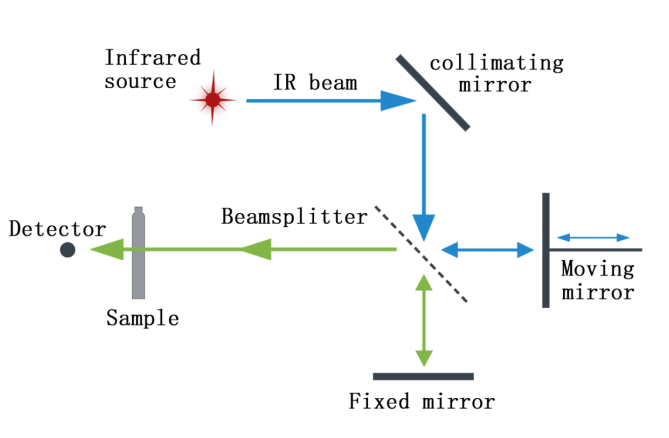
Beyond qualitative matching, FTIR spectroscopy performs quantitative analysis based on the Beer-Lambert Law. This principle establishes a direct linear relationship between spectral absorption peak intensity and substance concentration.
Fine Chemical Quality Control
In chemical manufacturing, FTIR monitors exact formulation ratios in coatings, commercial adhesives, and functional additives. It detects unreacted monomers and solvent residues in finished goods.
Industrial Lubricant and Oil Condition Monitoring
FTIR analyzes oxidation levels, nitration, and moisture content in synthetic and mineral lubricating oils. Detecting oxidation products helps plant engineers determine oil degradation and schedule preventive machinery maintenance.
Environmental Emission Compliance
FTIR equipment measures volatile organic compounds (VOCs) and trace gases in industrial exhaust streams and liquid effluents, supporting compliance with environmental discharge regulations.
Specialized Applications Across Core Industries
| Industry Field | Primary Detection Targets | Key Analytical Value |
| 医薬品 | Active pharmaceutical ingredients (APIs), excipients, polymorphs | Verifies raw material purity and formulation authenticity |
| Food Safety | Edible oil oxidation, illegal additives, dairy adulterants | Detects harmful chemical residues and food degradation |
| 環境モニタリング | Ambient VOCs, greenhouse gases, industrial stack emissions | Tracks air pollutants in real time for source attribution |
| Semiconductors & Forensics | Micro-contaminants, surface residue, trace fiber samples | Provides non-destructive micro-analysis on minute samples |
Table 1: Target analytes and analytical benefits of FTIR spectroscopy across major industrial sectors.
Key Advantages of Modern FTIR Spectrometers
Modern FTIR instrumentation replaces slower dispersive infrared techniques due to several operational advantages:
- Non-Destructive Testing: Analyzes sensitive samples without altering their physical or chemical structure.
- 最小限のサンプル前処理: Accepts solids, liquids, and gases directly with specialized attenuated total reflectance (ATR) accessories.
- High Operational Efficiency: Acquires complete spectral datasets within seconds to support high-throughput industrial testing.
よくある質問
Can FTIR detect inorganic materials?
FTIR primarily detects organic compounds containing covalent bonds. However, it can also identify polyatomic inorganic salts such as carbonates, sulfates, nitrates, and ammonium compounds.
How does FTIR detect oil oxidation in machinery?
As oil degrades, oxygen reacts with hydrocarbons to form carbonyl groups (C=O). FTIR measures the growth of the carbonyl absorption peak near 1710 cm⁻¹ to quantify oil oxidation.
What sample state is best suited for FTIR analysis?
FTIR accommodates solid powders, thin films, liquids, pastes, and gases. Utilizing ATR accessories allows direct measurement of liquids and solids without complex sample preparation.
How does FTIR quantitative analysis differ from GC-MS?
FTIR provides rapid, non-destructive quantitative measurements without separation columns. GC-MS separates complex volatile mixtures before detection, making FTIR faster for routine single-phase quality checks.
ヘンチについて
ヘンチ specializes in developing high-precision optical analysis instruments, including advanced Fourier Transform Infrared (FTIR) spectrometers and customized laboratory accessories. Engineered for exceptional stability, user-friendly software integration, and high optical performance, Hench instruments empower research institutes, testing centers, and industrial facilities worldwide. Hench provides reliable analytical solutions for material characterization, quality assurance, and environmental compliance.
参考文献