



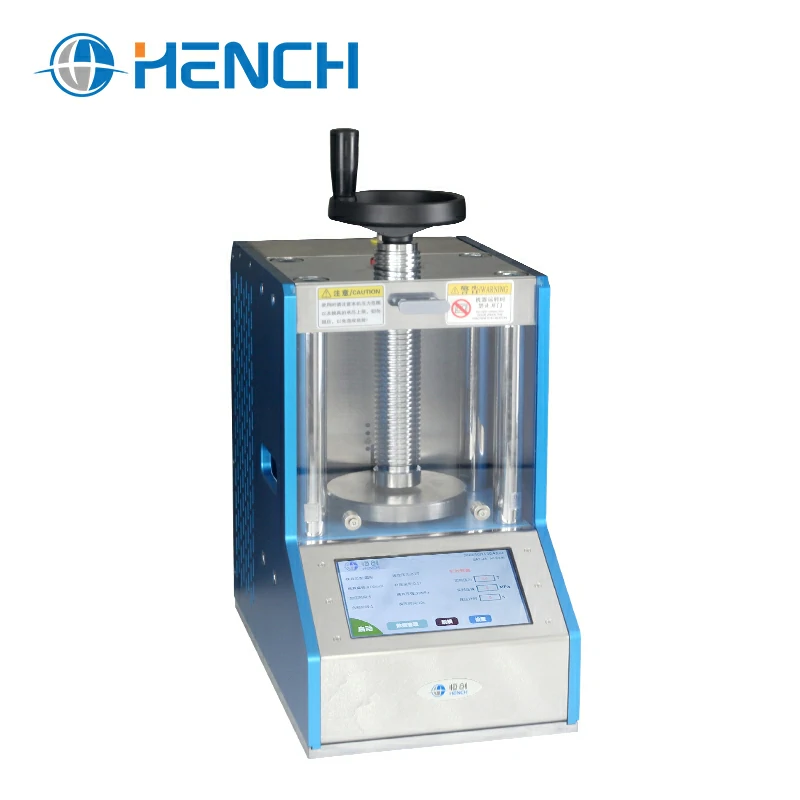
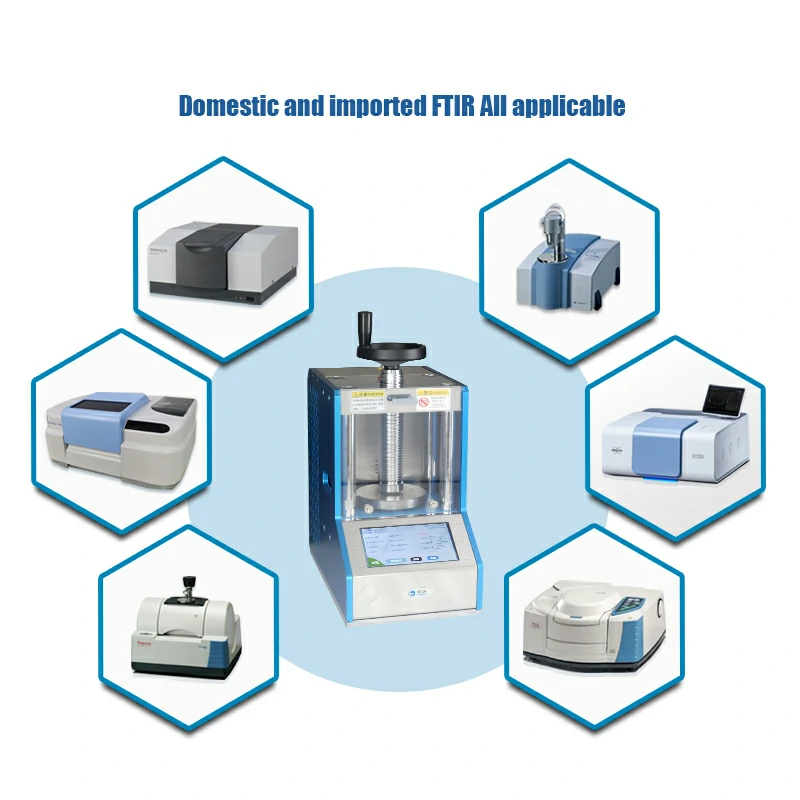
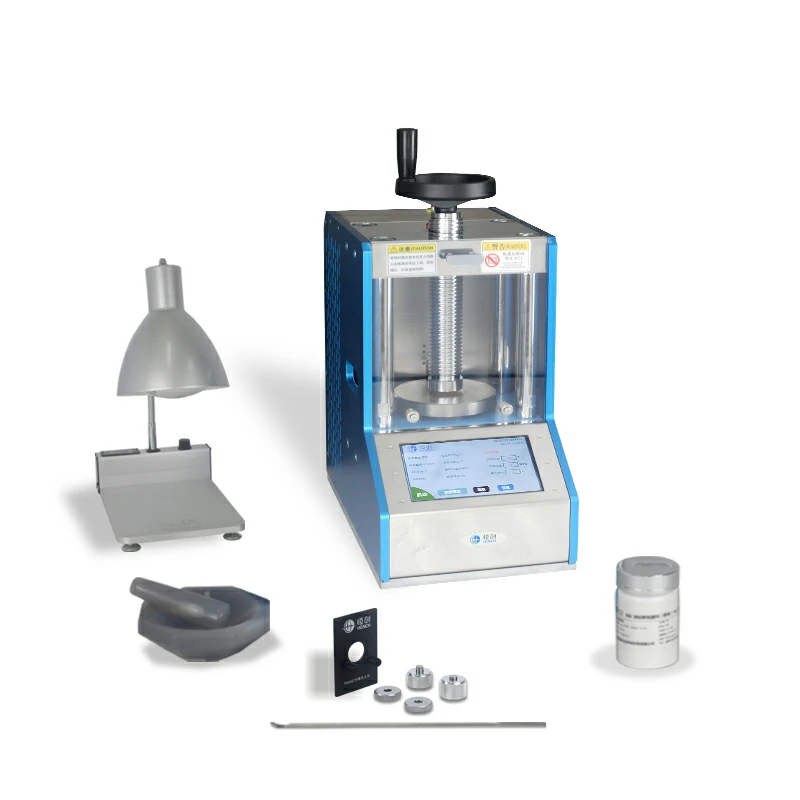
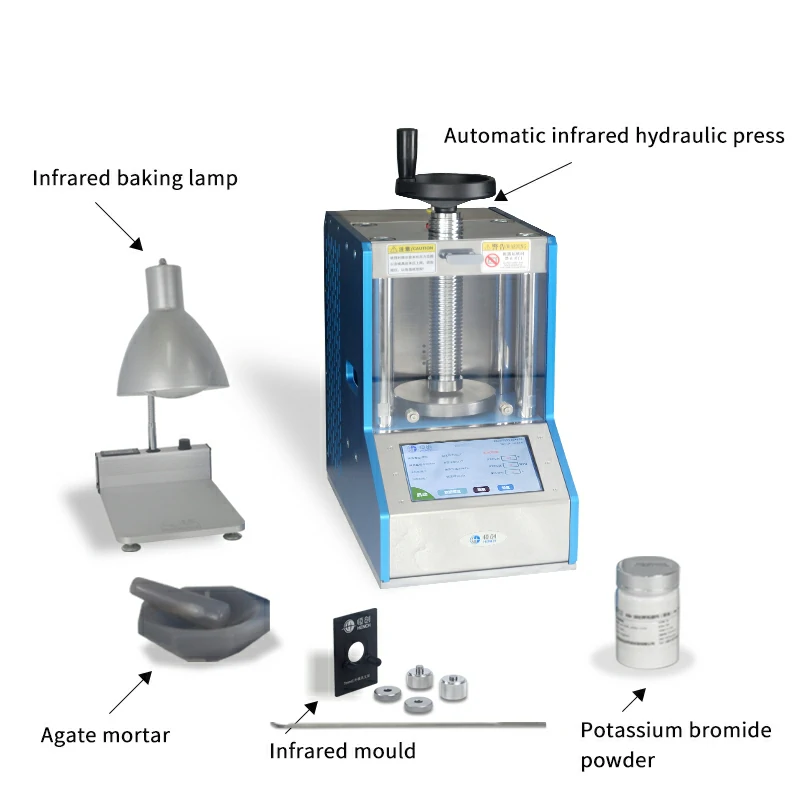
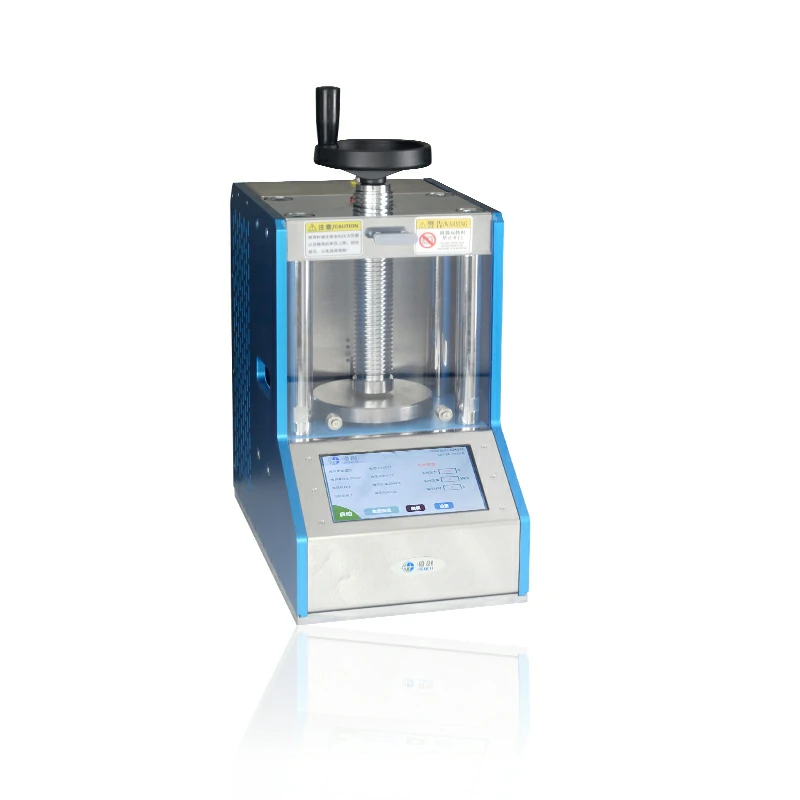
2/10-ton IR Automatic Tablets Press Machine SAT-2A/10A
Reliable Pressure Solution for High-Precision FTIR Spectroscopy Samples
The accuracy of FTIR (Fourier Transform Infrared Spectroscopy) analysis depends heavily on the quality of sample pellets. Inconsistent pressure, uneven compression, or air gaps in pellets can directly affect spectral clarity and lead to unreliable test results.
To solve this challenge, the 2–10 Ton IR Automatic Tablet Press Machine (SAT-2A / SAT-10A) is designed specifically for laboratory-grade sample preparation. It provides stable hydraulic pressure, precise control, and consistent repeatability for KBr pellet formation and infrared spectroscopy testing.
Whether used in chemical research, pharmaceutical development, polymer analysis, or material science laboratories, this automatic tablet press ensures high-quality sample preparation every time.
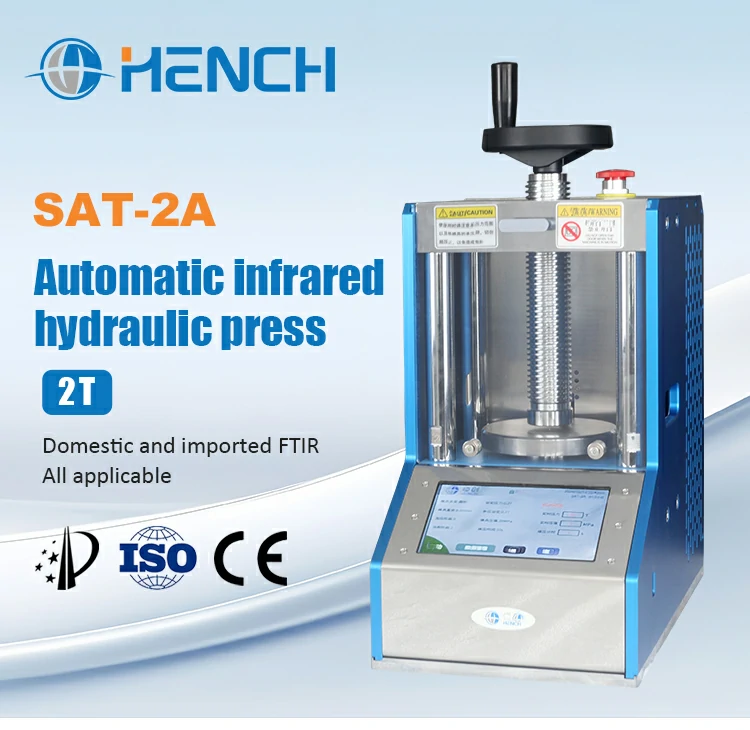
What is an FTIR Tablet Press Machine?
An FTIR tablet press machine is a laboratory hydraulic press used to compress powdered samples into solid pellets for infrared spectroscopy analysis.
In FTIR testing, materials such as potassium bromide (KBr) are mixed with samples and compressed into transparent pellets. These pellets allow infrared light to pass through and generate accurate spectral data.
Compared with manual pressing tools, an automatic FTIR tablet press provides:
- Stable and adjustable pressure output
- Higher repeatability for laboratory testing
- Reduced operator error
- Improved pellet transparency and uniformity
This makes it an essential instrument in modern analytical laboratories.
Why Sample Quality Matters in FTIR Analysis
Accurate FTIR results depend heavily on the quality of pellet preparation. If pressure is unstable or uneven, it may cause:
- Weak or distorted absorption peaks
- Inconsistent sample thickness
- Reduced infrared transmission efficiency
- Poor repeatability in experimental data
The SAT-2A / SAT-10A ensures controlled pressure from 2 to 10 tons, enabling stable pellet density and improving analytical accuracy across repeated tests.
Key Features of SAT-2A / SAT-10A Automatic Tablets Press
The machine is designed with laboratory precision and industrial reliability in mind.
- Stable Hydraulic Pressure System: Provides adjustable pressure from 2 to 10 tons, ensuring accurate and repeatable sample compression.
- Automatic Pressing Operation: Reduces manual labor and improves efficiency in laboratory workflows.
- Digital Pressure Control Interface: Allows users to set and monitor pressure levels easily during operation.
- High Safety Protection System: Includes overload protection, pressure release safety mechanism, and operational limit control.
- Durable Steel Structure: Built with high-strength materials for long-term laboratory use and stability.
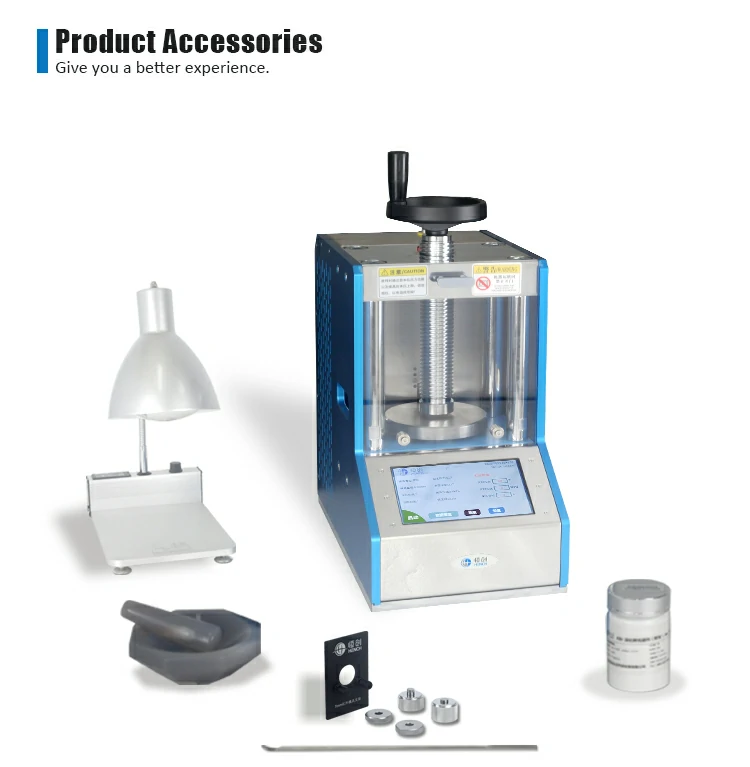
- Precise Mold Compatibility: Compatible with standard FTIR pellet dies for consistent sample preparation.
Product Description
| Item | Specification |
|---|---|
| Instrument model | SAT-2A |
| Pressure limit | 0.3-2T (1-28MPa) |
| Automatic control | Savta intelligent program is used to control the five-stage pressurization |
| Pressure mode | Automatic pressure replenishment - timed pressure retention - automatic pressure relief |
| Holding time | Unlimited time (seconds) |
| Pressure conversion | The system automatically converts the pressure of the sample |
| Pressure conversion | 7 inch touch screen |
| Equipment protection | 100mm high-strength aluminum oxide plate + 6mm plexiglass door |
| Limit protection | Cylinder above the limit height automatic pressure relief |
| Host protection | The actual pressure exceeds the maximum pressure of the machine and automatically starts the pressure relief program |
| Data administration | Can store 10,000 historical operation records, and can be exported to the U disk |
| Cylinder path | ≤30mm |
| Work space | 145 × 160mm |
| Size | 230 × 450 × 420mm |
| Device power supply | 220V/60Hz |
| Weight | 85Kg |
Applications of IR Tablet Press Machine
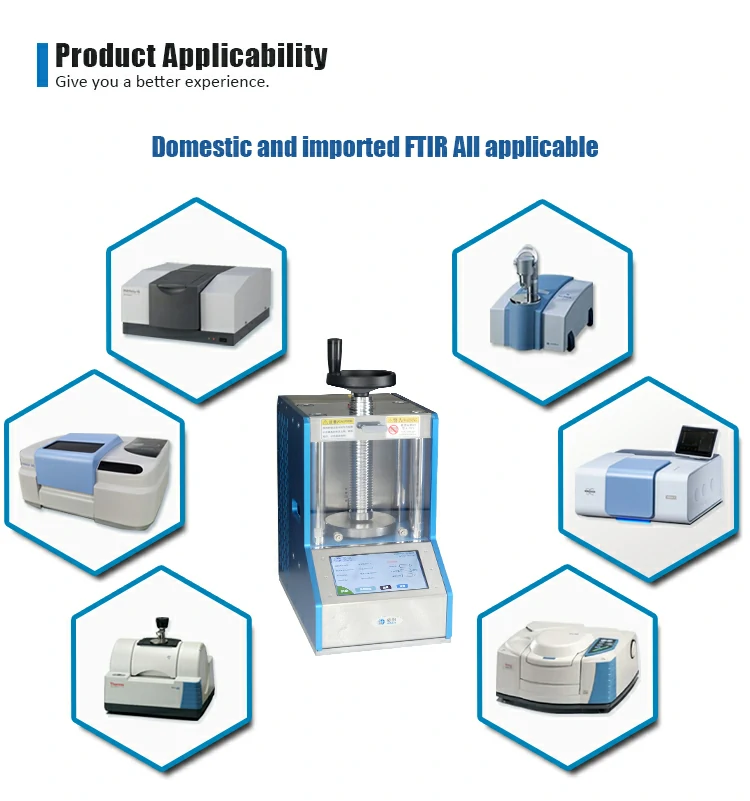
The SAT-2A / SAT-10A is widely used in scientific and industrial laboratories for FTIR sample preparation and material testing applications.
FTIR Spectroscopy Sample Preparation
Used for compressing KBr and sample mixtures into transparent pellets for infrared spectroscopy analysis. It ensures stable infrared transmission and consistent spectral results in research and routine laboratory testing.
Pharmaceutical Laboratory Testing
Applied in pharmaceutical analysis for raw material identification, compound structure evaluation, and formulation consistency testing. It supports reliable FTIR-based quality control processes.
Chemical Research Laboratories
Used for preparing solid samples in organic and inorganic chemical analysis. It supports molecular structure identification, reaction product verification, and spectroscopic research experiments.
Polymer and Material Science
Used in polymer composition analysis, additive detection, and material performance studies. It ensures uniform pellet formation for accurate FTIR evaluation of complex materials.
Academic Research Institutions
Widely used in universities and research institutes for FTIR teaching experiments and scientific research projects. It provides stable sample preparation for spectroscopy training and laboratory demonstrations.
Quality Control Laboratories
Used in industrial QC environments for routine FTIR testing of raw materials and production samples. It ensures consistent sample preparation for reliable batch comparison and quality verification.
How the FTIR Tablet Press Works
The operation process is simple and efficient, suitable for laboratory environments:
- Sample Loading
The powdered sample and KBr mixture are placed into the mold cavity. - Pressure Setting
The operator selects the required pressure level based on sample requirements. - Automatic Compression
The hydraulic system applies uniform pressure to form a dense pellet. - Pressure Holding & Release
Pressure is maintained for a set time to ensure structural stability, then released automatically. - Sample Removal
The finished pellet is removed and ready for FTIR analysis.
This automated workflow ensures consistent sample quality with minimal operator variation.
Manual vs Automatic Tablet Press
| Feature | Manual Press | SAT-2A / SAT-10A Automatic Press |
|---|---|---|
| Pressure Stability | Low | High |
| Repeatability | Inconsistent | Excellent |
| Operator Effort | High | Low |
| Efficiency | Low | High |
| Safety Level | Medium | High |
| FTIR Result Accuracy | Variable | Stable |
The automatic system significantly improves both laboratory efficiency and analytical reliability.
Operating Procedure
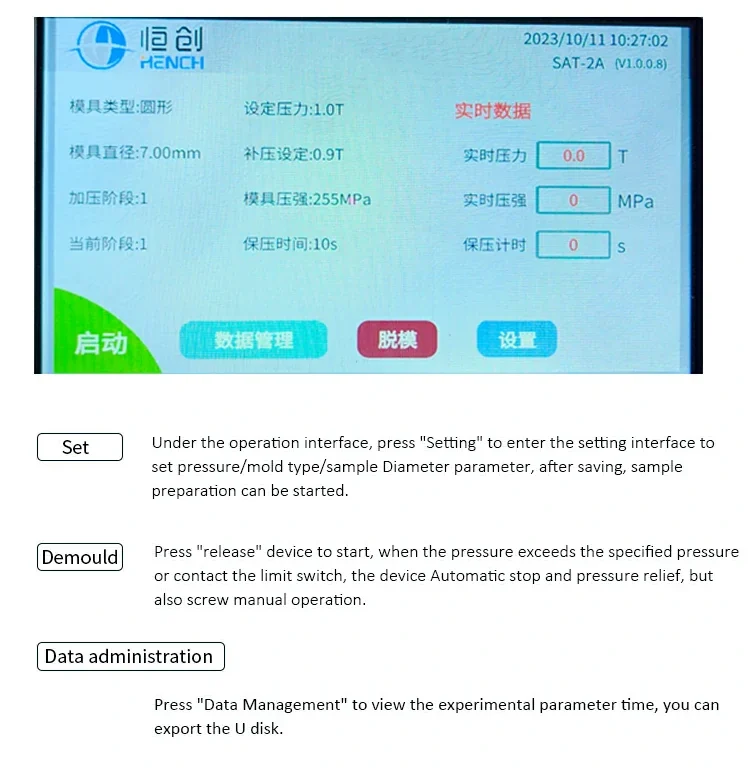
The SAT-2A / SAT-10A automatic tablet press is designed for simple and stable operation in laboratory environments. The standard operating procedure is as follows:
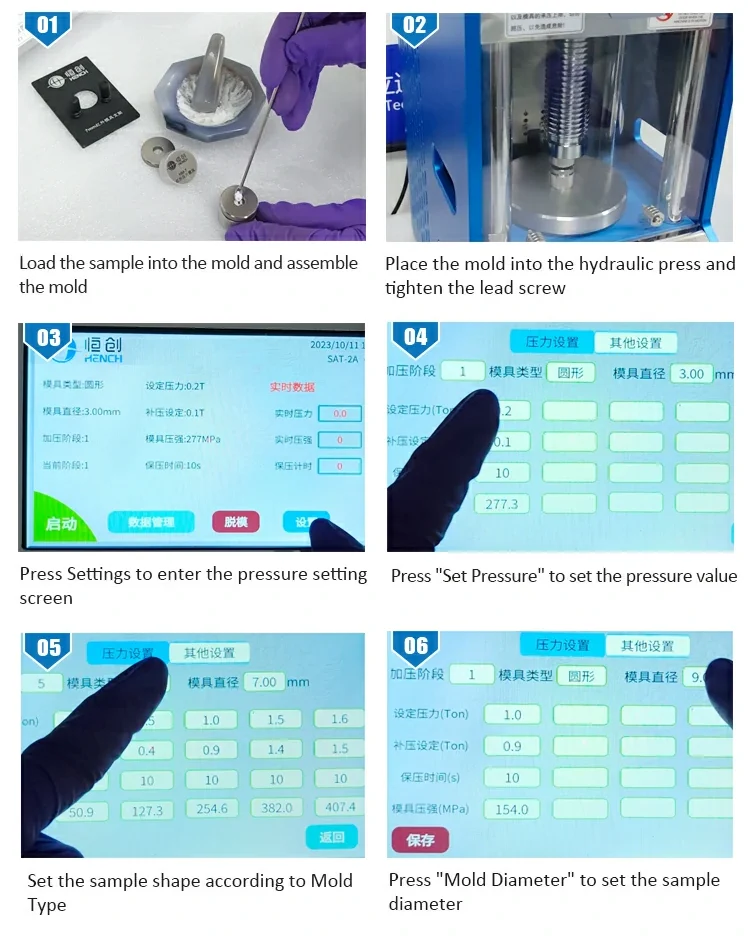
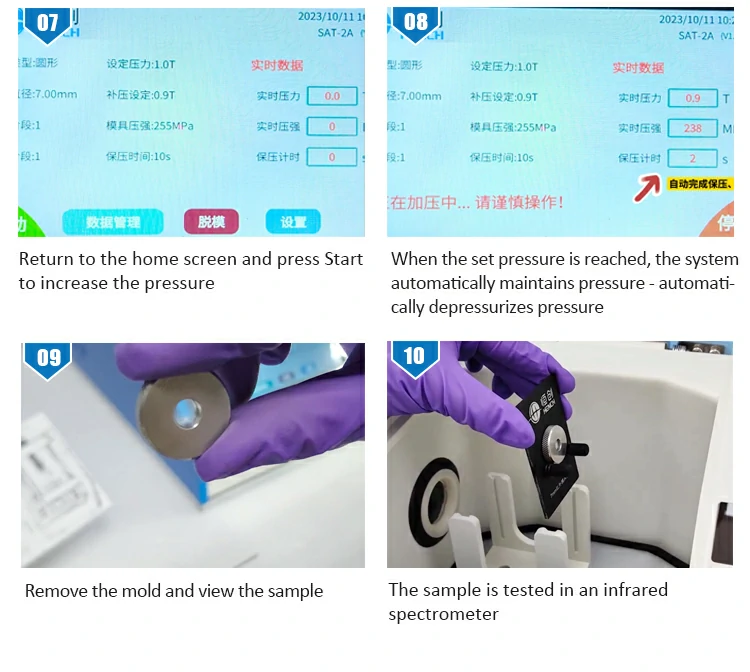
1. Sample Loading and Mold Assembly
Load the powdered sample (typically mixed with KBr for FTIR applications) into the mold cavity. Assemble the mold components securely to ensure proper sealing and uniform pressure distribution during pressing.
2. Mold Installation in Hydraulic Press
Place the assembled mold into the hydraulic press chamber. Tighten the lead screw to ensure the mold is correctly positioned and fixed before starting the pressing process.
3. Pressure Setting Configuration
Enter the control interface and access the pressure setting screen. Select the required pressure value according to the sample type and testing requirements.
4. Mold Parameter Adjustment
Set the mold specifications according to the sample shape requirements. Adjust the mold diameter settings to ensure compatibility with the FTIR pellet size standard.
5. Start Pressing Operation
Return to the main control interface and press the “Start” button. The system will begin automatic pressure increase according to the preset parameters.
6. Pressure Holding and Automatic Release
When the target pressure is reached, the system will automatically maintain stable pressure for a preset duration to ensure proper pellet formation. After completion, the system will automatically release pressure.
7. Sample Removal
Remove the mold from the press chamber and carefully extract the formed pellet. Ensure the sample remains intact and free from cracks or deformation.
8. FTIR Analysis
Place the prepared pellet into the infrared spectrometer for FTIR analysis. The high-quality, uniform pellet ensures stable infrared transmission and reliable spectral results.
About Hench Technology
Hench Technology Co., Ltd., based in Tianjin, China, specializes in the design and manufacturing of infrared spectroscopy sample preparation equipment. Their product line includes IR hydraulic presses, molds, heated dies, and full accessory sets. As a trusted hydraulic press supplier, Hench provides durable, high-performance solutions for laboratories worldwide.
Related Laboratory Equipment
- FTIR pellet dies and molds
- Laboratory moisture-proof storage cabinets
- Sample grinding and mixing tools
- Hydraulic press accessories and spare parts