.png)
.png)


laboratory presses
Discover Hench Technology’s range of precision laboratory presses, designed for efficient sample preparation and reliable performance. For inquiries or quotes, contact us today.
-
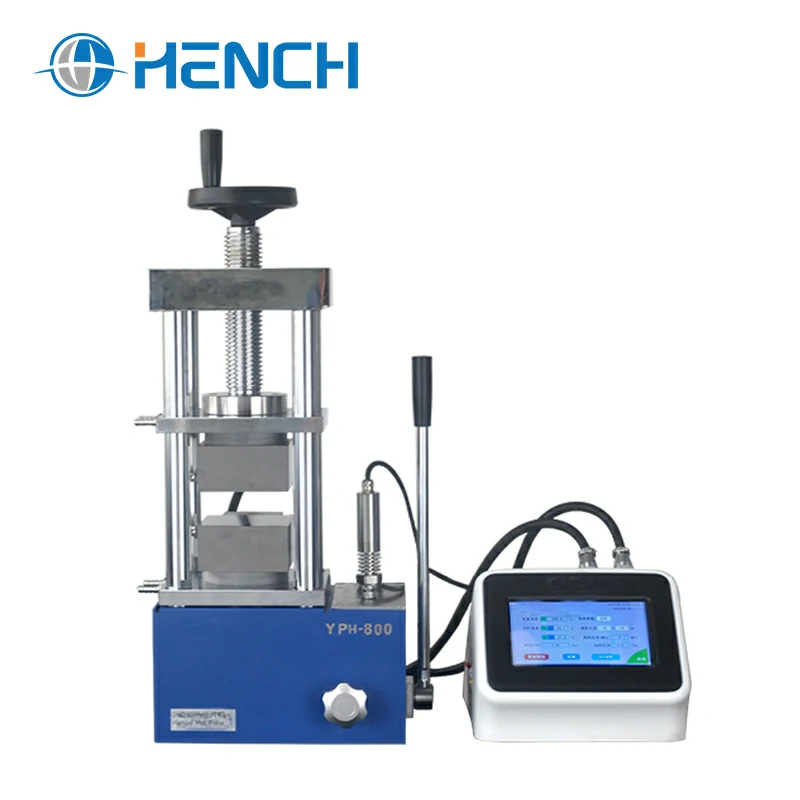
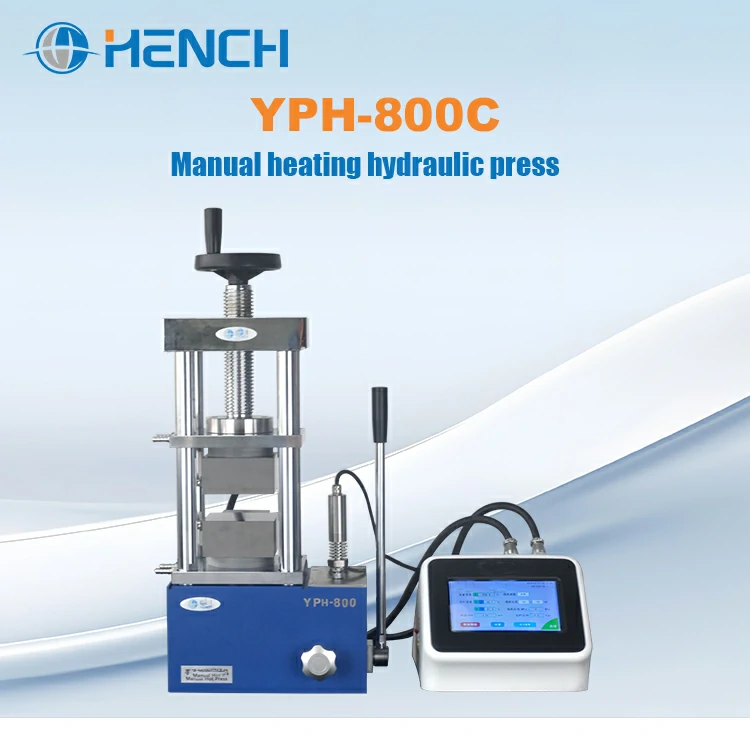
Hot Tablet Press Handheld YPH-800C
Overview
YPH-800C Series Laboratory Manual Hot Press is a high-precision, four-column heated pellet press designed for material science research, polymers, ceramics, and spectroscopy sample preparation (FTIR/XRF). Combining a heavy-duty 30-ton manual hydraulic press with a split-type intelligent touch-screen temperature controller, this series provides researchers with unparalleled pressure accuracy and precise thermal control.
Whether you need the standard version or the high-temperature model, the YPH-800C series ensures excellent sample consistency and structural integrity during thermoplastic molding, encapsulation, or powder pressing.
Explore our effective heated hydraulic press for powders, polymers, and small sample materials.
Key Features & Engineering Advantages
-
Heavy-Duty 30T Pressure Limit: Engineered with a 95mm diameter cylinder diameter and a $30\text{mm}$ stroke, delivering reliable and continuous pressing up to 30 Tons.
-
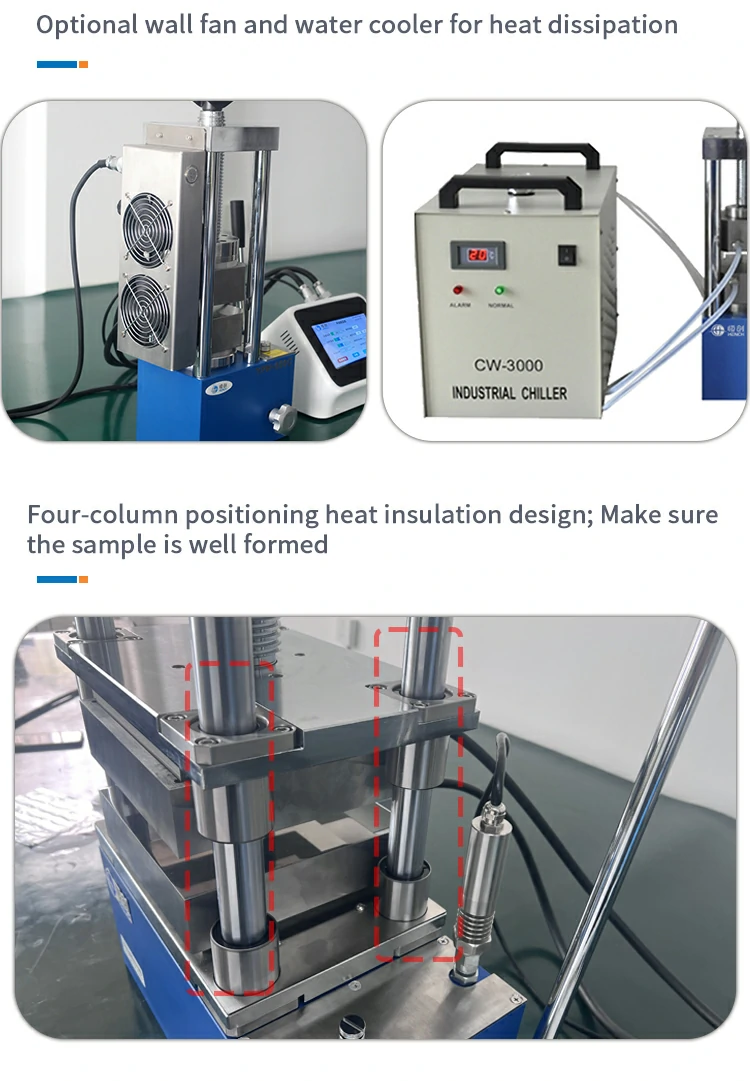
Four-Column Positioning & Heat Insulation: Features a rigid 4-column positioning structure paired with an optimized heat insulation design. This guarantees perfect alignment, uniform force distribution, and excellent sample formation while preventing thermal transfer to the hydraulic base.
-
7" Touch LCD Smart Controller: A standalone, split-type display mode featuring a 7-inch touchscreen. It manages, stores, and views heating profiles, showing real-time temperature, time, and automatic conversion/display of the direct sample pressure in MPa.
-
5-Section Programmable Temperature Control: Supports 5 sections of adjustable continuous temperature control with a precision control accuracy of s±0.1℃.
-
Enhanced Cooling Solutions (Optional): To accelerate cycle times and improve throughput, the system can be configured with an optional wall fan or a dedicated industrial water chiller (CW-3000) for efficient heat dissipation.
-
Anti-Scalding Safety Guard: Smart built-in safety alerts. After heating, the screen displays the real-time temperature of the mold as an explicit anti-scalding safety tip for lab operators.
Applications
Perfect for pressing small tablets or pellets in laboratories, R&D centers, or educational facilities. Often used alongside other lab supplies for sample preparation and analysis, this handheld press ensures precision and repeatability.
-
FTIR / XRF Spectroscopy: High-transparency KBr pellet pressing and thin polymer film preparation for infrared/fluorescence analysis.
-
Materials Science: Curing, hot-pressing, and compounding of advanced polymer composites, ceramics, and thin-film materials.
-
Battery Research: Compression and hot laminating for solid-state battery electrolytes and electrode sheets.
Product Description
Model YPH-800C YPH-800CG pressure limit 0-30T Cylinder diameter Φ95mm Cylinder stroke 30mm Temperature controller Control range Room temperature-800∘C Temperature controller Control mode 5 sections adjustable continuous temperature control Die heating range Room temperature-300∘C Room temperature-500∘C Die size 100x100mm Temperature control accuracy 0.1∘C Pressure control accuracy 0.1T (Customizable setting accuracy) Holding time Unlimited time (manual pressure relief) Display mode 7 "touch LCD screen Die pressure conversion The program automatically converts/displays the pressure of the sample directly (Mpa) Heating safety Tips After heating, display the real-time temperature of the mold and pay attention to anti-scalding Data management It can be managed, stored and viewed Power source 220V (50Hz/60Hz) Structural Analysis
-
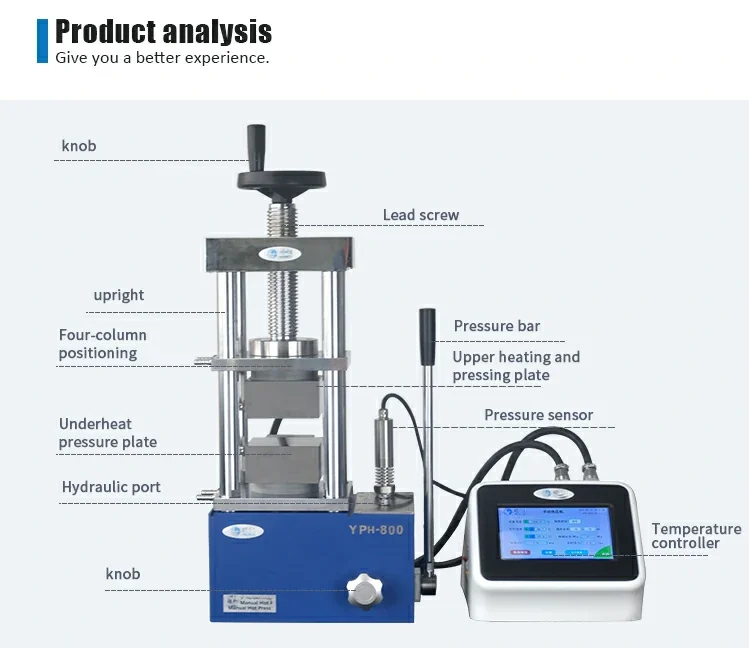
Lead Screw & Top Hand Wheel (Knob): For quick manual height adjustments to accommodate different sample thicknesses.
-
Four-Column Positioning: Heavy-duty upright pillars ensure maximum parallelism between the upper and lower plates.
-
Upper & Under Heating Platens: Precision-machined flat heating platens for uniform temperature distribution across the $100 \times 100\text{mm}$ molding area.
-
High-Precision Pressure Sensor: Transmits precise hydraulic data directly to the touchscreen panel.
-
Manual Pressure Bar & Release Knob: Ergonomic lever for smooth pressure generation and a secure knob for manual ventilation/pressure relief.
Operating Procedure
-
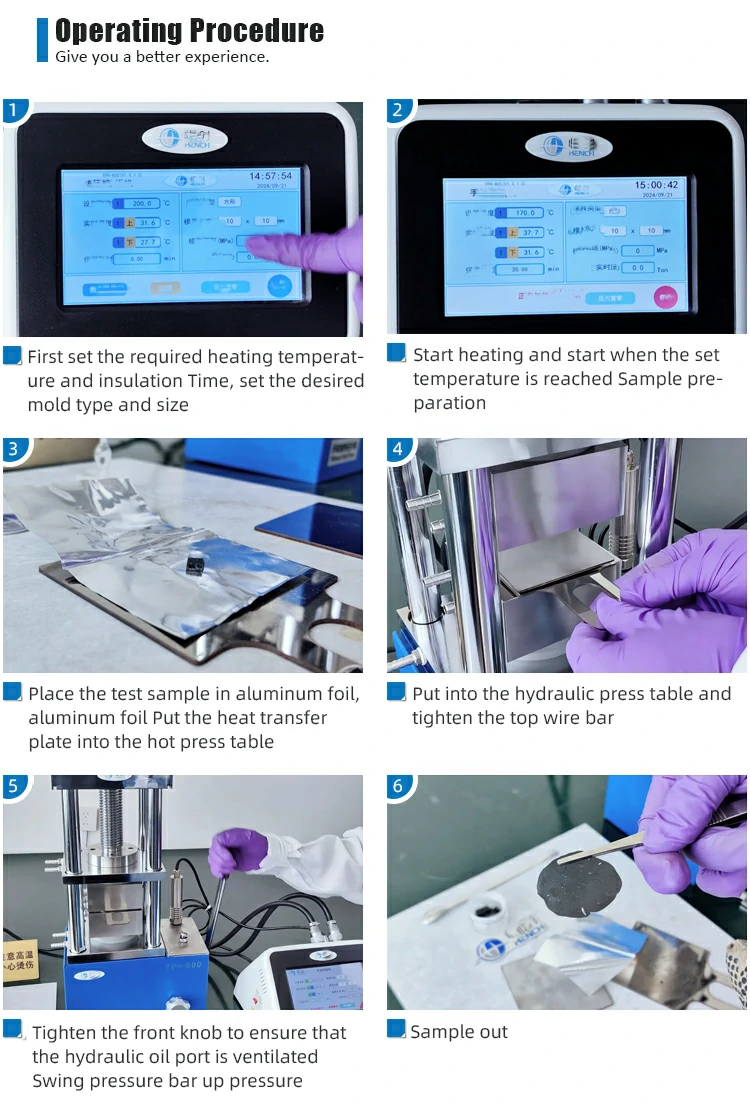
Step 1: Program the required heating temperature, insulation/holding time, mold type, and dimensions on the 7" smart touch controller.
-
Step 2: Start heating. Allow the system to reach the pre-set target temperature before starting your sample preparation.
-
Step 3: Prepare the testing material by placing the sample between aluminum foil, and place the assembly onto the heat transfer plate.
-
Step 4: Carefully insert the transfer plate assembly onto the hydraulic press lower table, and tighten the top lead screw wire bar.
-
Step 5: Fasten the front release knob to ensure the hydraulic oil port is sealed. Swing the manual pressure bar up and down to apply the target pressure.
-
Step 6: After the automated holding cycle is complete, manually vent the pressure, open the plates, and take out the perfectly formed sample disk/sheet using laboratory tweezers.
Why Hench?
Hench Technology Co., Ltd., headquartered in Tianjin, China, is a trusted hydraulic press manufacturer specializing in laboratory and industrial presses. Hench provides reliable hydraulic press machines designed for safety, performance, and ease of use. Their solutions support universities, laboratories, and industrial clients globally, backed by professional service and quality assurance.
-
-
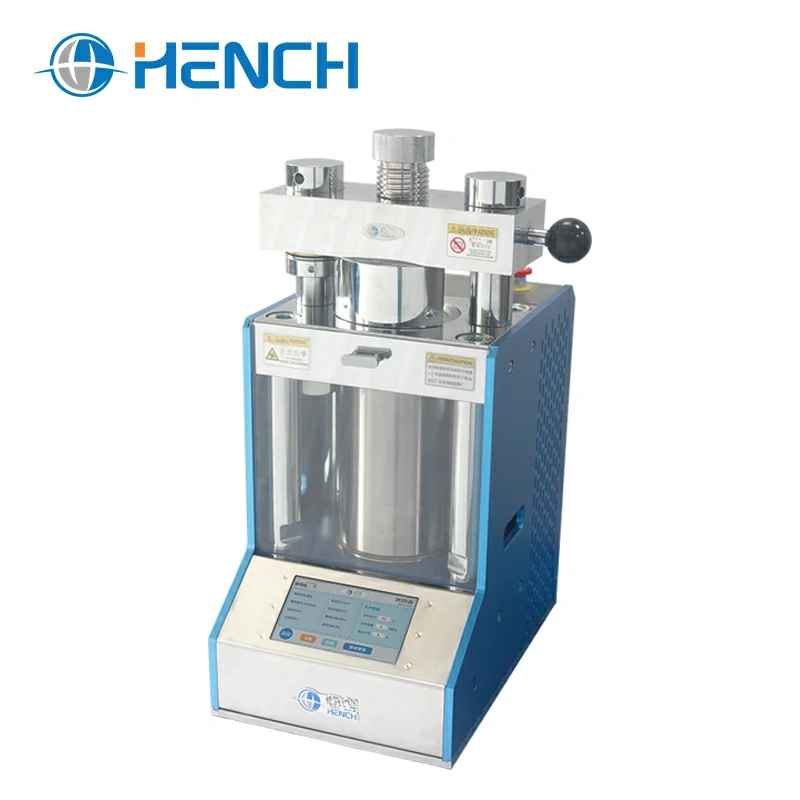
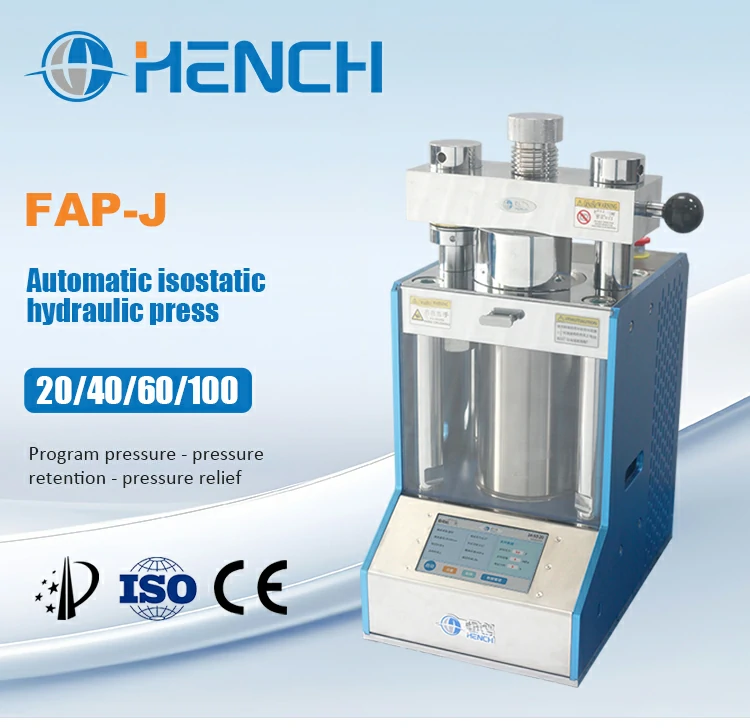
20/30/40/60/100-ton Fully Automatic Isostatic Desktop Tablet Press Machine HAP-J
Isostatic Desktop Tablet Press Machine Product Features
HAP-J series automatic isostatic press adopts upper plate rocker arm knot structure, more convenient operation,automatic program operation: program pressures low pressure -pressure retention -pressure replenishment - periodic pressure relief, etc.
Key Features
-
Available in 20T, 30T, 40T, 60T, and 100T models, with programmable pressing cycles for maximum reproducibility.
-
Compact desktop design allows easy integration into labs while maintaining high stability and precision.
-
Advanced control system with LCD interface for setting pressure, dwell time, and pressing sequence.
-
The robust hydraulic mechanism ensures consistent pressure, reflecting the quality of professional hydraulic press machines.
-
Suitable for frequent lab use, easy maintenance, and efficient operation, making it a valuable addition to any lab supplies inventory.
Product Description
Instrument model HAP-J series-20J HAP-J series-40J HAP-J series-60J HAP-J series-100J Pressure limit 0-20T 0-40T 0-60T 0-100T Cylinder diameter 110mm 130mm 152mm 202mm Pressurization process Program pressure - program pressure retention - program pressure relief Dwell time 0-999.59(min) Pressure conversion Automatic pressure conversion based on sample size Display Interface 7-inch Smart Touch LCD Screen Safety Shielding 4mm electroplated sprayed steel plate protection +3mm plexiglass door Lsostatic pressure 0-300Mpa 0-302Mpa 0-502Mpa Chamber Dimensions (ID × H) 30x150mm 50x150mm 60x150mm Cylinder stroke 50mm 52mm Characteristic Upper plate shaking alarm structure, more convenient operation Dimensions (W × D × H) 240x390x562mm 280x460x662mm 300x500x682mm 330x580x720mm Power supply 220V(50Hz/60Hz) 220V/1500W Weight 121Kg 180Kg 241Kg 352Kg 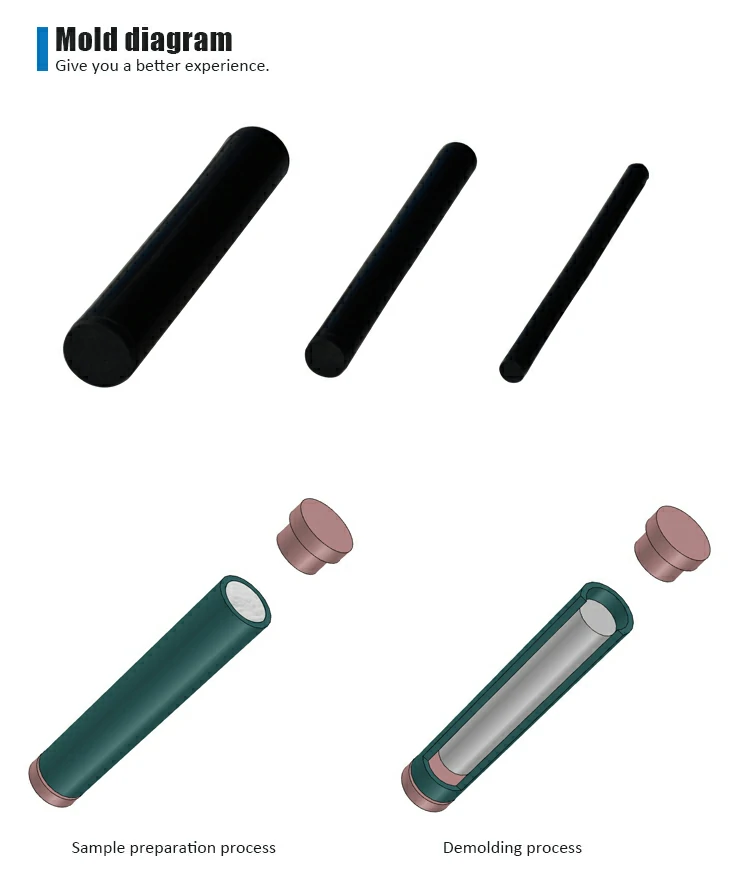
-
Working Medium: Ultra-pure hydraulic oil (Premium #46 Anti-wear).
-
Sample Protection: 100% contamination-free. Samples are triple-sealed in high-elasticity silicone bladders before submersion, fully isolating them from the medium.
-
Pressure Vessel Compliance: Forged from premium 3Cr13 die steel. Every unit undergoes rigorous Ultrasonic Non-Destructive Testing (NDT) to ensure flawless safety under 300–500 MPa. Meets international high-pressure vessel safety standards.
-
Programmable Pressure Rates:
-
Pressurization Speed: 0.1-10.0 MPa/s (Fully adjustable via UI).
-
Depressurization Speed: ≤0.5 MPa/s (Controlled multi-stage linear release to prevent pellet micro-cracking).
-
Why Choose Cold Isostatic Pressing (CIP)?
Feature Conventional Die Pressing HAP-J Desktop CIP Pressure Profile Unidirectional (Axial) load; severe wall friction losses. 360° Omnidirectional fluid pressure; absolute uniformity. Green Density Density gradient defects (Dense top, loose core). 100% Homogeneous density throughout the pellet. Sintering Result Prone to warping, delamination, and uneven shrinkage. Defect-free sintering with high geometric precision. Advanced Multi-Segment Control: The 7" touch screen displays real-time Pressure-Time (P-t) curves, automating your custom multi-step profiles (Rapid ramp →Dwell → Slow stepped release).
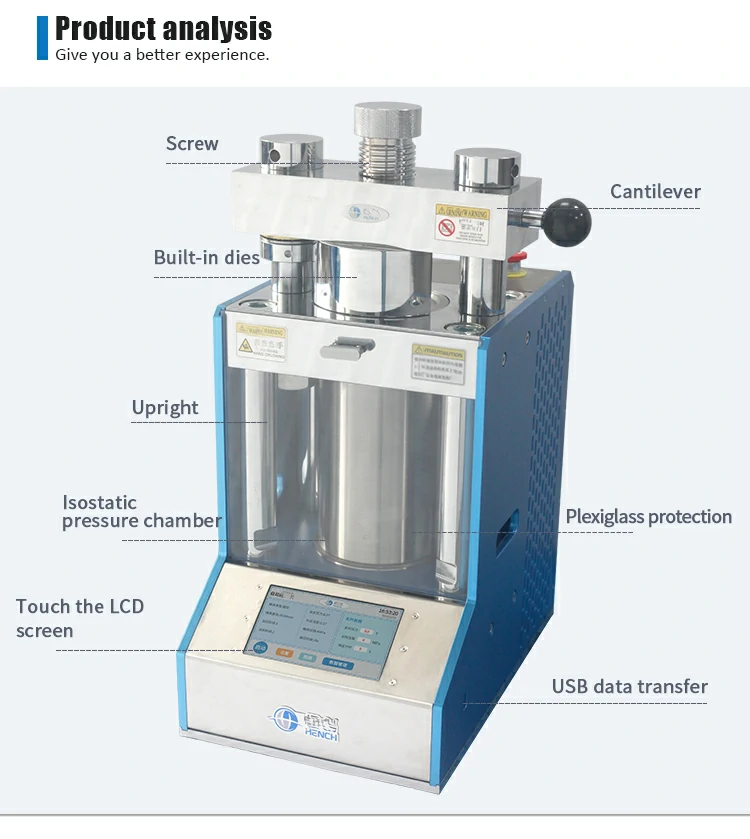
Detailed Overview of Core Components and Functions
Precision Pressing System:
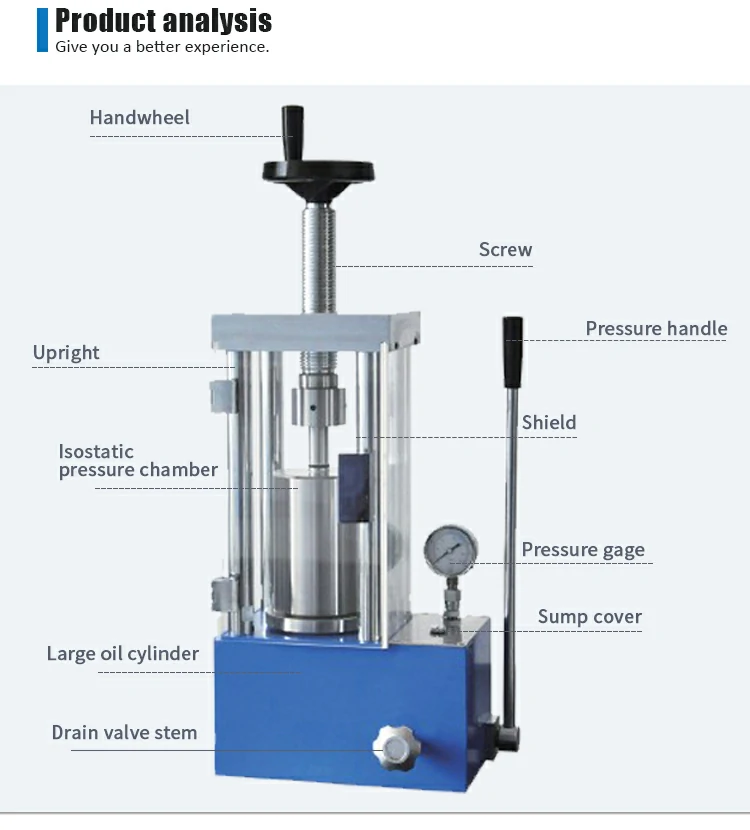
- Screw: A high-strength, precision-engineered screw that ensures constant and accurate pressure transmission.
- Built-in Dies: The core pressing components, ensuring consistency in the molding of samples.
- Cantilever: An ergonomically designed operating handle that provides precise manual adjustment capabilities.
- Upright: A robust column structure that guarantees the overall stability and compressive strength of the equipment.
Intelligent and Safety Features:
- Isostatic Pressure Chamber: The core vacuum/high-pressure working zone, enabling multi-dimensional, uniform pressing.
- Plexiglass Protection: A highly transparent protective panel that not only safeguards the operator but also serves as a clear viewing window for monitoring the real-time working status.
Human-Machine Interaction and Data Management:
- Touch LCD Screen: An intelligent operating terminal featuring a fully Chinese/graphical interface, enabling one-touch operation and real-time status monitoring.
- USB Data Transfer: A conveniently located USB port on the side of the unit, allowing for easy export and analysis of experimental data, thereby facilitating efficient digital management.
Application Notes & Bladder Selection
The HAP-J Series Desktop Cold Isostatic Press (CIP) overcomes the density-gradient limitations of conventional die pressing. By delivering 360° omnidirectional fluid pressure within its specialized Isostatic Pressure Chamber, it is the premier choice for advanced material synthesis across global R&D and industrial sectors.
1. Solid-State Batteries & Advanced Energy Storage
-
Target Materials: Sulfide, oxide, and polymer-based solid-state electrolytes (e.g., LLZO, LGPS).
-
The Challenge: Micro-cracks, grain boundary resistance, and air-sensitivity degrade battery performance.
-
Our Solution: The HAP-J’s ultra-high pressure eliminates internal voids, maximizing ionic conductivity. Combined with custom-sealed vacuum bladders, it prevents ambient contamination during high-pressure compaction.
2. Advanced Technical Ceramics & Semiconductors
-
Target Materials: Alumina ($\text{Al}_2\text{O}_3$), Zirconia ($\text{ZrO}_2$), Silicon Carbide ($\text{SiC}$), and high-purity sputtering targets.
-
The Challenge: Uneven "green density" causes severe warping, cracking, or dimensional distortion during high-temperature sintering.
-
Our Solution: Uniform fluid compression guarantees 100% homogeneous density throughout the pellet. The Touch LCD Screen allows precise multi-segment programming for slow, linear depressurization—preventing stress-induced fracturing.
3. Powder Metallurgy & Refractory Metals
-
Target Materials: Tungsten ($\text{W}$), Molybdenum ($\text{Mo}$), Titanium alloys, and porous metal implants.
-
The Challenge: High-hardness metal powders exhibit poor compressibility and severe mold-wall friction in conventional dies.
-
Our Solution: Delivering up to 500 MPa of isotropic force, the system bypasses friction losses to achieve high-density, binder-free near-net-shape blanks, reducing subsequent machining costs.
4. Pharmaceutical & Biochemical Research
-
Target Materials: Controlled-release drug tablets, high-density powder formulations, and bio-scaffolds.
-
The Challenge: Conventional mechanical pressing can cause capping, lamination, or chemical degradation due to localized heat.
-
Our Solution: Pure hydraulic, cold-compaction ensures zero thermal stress on bio-active ingredients, while the fully enclosed, contamination-free chamber meets strict laboratory hygiene standards.
Target Application Target Pressure Target Dwell Time Recommended Bladder Size Solid-State Electrolytes (e.g., Sulfides/Oxides) 200 ~ 250 MPa 3 ~ 5 min Ф10 mm/Ф15 mm(High-tightness) Advanced Technical Ceramics (AlzОs, Zr0₂) 300 ~ 400 MPa 2 ~ 3 min Ф20 mm/Ф30 mm(High-elasticity) Refractory Powder Metallurgy (W, Mo) > 400 MPa 5 min Custom Heavy-duty Bladders Step-by-Step Operating Guide
This guide outlines the standard protocol for operating the HAP-J Series Desktop CIP. Follow these steps to ensure uniform powder compaction, zero sample contamination, and absolute laboratory safety.
Phase 1: Pre-Check & Sample Preparation
-
Inspecting the Working Medium: Check the liquid level inside the Isostatic Pressure Chamber. Ensure the premium #46 hydraulic oil is clean and filled to the designated mark.
-
Powder Loading: Pour your target material (e.g., solid-state electrolyte or ceramic powder) into the high-elasticity silicone/rubber bladder.
-
Vacuum Sealing (Critical): Expel all ambient air from the bladder to create a vacuum-like state. Securely seal the bladder neck using heavy-duty sealing clips or specialized ties.
Note: Proper sealing prevents the hydraulic medium from penetrating the bladder and contaminating your sample under ultra-high pressure.
Phase 2: Loading & Mechanical Locking
-
Loading the Chamber: Swing open the upper assembly using the Cantilever. Gently lower the sealed sample bladder into the center of the pressure vessel.
-
Engaging the Screw: Swing the upper yoke back into place. Rotate the top Screw downward until the upper sealing plug is firmly and completely seated into the mouth of the chamber.
-
Closing the Shield: Fully slide shut the Plexiglass Protection.
Safety Interlock: The system’s smart sensors will prevent any pressurization cycle if the safety shield is left open.
Phase 3: Smart UI UI Programming & Execution
-
Setting the Recipe: Power on the Touch LCD Screen. Input your multi-segment pressure profile based on your material's characteristics:
-
Segment 1 (Ramp): Set the pressurization rate (e.g., 5.0 MPa/s) up to 200 MPa.
-
Segment 2 (Dwell): Set the target Dwell Time (e.g., 3 min) to allow complete, omnidirectional density equalization.
-
Segment 3 (Release): Set a controlled, slow Depressurization rate (< 0.5 Pa/s) to prevent micro-cracking during spring-back.
-
-
Initiating the Cycle: Click the "Start" button on the LCD screen. The automated internal hydraulic pump will begin the cycle, displaying a real-time Pressure-Time (P-t) curve on the screen.
Phase 4: Automated Release & Retrieval
-
Automated Depressurization: Once the dwell timer hits zero, the HAP-J automatically executes a controlled pressure release. Wait until the LCD screen registers exactly 0MPa.
-
Unlocking the Vessel: Slide open the plexiglass shield. Rotate the Screw upward to release the mechanical seal, and use the Cantilever to swing the assembly clear.
-
Sample Retrieval: Carefully extract the bladder from the chamber. Wipe any residual oil off the exterior of the bladder before opening the clips to retrieve your perfectly compacted, high-density green body.
-
Data Export (Optional): Plug a flash drive into the USB Data Transfer port on the side of the chassis to instantly export the run's P-t graph for your lab's audit trails or academic papers.
About Hench
Hench Technology Co., Ltd., based in Tianjin, China, specializes in laboratory and industrial press solutions. Hench offers a full range of high-quality hydraulic press machines designed for durability, safety, and precision. Their desktop and industrial tablet presses integrate seamlessly for research and production, providing professional support and proven quality worldwide.
-
-
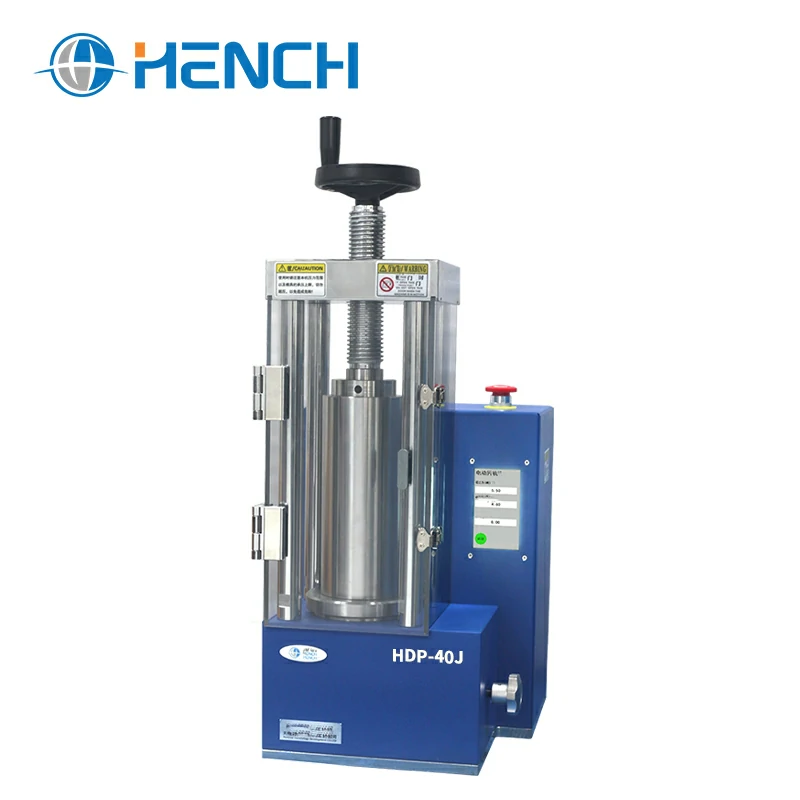
20/40/60-ton Isostatic Electric Press Machine HDP-J
Isostatic Electric Press Machine Overview
HDP-J Series is an advanced laboratory electric press machine engineered for materials scientists, industrial R&D centers, and universities requiring ultimate density uniformity in powder compaction. Available in multiple versatile configurations—including 12 Ton, 20 Ton, 40 Ton, and 60 Ton models—this electric cold isostatic press (CIP) delivers up to 305 MPa of ultra-balanced pressure. It eliminates the density gradients and internal structural defects commonly found in traditional single-axis hydraulic presses, providing highly consistent sample preparation for spectroscopic and structural analysis.
Technical Advantages
-
Omnidirectional Isostatic Pressure (Up to 305 MPa): Applies true balanced multi-directional force via a specialized liquid medium inside the sealed chamber. This guarantees ultra-uniform particle distribution, eliminates voids, and optimizes density for brittle or specialized powder complexes.
-
Digital Control & Crystal Display Monitoring: Replaces inaccurate analog meters with an integrated Liquid Crystal Display (LCD). Operators can set precise pressure limits, view digital pressure readouts, and track real-time load adjustments during critical sample cycles.
-
Integrated Dual Drive (Electric Boost & Manual Fine-Tune): Incorporates an automatic electric boost structure for rapid workload cycling alongside a precise manual pressure fallback valve, allowing researchers complete tactile control over dwell times and decompression profiling.
-
Smart Pressure Compensation: The advanced automated control loop features automatic pressure replenishment to mitigate material relaxation effects, paired with a slow pressure release mechanism to prevent structural fracturing or cracking during demolding.
-
Reinforced Laboratory Safety System: Fully enclosed by a durable organic glass protective shield to isolate the high-pressure workspace, complemented by an instantaneous emergency stop switch and a dedicated physical relief valve.
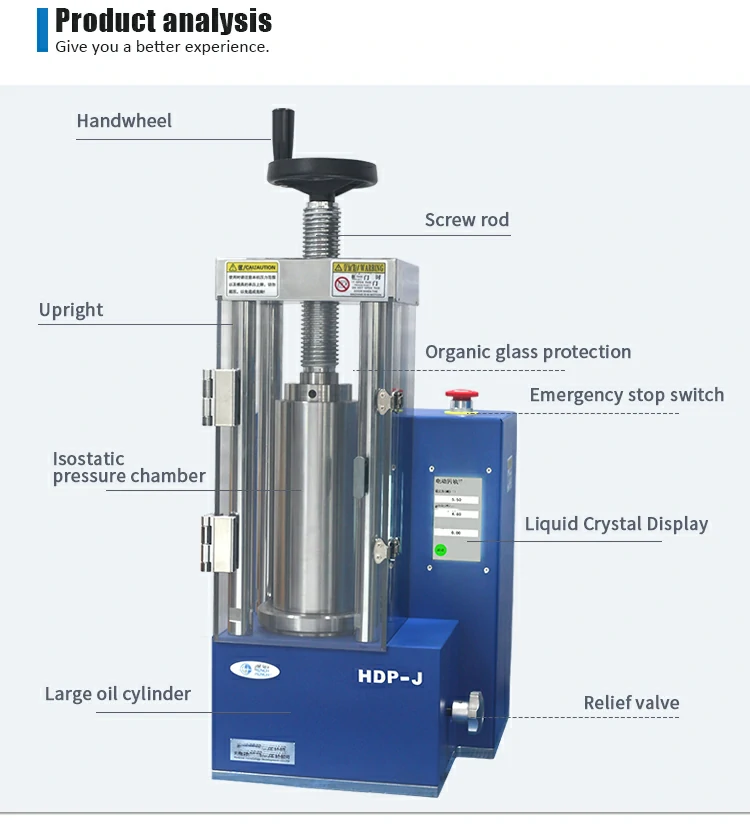
Hardware Structure & Component Breakdown
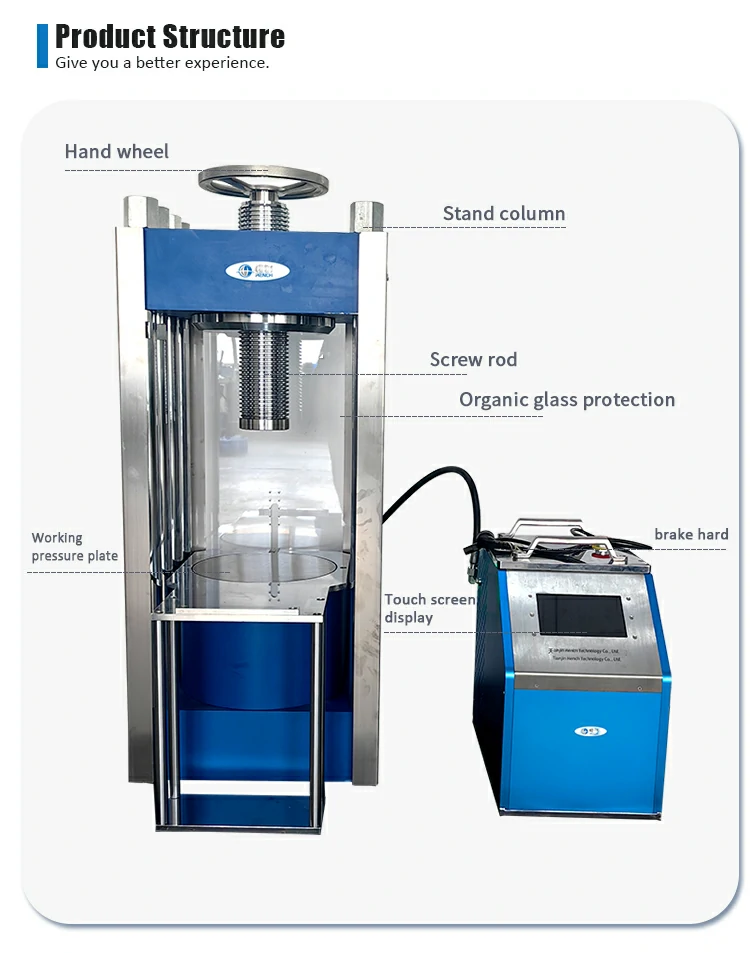
To provide an elite laboratory pressing experience, the HCFTIR HDP-J features a precision-engineered industrial layout where every premium component serves a dedicated performance and safety function:
-
High-Torque Handwheel: Located at the very top of the frame, allowing operators to easily adjust and lock the upper crosshead placement by hand before indexing cycles.
-
Heavy-Duty Screw Rod: A precision-threaded, high-carbon steel screw shaft that guides high-tonnage vertical force seamlessly while eliminating mechanical play.
-
Rigid Support Uprights: Heavy dual-column steel upright pillars form the core structural skeleton, minimizing frame deflection under ultimate 60-ton pressure loads.
-
Omnidirectional Isostatic Pressure Chamber: The core pressure-vessel core designed to hold specialized liquid media, ensuring true 305 MPa equalized hydraulic force distribution around sample molds.
-
Oversized Large Oil Cylinder: Positioned securely at the base to deliver smooth, high-capacity hydraulic fluid volume transmission for stable pressure ramp-ups.
-
Thick Organic Glass Protection Enclosure: A high-visibility physical safety shield that fully encloses the pressing workspace, protecting lab technicians without blocking the line of sight.
-
Instantaneous Emergency Stop Switch: A prominent, industrial-grade red e-stop button mounted on the control console for immediate power cut-off in abnormal conditions.
-
Intelligent Liquid Crystal Display (LCD): A multi-line digital operator panel providing sharp, real-time feedback on current pressure settings, limits, and dwell times.
-
Micro-Adjustable Relief Valve: A dedicated physical safety and bleed valve located at the base for highly controlled manual slow-pressure venting and quick mechanical de-indexing.
Practical Applications
Perfect for laboratories, R&D centers, and pilot production, the HDP‑J is suitable for pressing tablets, pellets, and composite materials. Its precision makes it an essential piece of lab supplies for research and experimental workflows.
-
FTIR Spectroscopy Sample Preparation: Produces uniform, ultra-dense pellets and matrices free of structural clouding or localized fracturing, ensuring pristine beam transmission during analytical scans.
-
Advanced Technical Ceramics: Perfect for forming structural ceramic components, oxides, nitrides, and carbide powders where consistent density is mandatory to mitigate firing shrinkage cracks.
-
Battery Material & Solid-State Electrolyte R&D: Allows precise density consolidation of cathode/anode particles and solid electrolyte interfaces to maximize electrical conductivity and lifetime performance.
-
Metallurgy & Powder Compaction Machine Testing: Provides quick-turn exploratory testing of custom metallurgical matrix compounds, refractory compositions, and high-performance composite alloys.
Technical Parameters
Instrument Model YPD-12J / HDP-12J YPD-20J / HDP-20J YPD-40J / HDP-40J YPD-60J / HDP-60J Pressure Limit 0-12T (0-19 MPa) 0-20T (0-22 MPa) 0-40T (0-32 MPa) 0-60T (0-36 MPa) Isostatic Pressure Limit 0 - 305 MPa (Omnidirectional) Cylinder Diameter 97 mm 115 mm 132 mm 152 mm Chamber/Cavity Size 22 × 70 mm 30 × 120 mm 40 × 150 mm 50 × 150 mm Travel of Piston 42 mm 42 mm 52 mm 52 mm Structure & Mode Integrated structural body, electric boost / electric pressure & manual pressure options Pressure Gage Type Digital pressure display with micro-adjustable configuration via LCD Aftercompaction Control Automatic pressure replenishment / manual slow pressure relief tracking Safety Protection Shield High-transparency thick Organic Glass enclosure Ambient Temperature 10 °C – 40 °C Machine Dimensions 305×430×535 mm 305×430×605 mm 355×450×715 mm 405×470×722 mm Net Weight 112 Kg 121 Kg 151 Kg 199 Kg Working Principle & Mold Diagram
Operating an electric cold isostatic press involves a distinct, precise sequence to prepare flawless samples:
-
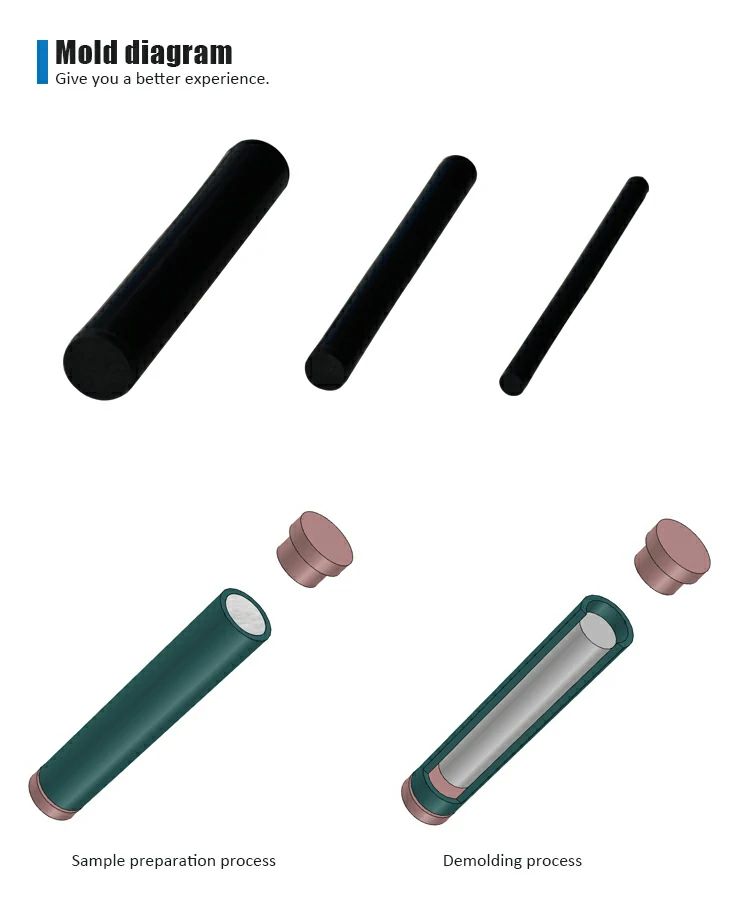
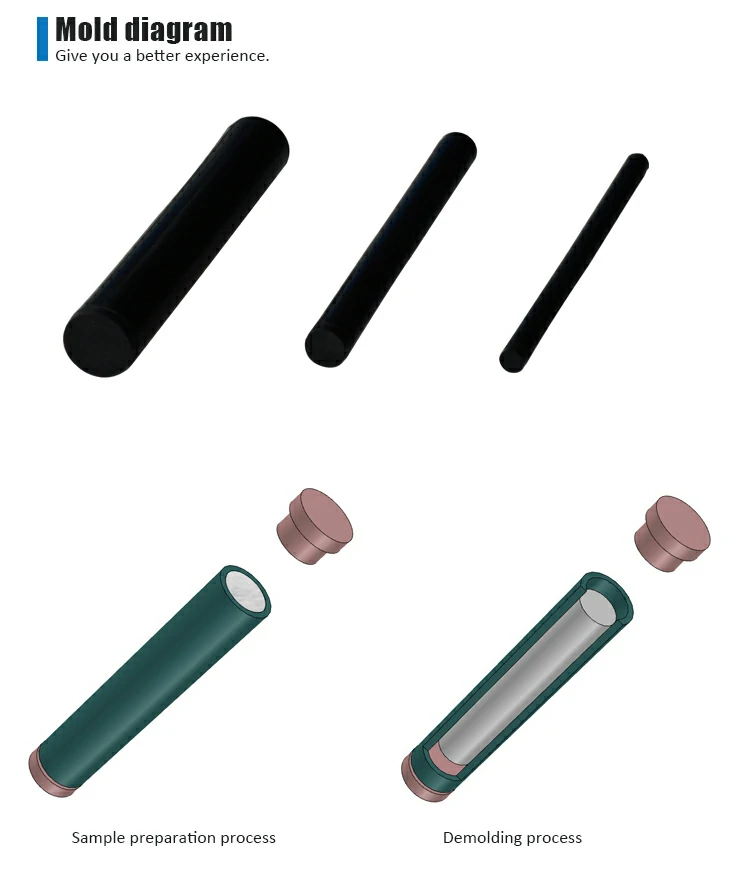
Chamber Hydraulics: The powder material is first pre-packed into a flexible, sealed rubber mold sleeve (as illustrated in our Mold Diagram). This assembly is submersed into the specialized fluid medium inside the isostatic pressure chamber.
-
Uniform Pressing: The electric boost system drives the large oil cylinder upward, compressing the liquid medium. The liquid transfers an equal, omnidirectional force surrounding the flexible sleeve, forcing the internal powder particles to lock together symmetrically.
-
Demolding Sequence: Once the digital holding dwell timer finishes, the operator utilizes the manual slow pressure system or relief valve to vent internal energies smoothly. The mold is extracted from the chamber, the end-plugs are removed, and the perfectly formed, crack-free green compact pellet is extracted during the demolding process.
Hench Advantage
Hench Technology Co., Ltd., based in Tianjin, China, is a leading hydraulic press supplier with decades of experience in laboratory and industrial press solutions. Hench provides durable, safe, and efficient presses that integrate seamlessly into laboratory and production workflows, supported by professional service and global quality standards.
People Also Ask
Q1: What is the distinct advantage of an electric isostatic press machine over a standard single-axis hydraulic press?
A: A single-axis hydraulic press applies force from only one vertical direction, creating significant friction against the mold walls and yielding uneven internal density distributions. An electric isostatic press machine applies equalized hydraulic pressure from all 360-degree directions through a liquid medium, resulting in uniform compaction, higher overall green density, and completely eliminating structural flaws or cracking during demolding.
Q2: Can the HDP-J series handle custom mold dimensions for different powder types?
A: Yes. The HDP-J series features internal cavity dimensions ranging from 22×70mm up to 50×150mm depending on the model selected (12T, 20T, 40T, or 60T). Custom flexible rubber or silicone molds can be easily integrated within these chamber spaces to accommodate distinct sample shapes.
Q3: What safety measures are built into the HCFTIR HDP-J laboratory pressing system?
A: Safety is paramount. The system is configured with an integrated thick organic glass safety shield enclosing the mechanical press frame, an immediate physical Emergency Stop Switch on the electronic enclosure console, a reliable manual over-pressure relief valve, and automated digital limit thresholds to prevent over-tonnage events.
Q4: Does the digital pressure display support dwell-time automation?
A: Yes, the built-in liquid crystal display system works in tandem with our automatic pressure replenishment logic, enabling precise target holding times, accurate load tracking, and continuous pressure stabilization during extended laboratory tests.
-
-
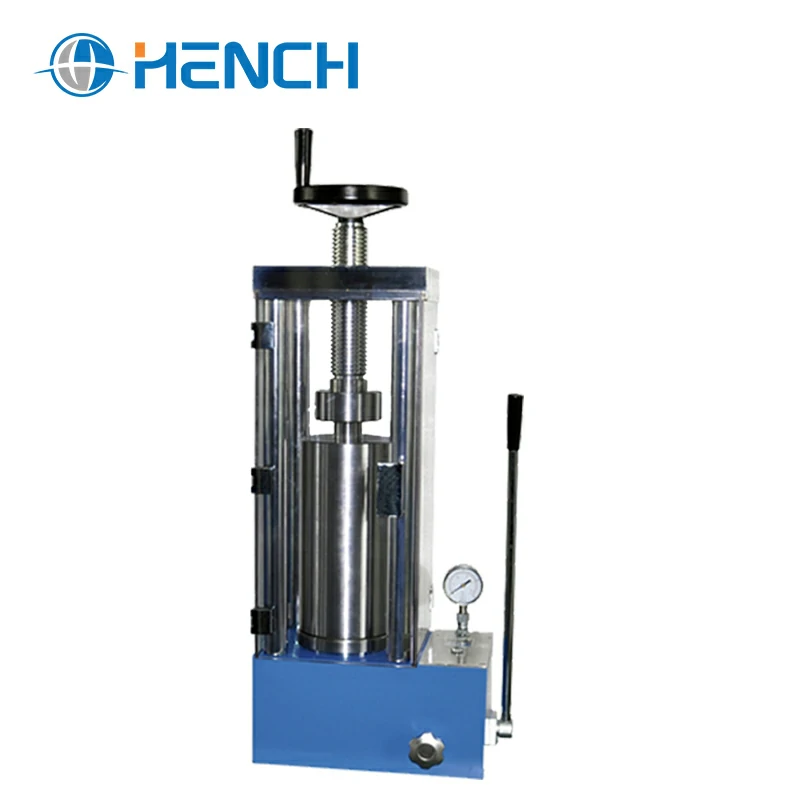
12/20/40/60-ton Manual Hot Isostatic Pressing Machine YP-J/S
Manual Hot Isostatic Pressing Machine Overview
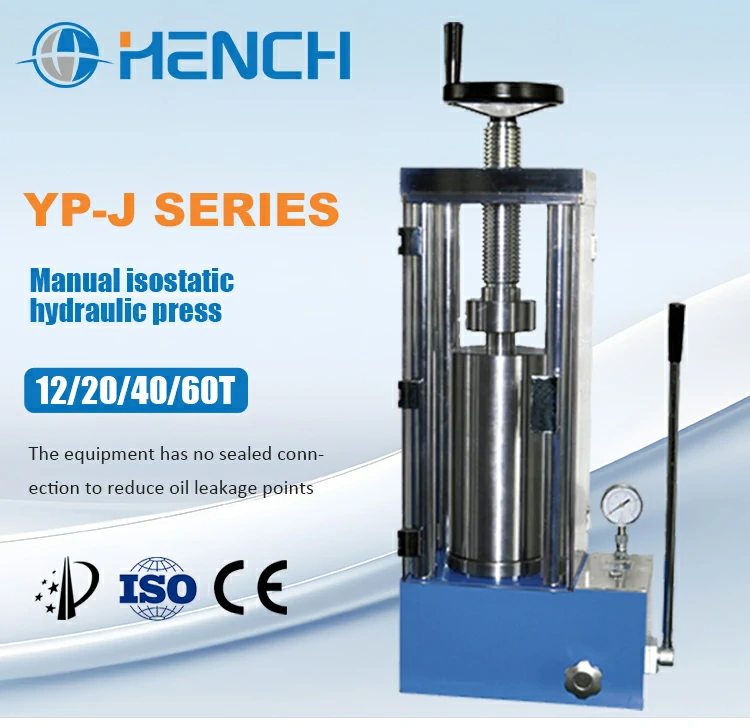
The YP‑J/S series is a high-precision Hot Isostatic Pressing Machine designed for laboratories and small-scale production. The powder can be formed directly by the isostatic pressure chamber,or the molded sample is pressed twice to make the sample density more uniform and removed the isostatic pressure chamber can also be used as an ordinary hydraulic press.
Key Features
-
Models available in 12T, 20T, 40T, and 60T, with piston diameter 110 mm and max travel 30 mm.
-
High-strength 3 chrome 13# die steel construction with side-opening protective plexiglass door for safety.
-
Compact design (305×195×605 mm, 105 kg) ensures easy integration into lab setups while maintaining reliable operation.
-
Precision pressure control reflects the quality of professional hydraulic press machines.
Applications
Ideal for pressing powders, polymers, and composite samples for laboratories, R&D, and pilot-scale production. Works seamlessly with other lab supplies to ensure reproducible results and consistent sample quality.
Product Description
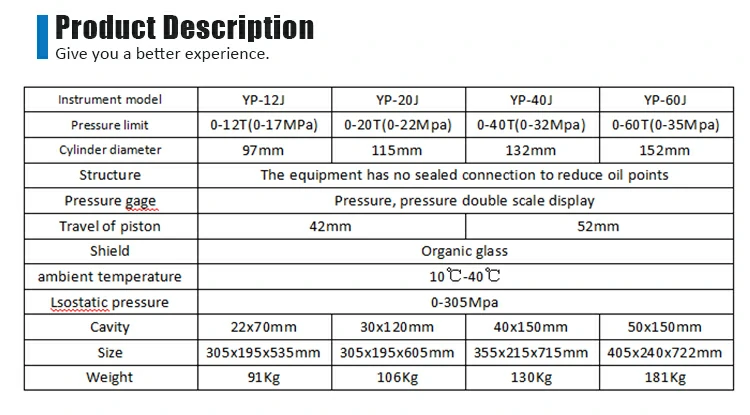
Instrument model YP-12J YP-20J YP-40J YP-60J Pressure limit 0-1.2T(0-17MPa) 0-20T(0-22Mpa) 0-40T(0-32Mpa) 0-60T(0-35Mpa) Cylinder diameter 97mm 115mm 132mm 152mm Structure The equipment has no sealed connection to reduce oil points Pressure gage Pressure double scale display Travel of piston 42mm 52mm Shield Organic glass ambient temperature 10∘C−40∘C Isostatic pressure 0-305Mpa Cavity 22x70mm 30x120mm 40x150mm 50x150mm Size 305x195x535mm 305x195x605mm 355x215x715mm 405x240x722mm Weight 91Kg 106Kg 130Kg 181Kg Pressure Conversion
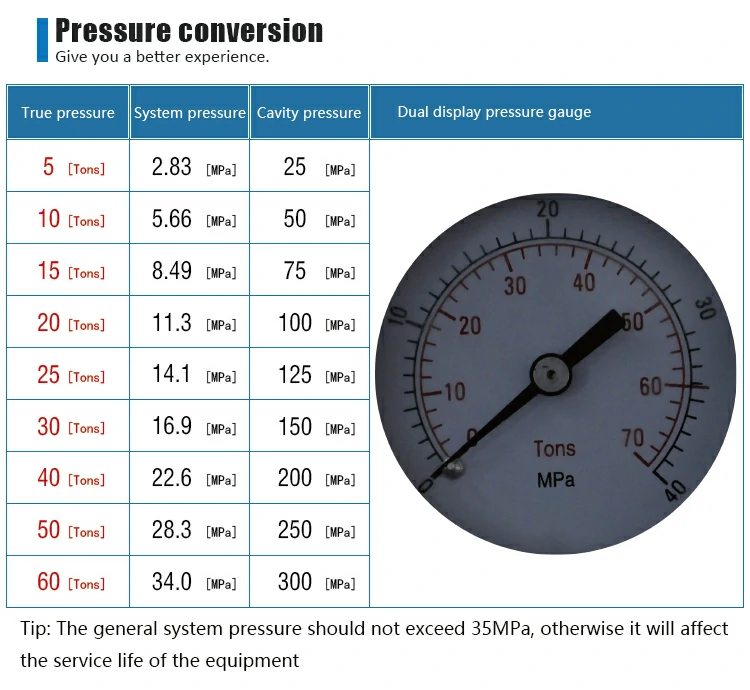
True Pressure System Pressure Cavity Pressure 5 [Tons] 2.83 [MPa] 25 [MPa] 10 [Tons] 5.66 [MPa] 50 [MPa] 15 [Tons] 8.49 [MPa] 75 [MPa] 20 [Tons] 11.3 [MPa] 100 [MPa] 25 [Tons] 14.1 [MPa] 125 [MPa] 30 [Tons] 16.9 [MPa] 150 [MPa] 40 [Tons] 22.6 [MPa] 200 [MPa] 50 [Tons] 28.3 [MPa] 250 [MPa] 60 [Tons] 34 [MPa] 300 [MPa] Tip: The general system pressure should not exceed 35MPa, otherwise it will affect the service life of the equipment.
Hench Technology Advantage
Hench Technology Co., Ltd., based in Tianjin, China, is a trusted hydraulic press supplier with decades of experience in designing reliable presses. Hench produces durable, precise, and safe equipment, including the YP‑J/S series, meeting the high standards of modern laboratories and industrial research.
-
-
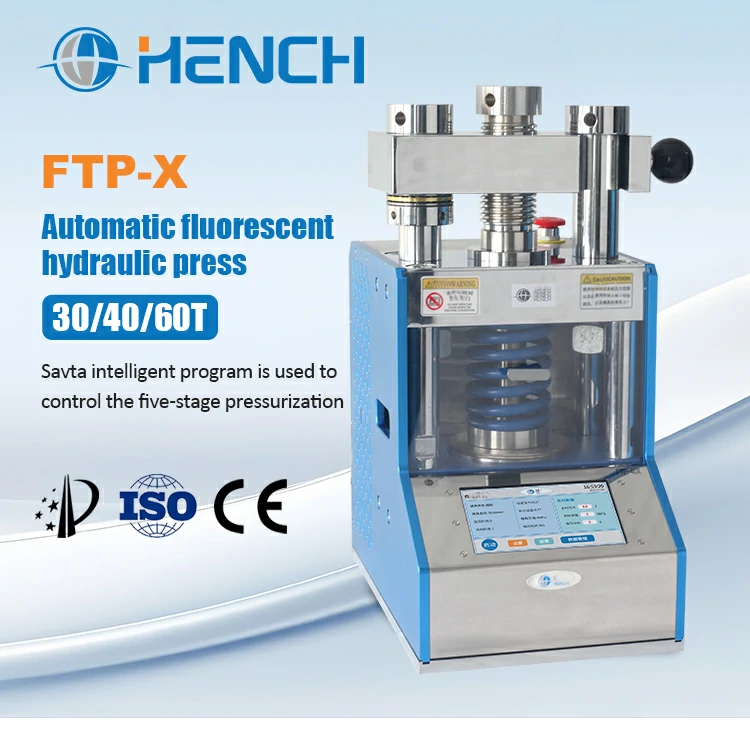
30/40/60-ton Automatic Fluorescent Tablet Hyd Press Machine FTP-X
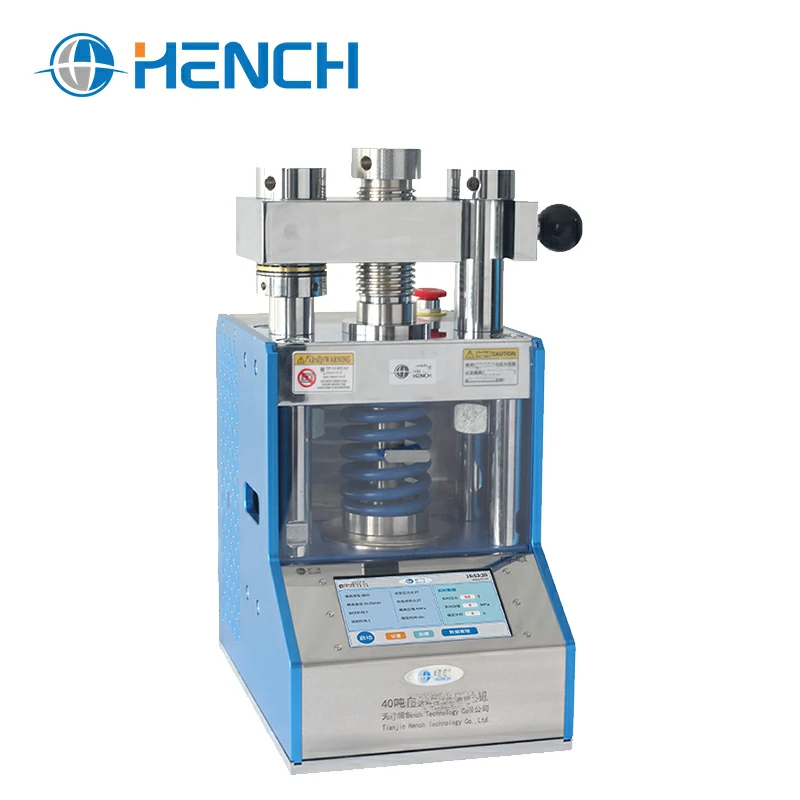
The FTP-X series is a fully automatic hydraulic press machine designed for precise tablet preparation in X-ray fluorescence (XRF) analysis. Available in 30T, 40T, and 60T models, it combines programmable multi-stage pressing, automatic pressure replenishment, pressure holding, pressure relief, and sample ejection in one compact system.
Designed as an automatic laboratory press, the FTP-X provides controlled pressing parameters and repeatable operating cycles for laboratories working with environmental, chemical, mineral, and materials samples. Its 7-inch touch LCD interface allows operators to directly configure mold diameter, sample pressure, supplementary pressure, and holding time.
Advanced Features
- 30T, 40T, and 60T models for different XRF sample preparation requirements
- Five-stage programmable pressurization for controlled sample compaction
- Automatic pressure replenishment, timed pressure holding, and pressure relief
- 7-inch LCD touchscreen for direct parameter setting and operation
- 440C high-hardness die steel mold material with quench hardness of 85°
- 40–32 mm standard mold specification, with customized mold options available
- Adjustable ejection pressure according to application requirements
- Automatic sample ejection through the release function
- 100 mm high-strength aluminum oxide plate and 6 mm plexiglass protective door
- Cylinder limit protection with automatic pressure relief
- Automatic pressure relief when actual pressure exceeds the machine's maximum pressure
- Storage capacity for up to 10,000 historical operation records
- USB data export for external storage and process documentation
- 220 V, 50/60 Hz power supply
Applications
The FTP-X series is designed primarily for preparing pressed pellets for X-ray fluorescence (XRF) analysis. It can be used in environmental, chemical, mineral, materials science, research, testing, and quality control laboratories.
The programmable pressing system helps maintain consistent pressure and holding conditions across repeated sample preparation cycles. Different mold configurations can also be supplied according to sample dimensions and application requirements.
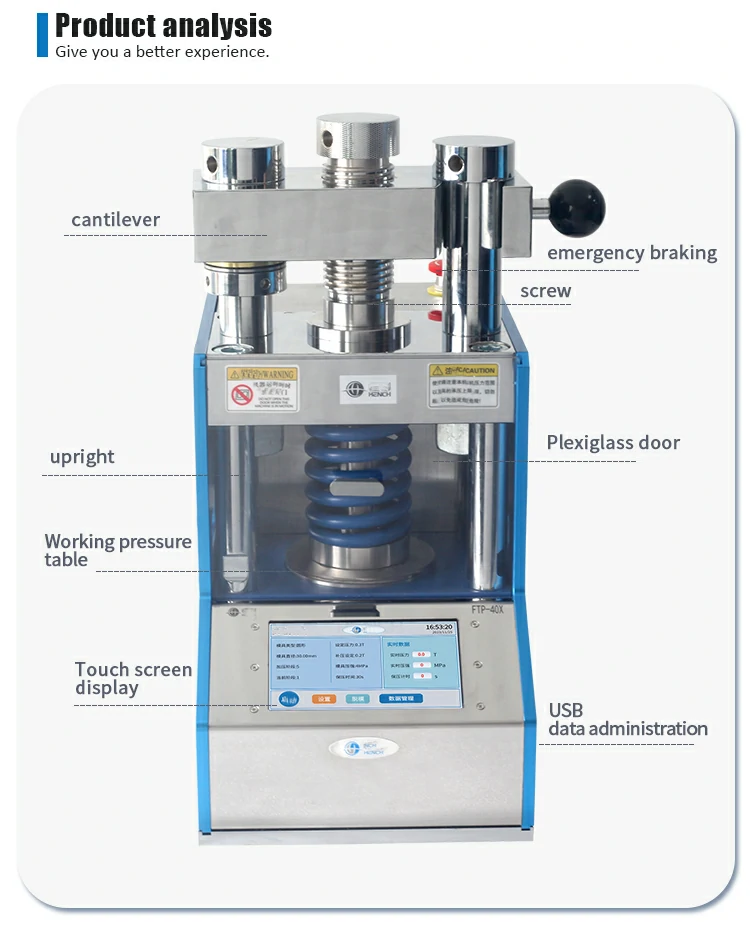
Product Details
High-Level System Settings
The FTP-X supports switchable English and Chinese operation interfaces, allowing operators to select the preferred language directly through the control system.
Mass Data Storage
The control system can store up to 10,000 historical operation records. Experimental data can be exported to a USB flash drive for external archiving and process documentation.
Product Description
Instrument model FTP-30X FTP-40X FTP-60X Pressure limit 0.3-30T 0.5-40T 1-60T Automatic control Savta intelligent program is used to control the five-stage pressurization Pressure mode Automatic pressure replenishment-timed pressure retention-automatic pressure relief Mold specification 40-32mm (Mold specifications can be customized) Holding time Unlimited time(seconds) Pressure conversion The system automatically converts the sample pressure (overpressure warning) Display usage 7 inch LCD screen (touch screen) Mold material 440C high hardness die steel (quench hardness 85°) Way of setting up Touch screen operation is convenient and fast Ejection pressure The pressure can be set according to the demand Release mode Press the "release key" to automatically remove the mold Equipment protection 100mm high-strength aluminum oxide plate +6mm plexiglass door Cylinder limit protection Cylinder above the limit height automatic pressure relief Host protection The actual pressure exceeds the maximum pressure of the machine and automatically starts the pressure relief program Data administration Can store 10,000 historical operation records, and can be exported to the U disk Device power supply 220V (50Hz/60Hz) Cylinder stroke ≤30mm ≤50mm Boundary dimension 261×391×468mm 281×461×560mm 301×521×590mm Weight 100Kg 150Kg 180Kg 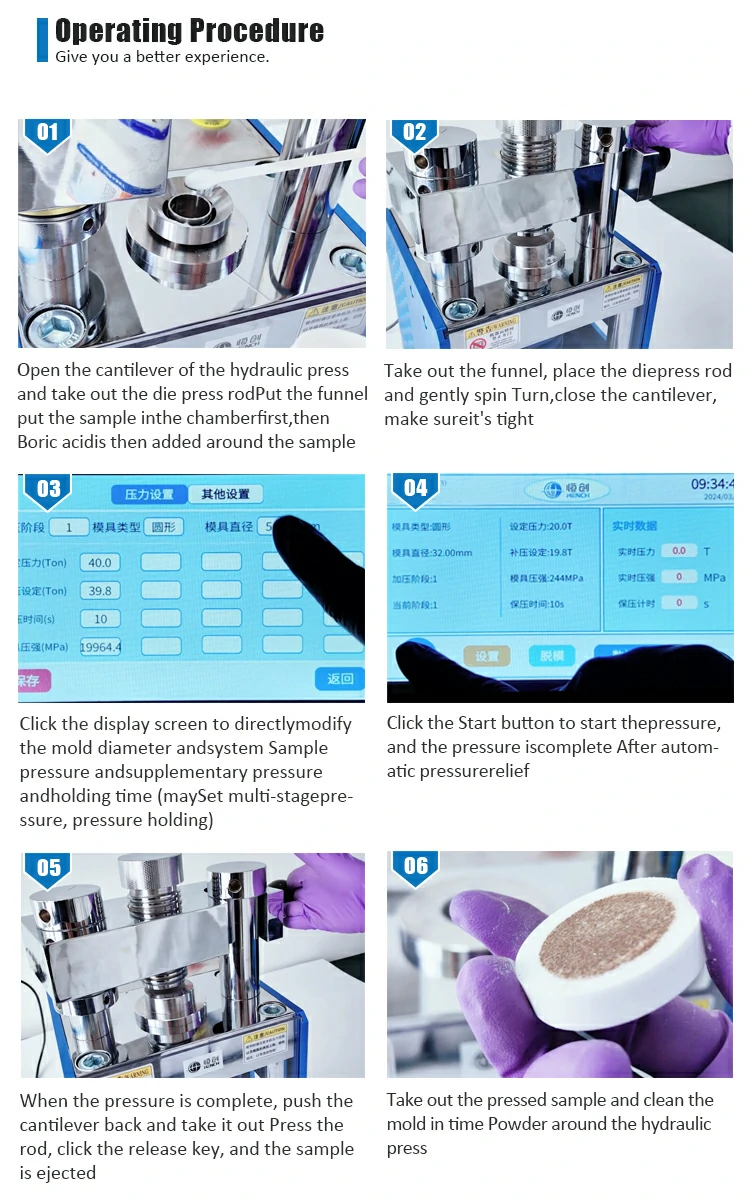
Core Operation Guide
Setting
On the main operation screen, tap Setting to configure the pressure value, mold type, sample diameter, supplementary pressure, and holding time. Multi-stage pressurization and pressure-holding cycles can also be configured before sample preparation.
Demould
Trigger the demould function after the pressing cycle is completed. When the pressure exceeds the specified threshold or the cylinder reaches the limit switch, the machine automatically stops and relieves pressure. Manual screw-driven operation is also available.
Data Administration
Tap Data Management to review experimental parameters and operating timestamps. Stored data can be exported via USB drive.
Pressurization Phase
Within the settings menu, select Pressure Phase to configure up to five stages of segmented pressurization.
Mold Type
The system supports round, square, and special-shaped mold configurations. Mold specifications can also be customized according to application requirements.
Die Diameter
Enter the required sample diameter under the die-diameter settings. Save the selected parameters before starting the sample preparation cycle.
Operating Procedure
01. Load the Sample
Open the cantilever of the hydraulic press and remove the die-press rod. Insert the funnel, load the sample into the chamber, and add boric acid around the sample.
02. Install the Die-Press Rod
Remove the funnel, insert the die-press rod, and gently twist it into position. Close the cantilever and ensure that it is firmly locked.
03. Set the Parameters
Use the touchscreen display to adjust the mold diameter, target sample pressure, supplementary pressure, and holding time. Multi-stage pressurization and pressure-holding cycles can also be configured.
04. Start the Pressing Cycle
Tap Start to begin pressurization. Once the programmed pressure is reached, the system automatically completes the pressure-holding and pressure-relief sequence.
05. Eject the Sample
After the pressing cycle is complete, swing open the cantilever and remove the die-press rod. Insert the eject rod and press the Release button to eject the pressed sample.
06. Remove and Clean the Pellet
Retrieve the finished pellet sample. Clean the mold and remove residual powder from the hydraulic press promptly after operation.
Why Choose Hench?
Hench Technology Co., Ltd., headquartered in Tianjin, China, supplies laboratory and industrial hydraulic pressing equipment for sample preparation and material testing applications. The FTP-X series combines automatic pressing control, programmable pressure profiles, automatic pressure relief, sample ejection, and data management in a compact laboratory system.
With 30T, 40T, and 60T pressing capacities and customizable mold configurations, the FTP-X can be adapted to different XRF sample preparation requirements while maintaining controlled and repeatable pressing conditions.
-
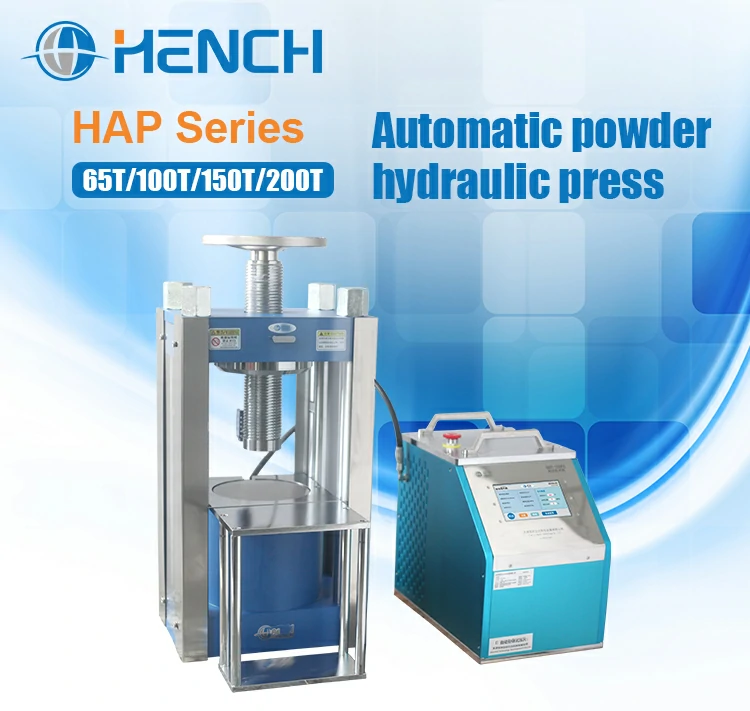
65/100/150/200-ton Modular Automatic Powder Press Machine HAP-FS
Automatic Powder Press Machine Overview
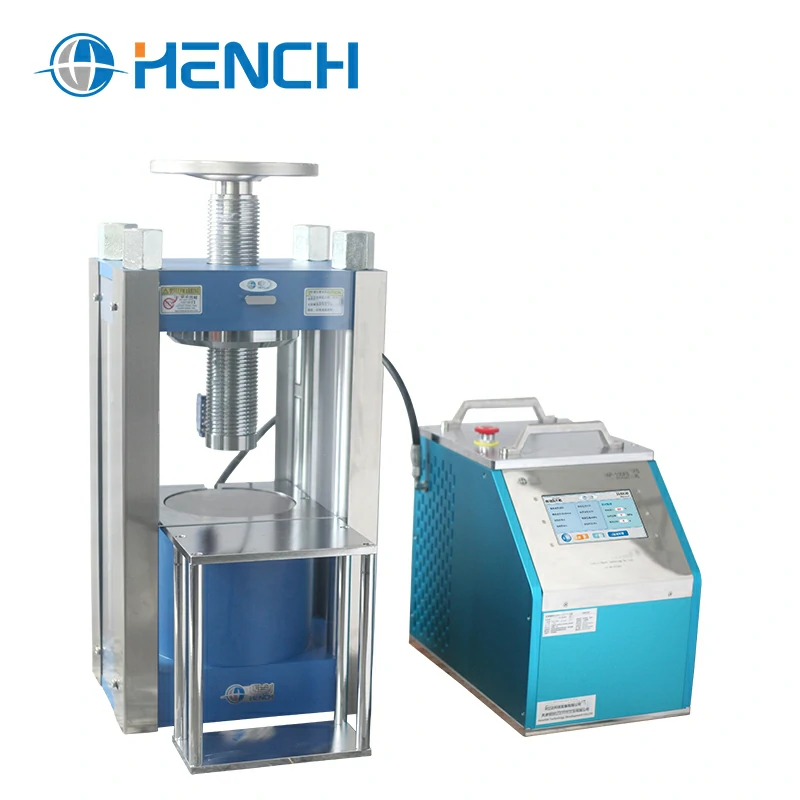
HAP-FS Series Modular Automatic Powder Press Machine is a high-pressure hydraulic pellet press designed for laboratory and industrial sample preparation. Available in 65, 100, 150, and 200 ton models, it provides programmable pressure control, multi-stage pressurization, automatic pressure compensation, controlled dwell time, and automatic demolding.
The split-type modular structure provides a larger working space for different mold configurations and high-pressure sample preparation requirements. The system supports round, square, irregular, and battery-related molds within the applicable pressure range.
With a 7-inch touch LCD interface, configurable pressure stages, automatic pressure relief, operation data storage, and optional computer connectivity, the HAP-FS series provides controlled and repeatable powder pressing for applications including XRF, FTIR, materials testing, ceramics, metal powders, and other laboratory sample preparation processes.
Key Features
High-Pressure Powder Compaction
The HAP-FS series covers a pressure range from 65 to 200 tons, providing different capacity options for laboratory and industrial applications. The hydraulic system allows the pressing force to be adjusted according to the sample, mold, and required compaction conditions.
The available models include:
- HAP-65S: up to 65 tons
- HAP-100S: up to 100 tons
- HAP-150S: up to 150 tons
- HAP-200S: up to 200 tons
Programmable Multi-Stage Pressing
The intelligent control system supports five programmable pressure stages as standard, with an optional 15-stage configuration.
The pressing sequence can be programmed to include:
- Initial pressurization
- Pressure compensation or repressurization
- Pressure holding
- Timed pressure release
- Automatic pressure relief
This allows the pressing cycle to be adjusted for different powder materials, mold designs, and sample preparation requirements.
Automatic Pressure Control
The system automatically monitors the programmed pressure and adjusts the pressing process according to the selected parameters. An overpressure warning is provided when the actual pressure exceeds the specified setting.
The minimum pressure adjustment increment is 0.3 tons as standard and can be customized when finer pressure control is required.
Automatic Demolding
After the pressing cycle is completed, the sample mold can be transferred to the demolding position. The automatic demolding function helps reduce manual handling during sample preparation and improves operational consistency.
Manual screw operation is also available when required.
7-Inch Touchscreen Control
The HAP-FS uses a 7-inch touch LCD display with switchable Chinese and English interfaces.
The operating interface provides direct access to:
- Mold type
- Mold diameter
- Pressurization stage
- Set pressure
- Pressure compensation
- Mold pressure
- Pressure-holding time
- Real-time pressure
- Real-time pressure-holding time
- Start
- Setting
- Demolding
- Data management
Operation Data Storage
The control system can store up to 10,000 historical operation records. Experimental parameters and time records can be exported to a USB drive for storage, review, and process documentation.
Multiple Safety Protection Systems
The HAP-FS incorporates mechanical, electrical, and hydraulic protection functions for high-pressure operation.
Safety features include:
- High-strength steel protective structure
- 6 mm plexiglass protective door
- Leakage protection
- Emergency stop switch
- Cylinder height limit protection
- Automatic pressure relief
- Overpressure warning
- Mechanical fault alarm and stop function
Applications
The HAP-FS series is designed for high-pressure powder compaction and laboratory sample preparation where controlled and repeatable pressing is required.
Typical applications include:
- XRF sample pellet preparation
- FTIR sample preparation
- Ceramic powder pressing
- Metal powder compaction
- Mineral sample preparation
- Material research
- Powder metallurgy testing
- Quality control laboratories
- Research and development laboratories
- Industrial material testing
For XRF and FTIR applications, the press can be configured with suitable molds according to the required sample diameter, material, and pressing force.
How the HAP-FS Powder Press Machine Works
The HAP-FS uses a programmable hydraulic pressing process to compact powder material inside a selected mold.
The basic workflow is:
Powder Loading → Mold Assembly → Mold Installation → Pressure Setting → Multi-Stage Pressing → Pressure Holding → Automatic Pressure Relief → Demolding → Finished Pellet
Before starting the cycle, the operator selects the mold type, mold diameter, target pressure, pressure stages, and dwell time through the touchscreen interface.
During pressing, the hydraulic system applies the programmed force and maintains the required pressure for the specified period. Once the cycle is completed, the system releases the pressure and the sample can be demolded.
This controlled process helps reduce variation caused by inconsistent manual pressing conditions.
HAP-FS Model Selection
The four HAP-FS models provide different maximum pressing capacities for different sample preparation requirements.
Model Maximum Pressure Cylinder Diameter Effective Space Host Weight HAP-65S 65 tons Φ165 mm 220 × 220 × 220 mm 285 kg HAP-100S 100 tons Φ200 mm 260 × 260 × 220 mm 451 kg HAP-150S 150 tons Φ250 mm 300 × 480 × 290 mm 552 kg HAP-200S 200 tons Φ290 mm 290 × 480 × 300 mm 703 kg The appropriate model depends on the required pressing force, mold size, sample material, and available working space. Hench can recommend the suitable configuration based on the intended sample preparation process.
Technical Specifications
Parameter HAP-65S HAP-100S HAP-150S HAP-200S Pressure Range 0.5–65 T 1–100 T 3–150 T 3–200 T Cylinder Diameter Φ165 mm Φ200 mm Φ250 mm Φ290 mm Automatic Control 5-stage programmable / optional 15-stage 5-stage programmable / optional 15-stage 5-stage programmable / optional 15-stage 5-stage programmable / optional 15-stage Pressurization Automatic pressurization, compensation, dwell, and pressure release Same Same Same Dwell Time No fixed time limit No fixed time limit No fixed time limit No fixed time limit Pressure Conversion Automatic with overpressure warning Automatic with overpressure warning Automatic with overpressure warning Automatic with overpressure warning Display 7-inch touch LCD 7-inch touch LCD 7-inch touch LCD 7-inch touch LCD Interface Chinese / English switchable Chinese / English switchable Chinese / English switchable Chinese / English switchable Protective Door 6 mm plexiglass 6 mm plexiglass 6 mm plexiglass 6 mm plexiglass Cylinder Stroke ≤50 mm ≤50 mm ≤50 mm ≤50 mm Data Storage 10,000 records 10,000 records 10,000 records 10,000 records Data Export USB USB USB USB Ejection Pressure Adjustable within pressure-bearing range Adjustable within pressure-bearing range Adjustable within pressure-bearing range Adjustable within pressure-bearing range Safety Leakage protection + emergency stop Leakage protection + emergency stop Leakage protection + emergency stop Leakage protection + emergency stop Power Supply 220 V, 50/60 Hz; 110 V optional 220 V, 50/60 Hz; 110 V optional 220 V, 50/60 Hz; 110 V optional 220 V, 50/60 Hz; 110 V optional Power 800 W 1500 W 1500 W 1500 W Host Size 350 × 220 × 885 mm 410 × 300 × 965 mm 440 × 520 × 1110 mm 480 × 650 × 1110 mm Host Weight 285 kg 451 kg 552 kg 703 kg Controller Size 260 × 400 × 400 mm 300 × 480 × 480 mm — — Controller Weight 66 kg 85 kg — — Mold and Configuration Options
The HAP-FS series supports different mold configurations within the applicable pressure range. Mold selection should be based on the sample material, target pellet dimensions, required pressing force, and analytical method.
Available mold configurations can include:
- Circular molds
- Square molds
- Irregular molds
- Battery-related molds
- Customized molds
The system also allows the mold diameter to be entered through the control interface so that the pressing parameters can be matched to the selected mold.
Hench can customize or modify the press and mold configuration according to specific sample preparation requirements.
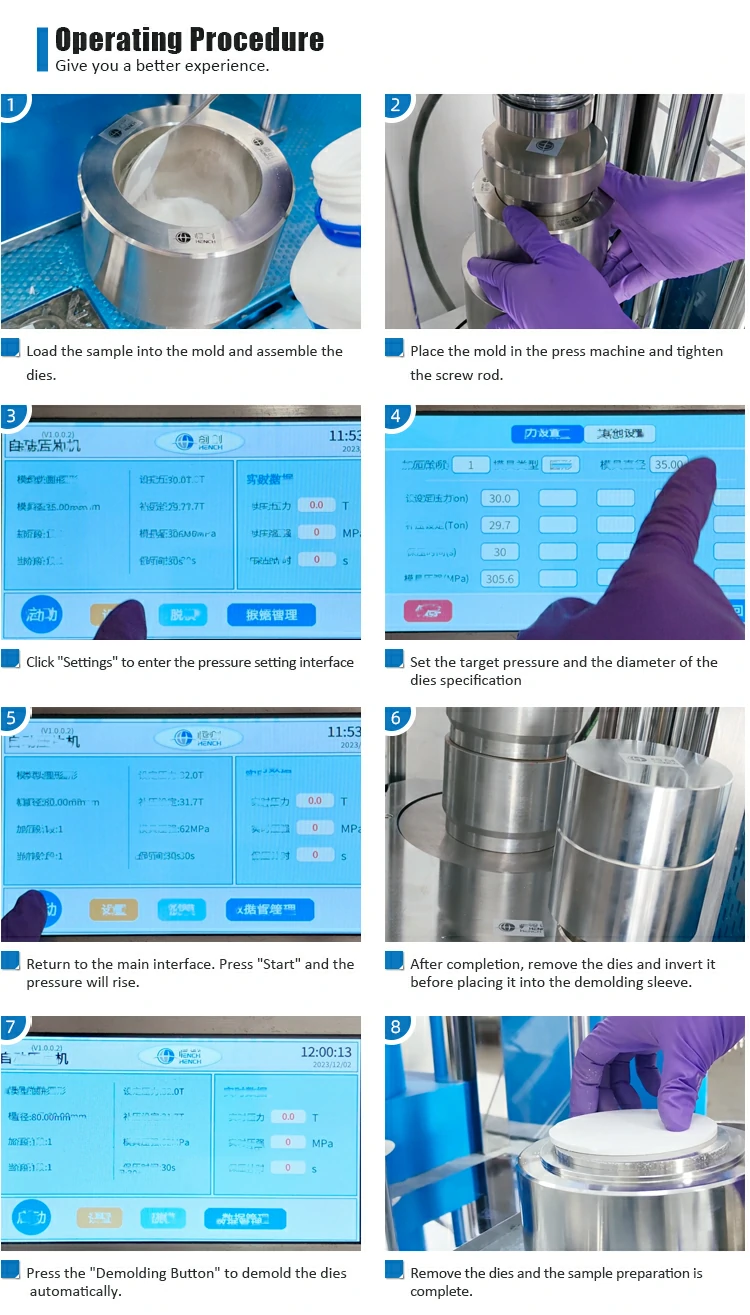
Operating Procedure
1. Load the Powder
Place the prepared powder sample into the selected mold and assemble the mold components correctly.
2. Install the Mold
Place the assembled mold into the working area of the hydraulic press and secure it using the screw mechanism.
3. Set the Pressing Parameters
Select Setting on the touchscreen interface. Enter the required mold type, mold diameter, target pressure, pressure compensation, pressure stages, and dwell time.
4. Start the Pressing Cycle
Return to the main interface and press Start. The hydraulic system begins the programmed pressure cycle.
5. Hold and Release Pressure
The system maintains the programmed pressure for the specified dwell time before automatically releasing pressure according to the programmed sequence.
6. Demold the Sample
After pressure release, remove the mold, invert it if required, and place it into the demolding sleeve. Select Demould to complete the automatic demolding process.
7. Remove the Finished Pellet
Remove the compacted sample from the mold. The prepared pellet is then ready for the next analytical or testing procedure.
Control Interface
The HAP-FS control interface is designed to provide direct access to the parameters required during powder pressing.
A typical operation screen displays:
- Mold Type: Circular
- Mold Diameter: 25.00 mm
- Pressurization Stage: 1
- Current Stage: 1
- Set Pressure: 0.3 T
- Pressure Compensation: 0.0 T
- Mold Pressure: 6 MPa
- Hold-Pressure Time: 10 s
- Real-Time Pressure: 0.0 T
- Real-Time Pressure: 0 MPa
- Hold-Pressure Timing: 0 s
The main interface includes Start, Setting, Demould, and Data Management functions.
Data Management and Process Records
The built-in data management function allows operators to review historical experimental parameters and operating times.
Up to 10,000 operation records can be stored in the system. Records can be exported to a USB drive for external storage and process documentation.
This function is particularly useful for laboratories that need to maintain repeatable sample preparation conditions and retain historical operating data.
Safety and Protection
High-pressure powder pressing requires controlled operation and appropriate mechanical protection. The HAP-FS integrates several protection functions into the hydraulic and control systems.
The protective system includes a high-strength steel structure, plexiglass safety door, leakage protection, emergency stop, cylinder limit protection, overpressure monitoring, automatic pressure relief, and mechanical fault alarms.
If the hydraulic cylinder exceeds its permitted height or the system detects an abnormal pressure condition, the corresponding protection function can stop the operation and initiate pressure relief.
Customization Options
The HAP-FS can be configured according to specific sample preparation and laboratory requirements.
Customization may include:
- Pressing capacity
- Mold type
- Mold diameter
- Mold configuration
- Pressure control stages
- Pressure adjustment resolution
- Electrical configuration
- Language interface
- Computer connectivity
- Remote operation functions
- Special sample preparation requirements
For applications involving unusual sample dimensions, high-density materials, special mold shapes, or specific analytical procedures, Hench can evaluate the required pressing force and mold configuration before production.
Why Choose Hench HAP-FS Powder Press Machine?
The HAP-FS combines high pressing capacity with programmable process control and modular configuration. As a versatile laboratory press, it allows operators to adjust pressure stages, dwell time, mold parameters, and pressure compensation according to the sample preparation process instead of relying on a fixed pressing cycle.
Its 65–200 ton capacity range allows the HAP-FS product family to cover different laboratory and industrial pressing requirements. As an automatic hydraulic press, it also provides automated pressure control, pressure holding, pressure relief, and demolding functions. Optional molds and customized configurations further extend its application range.
For laboratories preparing samples for XRF, FTIR, materials analysis, or quality control, the HAP-FS provides a controlled hydraulic platform for repeatable powder compaction.
Frequently Asked Questions
What is an automatic powder press machine used for?
An automatic powder press machine compacts powdered materials into pellets or shaped samples under controlled hydraulic pressure. The HAP-FS is designed for applications including XRF and FTIR sample preparation, ceramic pressing, metal powder compaction, and material testing.
What is the difference between the HAP-65S, HAP-100S, HAP-150S, and HAP-200S?
The main difference is the maximum pressing capacity and corresponding cylinder size. The HAP-65S provides up to 65 tons, while the HAP-100S, HAP-150S, and HAP-200S provide up to 100, 150, and 200 tons respectively.
Can the powder press machine use different molds?
Yes. The HAP-FS supports different mold configurations within the applicable pressure range, including circular, square, irregular, and customized molds.
How many pressure stages can be programmed?
The standard control system supports five programmable pressure stages. A 15-stage configuration is available as an option.
Can the pressing time be adjusted?
Yes. The dwell time can be programmed according to the sample preparation requirements, with no fixed maximum time specified in the system configuration.
Can the machine store operating data?
Yes. The system can store up to 10,000 historical operation records. Data can be exported to a USB drive.
Is the HAP-FS suitable for XRF sample preparation?
Yes. The HAP-FS can be configured for XRF powder pellet preparation. The appropriate pressing capacity and mold should be selected according to the material, pellet dimensions, and analytical requirements.
Can the HAP-FS be customized?
Yes. Hench can customize the mold, pressure configuration, electrical supply, interface, computer connectivity, and other machine parameters according to specific application requirements.
About Hench Technology Co., Ltd.
Hench Technology Co., Ltd. is a China-based supplier of laboratory and industrial hydraulic pressing equipment. The company provides powder pressing and sample preparation solutions for laboratories, research institutions, material testing, and industrial applications.
The HAP-FS series is developed for applications requiring controlled high-pressure compaction, programmable pressing cycles, and repeatable sample preparation. Hench can provide different pressing capacities, mold configurations, and customized options according to application requirements.
For model selection, mold configuration, or a customized powder pressing solution, contact Hench Technology to discuss your sample material, target pellet size, required pressing force, and application.
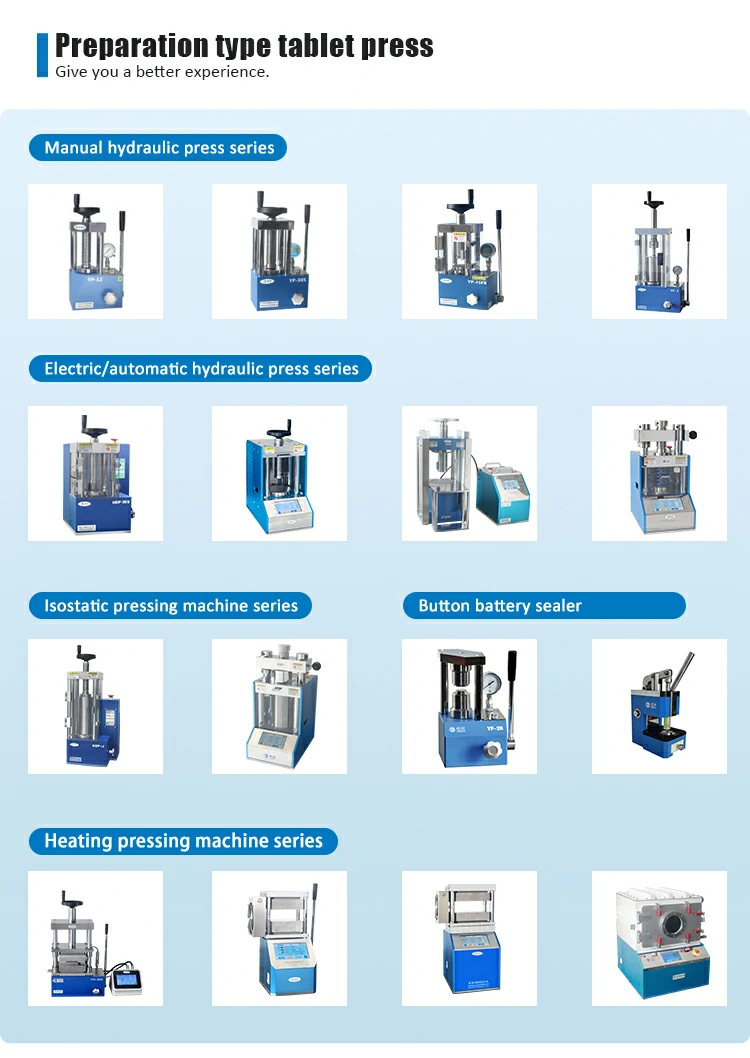
High-Quality Laboratory Presses for Precise Sample Preparation
Hench Technology offers advanced laboratory presses that ensure accurate and reproducible results for a variety of laboratory applications. Designed for efficiency and reliability, these presses are ideal for powders, tablets, and other sample types.
Trusted Lab Equipment Supplier
As a professional lab equipment supplier, Hench Technology provides comprehensive solutions and technical support for laboratory operations. Our commitment to innovation and quality ensures that every laboratory press meets the highest standards.