



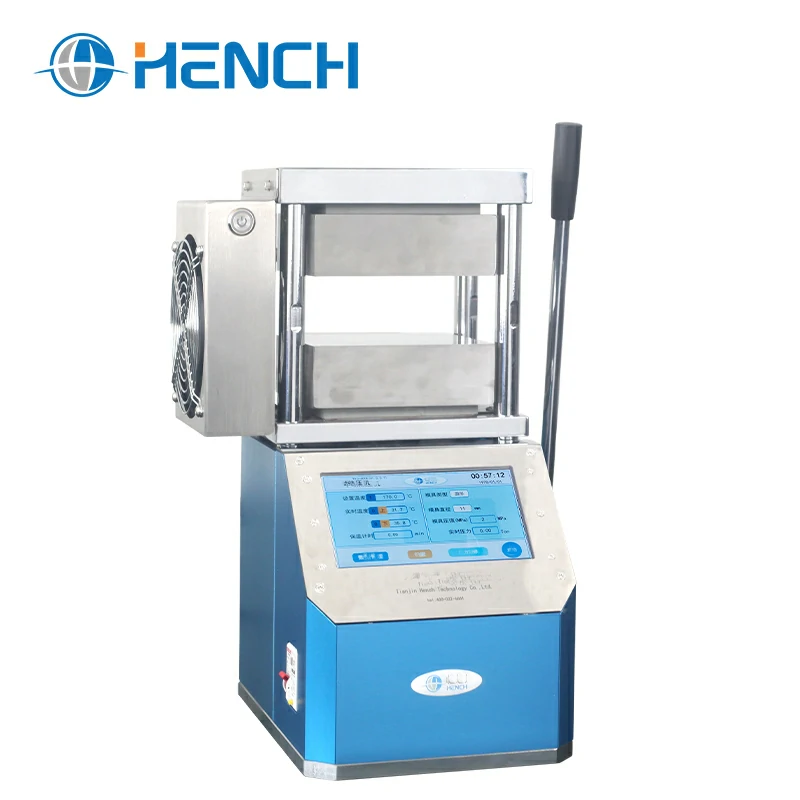
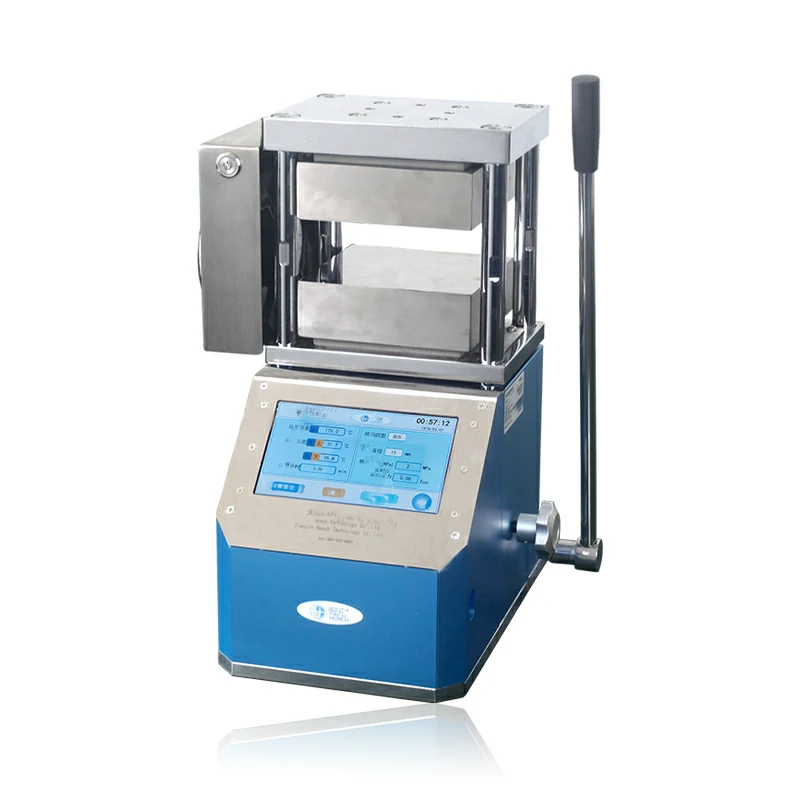
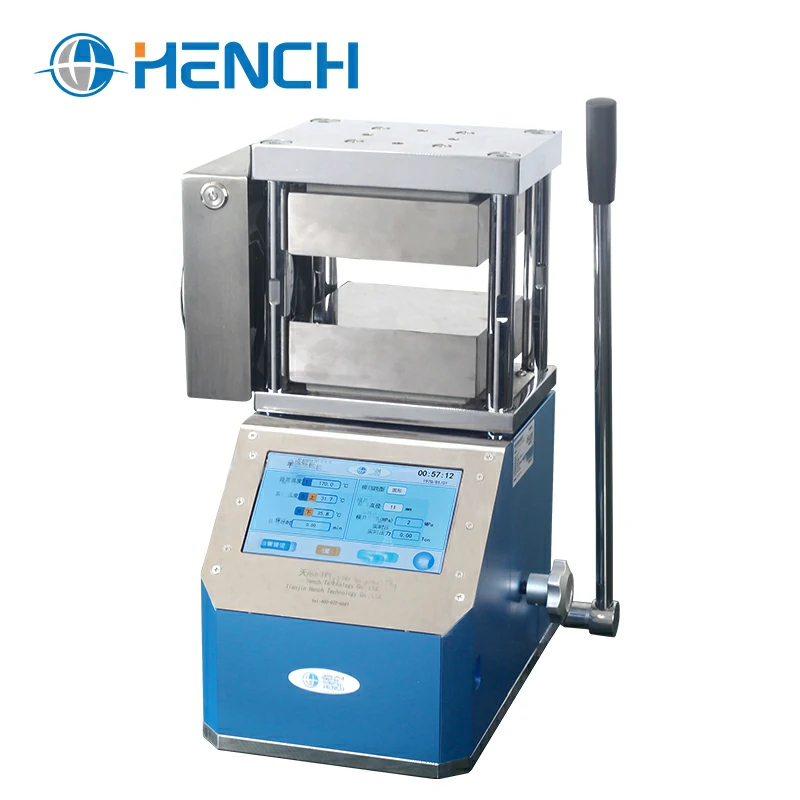
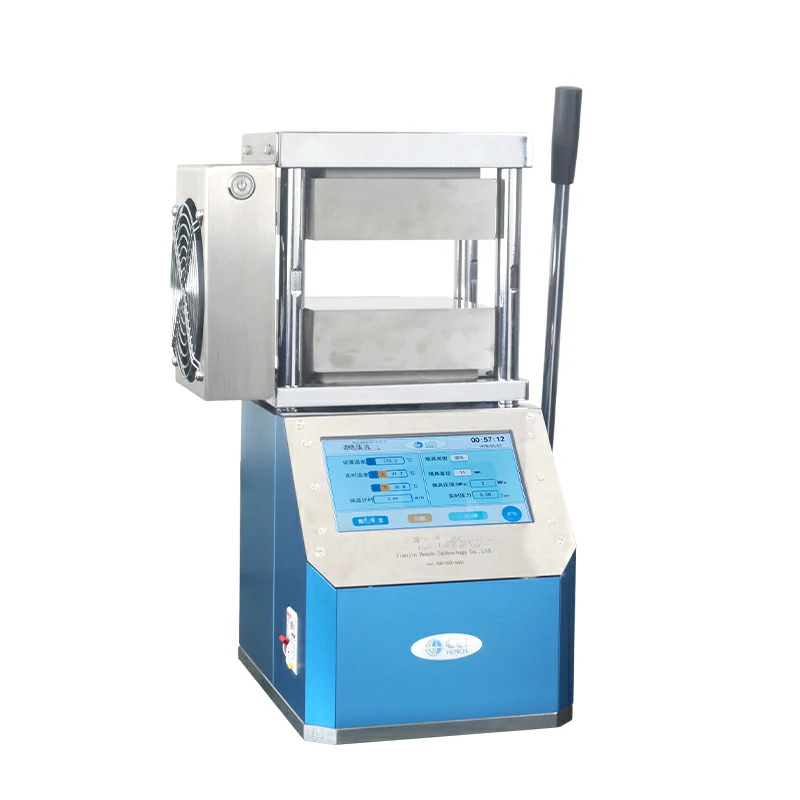
Manual Integrated Heating Tablet Press Machine HPC-800D/DG
Hench Technology (HCFTIR) HPC-800D/DG series is a professional-grade manual heated hydraulic press engineered specifically for laboratory sample preparation. Combining high-tonnage manual pressing (up to 30T) with integrated heating plates (up to 800°C), the HPC-800 series provides uniform, controlled temperature and pressure distribution essential for FTIR pellets, polymer thin-film pressing, ceramic sintering research, and advanced material compaction spectroscopy.
Key Features
-
Dual-Action Integrated Thermal Compaction: Consolidates high-tonnage manual hydraulic force and precise closed-loop temperature control into a single benchtop lab footprint.
-
Broad Temperature Spectrum: Standard configurations handle up to 300°C (Aluminum heating core) or 500°C (Copper heating core), with extreme thermal limits reaching up to 800°C for high-performance sintering.
-
Monolithic Leak-Free Architecture: Built using a rigid, integrated four-column forged structure with dual thermal isolation plates to guarantee long-term zero oil weepage and structural stability under load.
-
Multi-Tier Passive & Active Safety: Complete work area isolation with a 5mm high-strength plexiglass sliding safety shield, instantaneous mechanical emergency stop, and built-in ground electrical leakage protection.
Hardware Component Breakdown
-
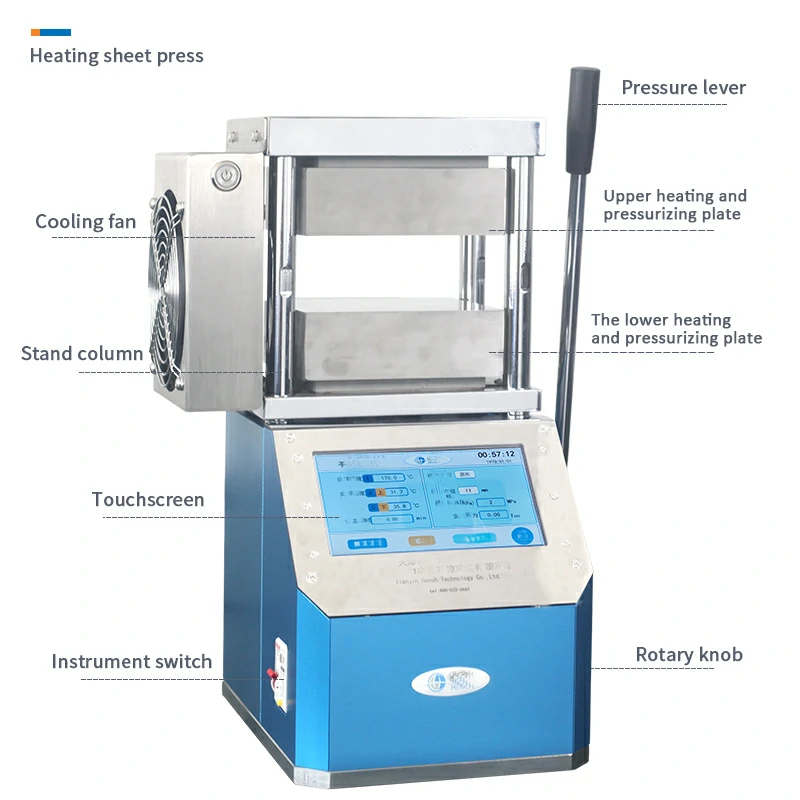
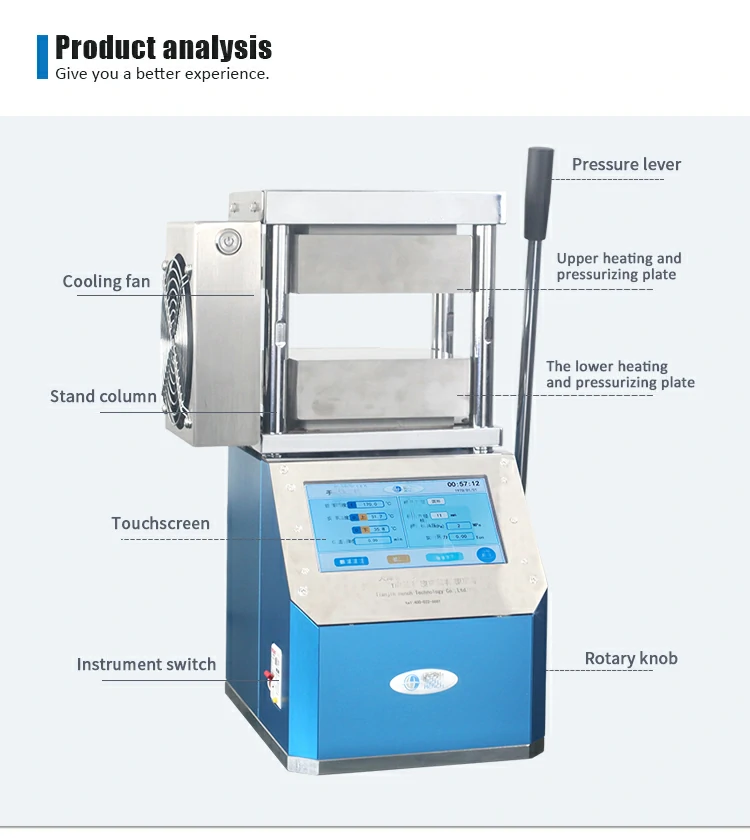
Dual-Zone Thermal Plates: Precision electroplated and mirror-polished upper and lower heating elements with a structural screw suspension design to secure parallel pressure distribution.
-
Mechanical Pressure Lever: High-leverage manual pump arm optimized for ergonomic operations, allowing steady force application up to 30T with minimum operator effort.
-
Intelligent Touchscreen PLC: Features real-time multi-stage PID temperature profiling, real-time pressure conversions (MPa to Tonnage), and "High-Temperature Alert" (activates automatically above 50°C).
-
Dual-Action Rapid Cooling: Integrated high-velocity side-mounted cooling fan paired with natural ventilation paths to rapidly cycle temperatures down between experiments.
Product Description
The HPC-800 series is available in four distinct frame sizes, each configurable with either standard Aluminum cores (300℃ limit) or premium high-conductivity Copper cores (500℃ to 800℃ limit). Review the engineered specifications below to select the ideal configuration for your laboratory:
| Technical Parameter | HPC-800D1 / DG1 | HPC-800D2 / DG2 | HPC-800E / EG | HPC-800F / FG |
| Max Pressure Limit
| 0 - 10 T (100 kN) | 0 - 10 T (100 kN) | 0 - 24 T (240 kN) | 0 - 30 T (300 kN) |
| Piston Diameter
| Φ 65 mm | Φ 65 mm | Φ 95 mm | Φ 110 mm |
| Piston Travel (Stroke)
| ≤ 60 mm | ≤ 60 mm | ≤ 60 mm | ≤ 60 mm |
| Max Temperature Range
| Ambient to 800℃ | Ambient to 800℃ | Ambient to 800℃ | Ambient to 800℃ |
| Heating Core Material
| D1: Aluminum (300℃)
DG1: Copper (500℃) | D2: Aluminum (300℃)
DG2: Copper (500℃) | E: Aluminum (300℃)
EG: Copper (500℃) | F: Aluminum (300℃)
FG: Copper (500℃) |
| Heating Control Method
| 5-stage PID curve adjustment; automatic heat, insulation, and air cooling | 5-stage PID curve adjustment; automatic heat, insulation, and air cooling | 5-stage PID curve adjustment; automatic heat, insulation, and air cooling | 5-stage PID curve adjustment; automatic heat, insulation, and air cooling |
| Heating Plate (Die) Size
| 150 × 150 mm | 200 × 200 mm | 300 × 300 mm | 400 × 400 mm |
| Effective Working Space
| 150 × 60 mm | 200 × 60 mm | 300 × 60 mm | 400 × 60 mm |
| Pressure & Temp Precision
| ± 0.1 T / ± 0.1℃ (User customizable precision limits)
| ± 0.1 T / ± 0.1℃ (User customizable precision limits)
| ± 0.1 T / ± 0.1℃ (User customizable precision limits)
| ± 0.1 T / ± 0.1℃ (User customizable precision limits)
|
| Dwell Time Capabilities
| Unlimited holding time with manual controlled slow pressure venting | Unlimited holding time with manual controlled slow pressure venting | Unlimited holding time with manual controlled slow pressure venting | Unlimited holding time with manual controlled slow pressure venting |
| Control Interface Display
| 7-inch LCD high-resolution touch screen (English / Chinese switchable) | 7-inch LCD high-resolution touch screen (English / Chinese switchable) | 7-inch LCD high-resolution touch screen (English / Chinese switchable) | 7-inch LCD high-resolution touch screen (English / Chinese switchable) |
| Thermal Insulation Barrier
| Four-column heavy alignment with imported high-purity natural mica sheets | Four-column heavy alignment with imported high-purity natural mica sheets | Four-column heavy alignment with imported high-purity natural mica sheets | Four-column heavy alignment with imported high-purity natural mica sheets |
| Equipment Power Rating
| 1300 W | 1900 W | 2500 W | 5100 W |
| Footprint Dimensions
| 300 × 400 × 435 mm | 350 × 400 × 445 mm | 455 × 410 × 455 mm | 560 × 600 × 625 mm |
| Net Equipment Weight
| 62 kg | 98 kg | 365 kg | 425 kg |
| Standard Input Voltage
| 220V (50Hz/60Hz) | 110V customizable for international labs
| 220V (50Hz/60Hz) | 110V customizable for international labs
| 220V (50Hz/60Hz) | 110V customizable for international labs
| 220V (50Hz/60Hz) | 110V customizable for international labs
|
This product can be customized or improved according to customer requirements.*
Standard Operating Procedure
-
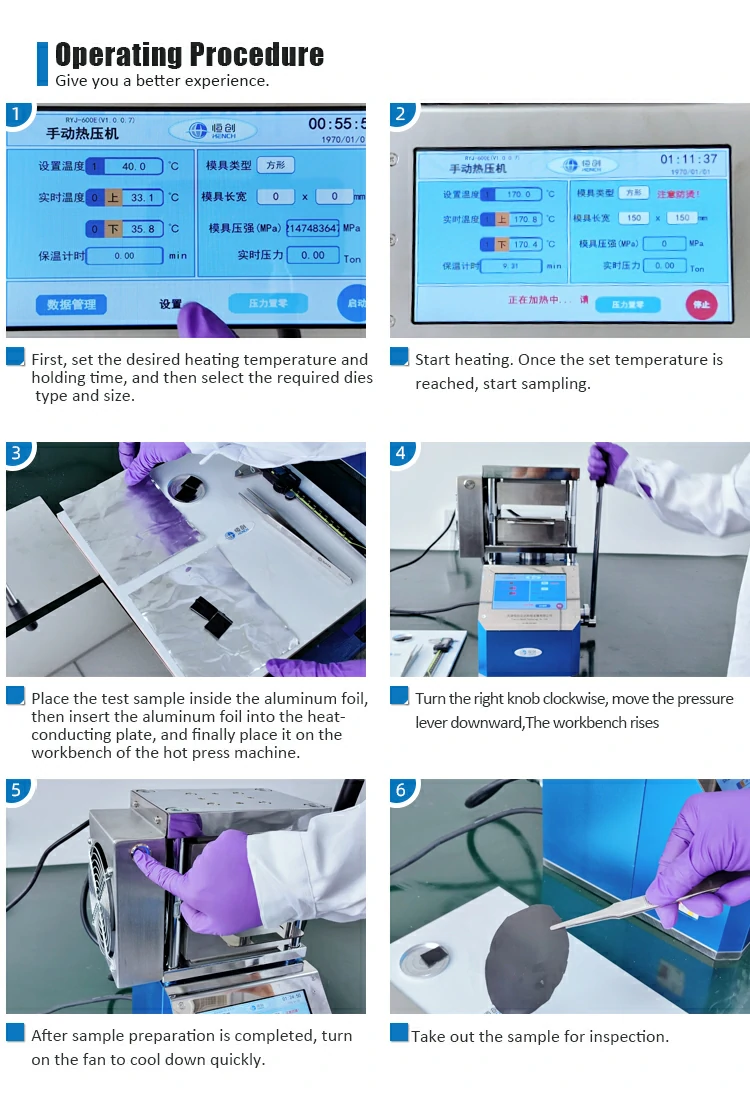
Parameter Definition: Power on the system. Use the 7-inch PLC interface to input targeted heating curves, dwell thresholds, and choose the correct sample dies.
-
Pre-Thermal Phase: Activate the heating program. Allow the integrated copper or aluminum cores to stabilize at the targeted temperature before feeding samples.
-
Sample Alignment: Place material/powders inside thin protective aluminum foil, place the sandwich directly between the insulated hot plates, and shut the sliding plexiglass door.
-
Hydraulic Compaction: Turn the hand valve clockwise to lock, then stroke the pressure lever downward to lift the piston workbench until target pressure is attained.
-
Active Heat Venting: After target dwell time is reached, release pressure, slide the protective gate open, and switch on the high-flow air-cooled system to accelerate cool-down.
-
Specimen Extraction: Once safe handling temperatures are displayed on screen, use tweezers to extract the highly densified target pellet or film for analysis.
Key Application Focus Areas
-
FTIR Spectroscopy Sample Preparation: Perfectly engineered for pressing ultra-thin, highly translucent, and uniform Potassium Bromide (KBr) or Sodium Chloride (NaCl) pellets. The high-tonnage precision force ensures zero macro-voids, while the integrated dual-heating plates eliminate ambient moisture interference during the pressing process, preventing baseline drifts and water vapor peaks in high-resolution Infrared Spectroscopy.
-
Advanced Polymer & Composite Sintering: Ideal for academic and industrial research into thermoplastic polymers (e.g., PEEK, PTFE, PVDF), elastomers, and advanced carbon-fiber/fiberglass reinforced composites. The precise closed-loop PID thermal cycling allows researchers to precisely control the melting, hot-flowing, thermoforming, and crystallization phases required to test tensile strength, molecular orientation, and thermal stability.
-
Technical Ceramic & Solid-State Battery Development: Provides critical high-temperature powder compaction for technical ceramics, advanced oxides, nitrides, and sulfide-based solid-state electrolyte materials. Compacting these sensitive powder compounds under precise continuous thermal load significantly enhances green density, accelerates grain boundary contact, and reduces micro-cracking during solid-state battery cell assembly and sintering evaluations.
-
Metallurgy & Powder Compaction Technology: Enables low-to-high tonnage hot-pressing experiments for specialty metal alloys, organic powder mixtures, and chemical catalysts. It ensures uniform structural density throughout the compact, making it a staple desktop unit for material science departments in top-tier universities and industrial R&D laboratories.
Why Choose Hench?
Hench Technology Co., Ltd., based in Tianjin, China, is a trusted manufacturer of precision laboratory and industrial presses. Hench designs high-quality heated hydraulic presses that deliver performance, safety, and ease of use. Their equipment serves universities, labs, and industrial clients worldwide, backed by professional support and rigorous quality control.
Frequently Asked Questions
Q: What dynamic customization options are available for the HPC-800 series to match unique experimental setups?
A: Hench Technology provides full-tier industrial customization for the HPC-800 platform. Depending on your lab's spatial and experimental limits, we can increase the effective day-light opening by extending the heavy-duty vertical support columns. Furthermore, the heating platens can be customized in terms of dimensions (up to 400×400mm) or materials (such as vacuum-hardened die steel or high-conductivity alloys). For glovebox integrations or cleanroom operations, we can engineer a remote-control console that splits the thermal touchscreen controller away from the core hydraulic press body.
Q: How does the thermal isolation system prevent the core hydraulic assembly from overheating during 500°C–800°C operations?
A: Operating at extreme temperatures requires strict thermal management to prevent hydraulic fluid breakdown. The HPC-800 series utilizes a multi-layer passive protection strategy: premium imported natural mica insulation boards are installed between the heating cores and the structural press plates to block vertical thermal conductivity. Additionally, dual heavy-duty side-mounted forced cooling fans activate to continuously dissipate heat from the structural columns. This guarantees that the hydraulic cylinder, internal seals, and main frame remain within safe, ambient operational thresholds even during prolonged high-temperature testing.
Q: What active and passive safety mechanisms protect lab personnel from thermal burns and high-pressure failure?
A: User safety is our top priority. Passively, the entire compression zone is fully enclosed behind a heavy-duty, 5mm blast-resistant plexiglass door equipped with a secure snap lock, protecting operators from mechanical failures or powder fragmentation. Actively, the 7-inch PLC controller monitors the platen sensors in real time—if the plate surface exceeds 50°C, a high-visibility "Be Careful of Heat" warning triggers on screen. In case of any electrical or program anomaly, the physical industrial emergency stop button cuts off all heating and hydraulic system power instantaneously, while the built-in ground-leakage circuit breaker isolates all high-voltage components.
Q: What is the mechanical difference between the standard Aluminum core and the premium Copper heating core sub-models?
A: The standard models (D1, D2, E, F) feature an high-grade Aluminum heating core optimized for standard thermal routines up to 300°C, providing reliable parallel heat distribution for everyday polymers and FTIR pellet prep. The premium upgrade models (DG1, DG2, EG, FG) implement a high-purity Copper heating core. Copper delivers significantly higher thermal conductivity and structural stability under load at extreme temperatures up to 500°C (customizable to 800°C), resulting in much faster ramp-up times, tighter PID temperature accuracy, and excellent resistance to thermal deformation under continuous high-tonnage cycles.