The Application of Laboratory Hot Presses in Inorganic Materials
2月 5, 2026
について laboratory heating compaction machine is the core equipment for research and sample preparation of inorganic materials. It solves issues such as difficulty in forming inorganic powders, uneven microstructures, and poor performance controllability through coordinated regulation of temperature and pressure. Its applications span nearly all sub-sectors of inorganic materials, including ceramics, new energy functional materials, minerals and silicates, glass, and nano-inorganic materials.
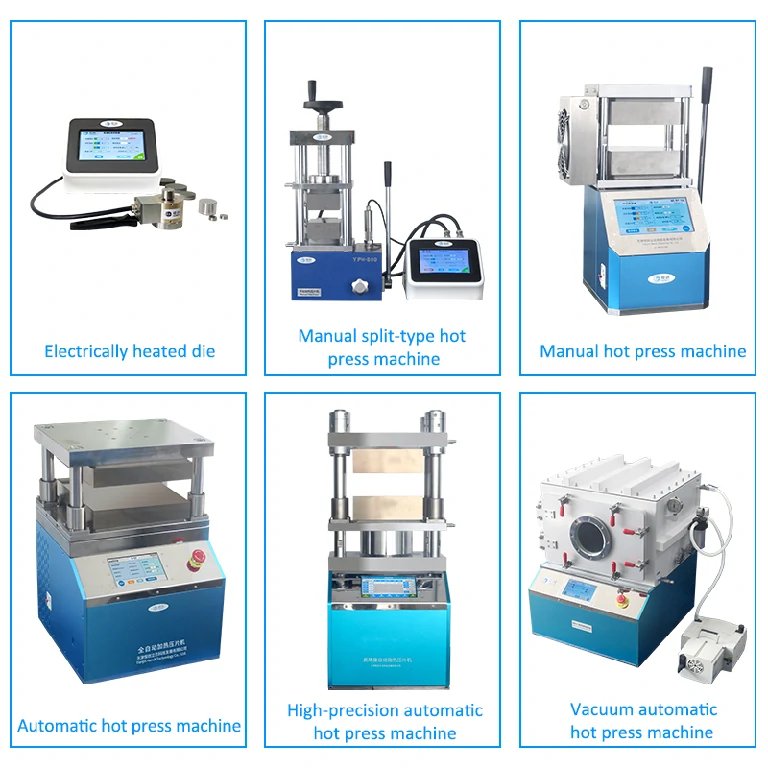
The figure below shows typical hot-pressed products from Hengchuang Company:

The following sections outline systematic application scenarios, technical highlights, and representative cases.
1. Ceramic Materials: From Raw Material Molding to High-Density Sintering
Ceramics are the core category of inorganic materials. Laboratory hot presses are applied throughout pre-sintering, hot pressing sintering, and composite material preparation, directly determining material density and performance.

Oxide Ceramics (Al₂O₃, ZrO₂, TiO₂)
- Pre-sintering (≤ 500℃, 10–25 MPa, 10–20 min): Removes binders (e.g., PVA), prepares high-strength green bodies, and prevents cracking during high-temperature sintering. Density of green bodies can reach 50–70%, meeting requirements for subsequent high-temperature sintering.
Non-Oxide Ceramics (SiC, Si₃N₄, AlN)
- Hot pressing can reduce sintering temperature by 200–400℃ compared to pressureless sintering, inhibit abnormal grain growth, and achieve a fine-grained, high-density structure.
Ceramic Matrix Composites
- Fiber- or particle-reinforced composites (e.g., C/SiC, graphene/Al₂O₃) benefit from uniform phase dispersion under moderate high temperature and pressure, enhancing toughness.
- Key point: Pressure must be controlled to prevent fiber breakage; non-oxide matrices require an inert atmosphere.

2. New Energy Inorganic Functional Materials: Structure Integrity & Performance
Hot presses are essential in preparing lithium batteries and fuel cell materials, ensuring densification without damaging the crystal structure.
- Solid Electrolytes (Sulfide Li₆PS₅Cl, Oxide LLZO): Sulfide electrolytes are thermally sensitive. Preparation uses medium-low temperature (150–300℃) and high pressure (30–50 MPa) under argon to prevent decomposition, maintaining ionic conductivity at 10⁻³–10⁻⁴ S/cm.
- Positive Electrode Materials (LFP, NCM): Softening binders (PVDF) are pressed at 150–200℃, 10–20 MPa to ensure close contact between active materials and conductive agents. This simulates industrial electrode preparation for electrochemical performance testing.
3. Mineral and Silicate Materials: Pre-Treatment & Sample Preparation
Laboratory hot presses simulate geological environments or prepare samples for analysis.
- Cement Clinker & Hydration Studies: Simulated medium-temperature, high-pressure hydration (100–200℃, 5–15 MPa) allows study of hydration products and optimization of cement formulas to enhance early strength.
- Ore / Mineral Samples: Heating to 200–500℃ and pressing at 20–40 MPa produces high-density, smooth sample sheets suitable for XRF or XRD analysis. Compared with cold pressing, these samples have higher strength and better repeatability.
Optional table for quick reference:
| 素材 | Temp & Pressure | Purpose |
|---|---|---|
| Cement | 100–200℃, 5–15 MPa | Hydration study, formula optimization |
| Ore / Minerals | 200–500℃, 20–40 MPa | High-density XRF/XRD samples |
4. Glass, Microcrystalline Glass & Nano-Inorganic Materials
- Low-Melting Glass (Borosilicate): Heated and pressed at 350–480℃, 5–15 MPa to form bubble-free thin sheets for optical testing.
- Microcrystalline Glass: Hot pressing followed by controlled crystallization allows precise control over crystal phases.
- Nano-Inorganics (TiO₂, Al₂O₃): Pressed at 300–500℃, 25–40 MPa to form weak sintering necks without binders, preserving unique nanomaterial properties like photocatalysis and thermal conductivity.

5. Die Selection & Atmosphere
- Oxide Ceramics: Hard alloy dies to avoid carbon contamination.
- Non-Oxide Ceramics: Graphite molds with BN release agent; inert or vacuum protection required.
- Temperature-Sensitive Materials: Medium-low temperature compaction machines, complex atmosphere systems often unnecessary.
結論
Laboratory hot presses are critical for inorganic material research, enabling controlled densification, fine microstructures, and reliable performance. From ceramics to nano-inorganics, they improve sample quality, reduce sintering temperatures, and maintain material properties.
参考文献
- Kingery, W.D., Bowen, H.K., Uhlmann, D.R., Introduction to Ceramics, 3rd Edition, Wiley, 2004.
- Goodenough, J.B., Lithium-Ion Batteries: Fundamentals and Applications, Springer, 2010.
- Kingery, W.D., Ceramic Processing, Wiley, 1976.