



FTIR vs Raman
FTIR and Raman both probe molecular vibrations, but they measure different physical events and therefore suit different samples. FTIR measures how much infrared light a sample absorbs; Raman measures the small shift in scattered laser light. Understanding where each technique is strong avoids buying the wrong instrument or preparing samples the wrong way.
What Each Technique Measures
In FTIR, the sample absorbs infrared radiation at frequencies that match its molecular vibrations; the resulting absorption spectrum is the familiar “fingerprint”. In Raman, a monochromatic laser excites the sample and a small fraction of the scattered light shifts in frequency according to the same vibrational modes.
The practical consequence is that the two techniques are not identical in what they see: vibrations that change a molecule’s dipole moment are strong in FTIR, while vibrations that change its polarisability are strong in Raman. Many laboratories use both for exactly this reason.
Water, Air and Sample Handling
| Factor | FTIR | Raman |
|---|---|---|
| Water | Strong absorption; aqueous samples are difficult and require special cells or ATR | Weak; aqueous solutions are routinely measured |
| Air (CO₂ and water vapour) | Interferes; purging or atmospheric compensation is common | Largely unaffected |
| Glass and packaging | Glass is opaque in the mid-IR; sampling through containers is limited | Can measure through glass and many transparent packaging materials |
| Sample preparation | Often required (KBr pellet, mull, ATR contact) | Little or none; solids and liquids can be measured directly |
| Fluorescence | Not an issue | Can mask the Raman signal in some coloured or organic samples |
Where FTIR Is the Better Choice
- Organic compounds, polymers and pharmaceutical materials with strong infrared absorption
- Quantitative work based on established FTIR methods and spectral libraries
- Laboratories that already run KBr pellet or ATR workflows
- Applications requiring standard reference spectra and compliance documentation
Where Raman Is the Better Choice
- Inorganic materials, minerals and metal oxides, which are often weak in the mid-IR
- Aqueous solutions and biological samples where water interference dominates FTIR
- Measurement through glass vials or packaging, or in-situ and remote sampling
- Symmetric molecules whose vibrations are inactive or weak in the infrared
Practical Selection Checklist
- What is the sample state — powder, solid, film, liquid or gas?
- Does the sample contain water, and can it be dried?
- Is the target compound organic (favours FTIR) or inorganic (favours Raman)?
- Must the sample stay inside its container or a controlled atmosphere?
- Is a reference library or a regulated method required?
- What sample preparation time and skill level are available?
The FTIR Side at Hench
Hench supplies FTIR spectrometers and the sample preparation equipment that supports them:
- FTIR spectrometers — ENERGY-30, MATRIX-50 and LIDA-20 models
- FTIR accessories — ATR attachments, liquid and gas cells, sample holders
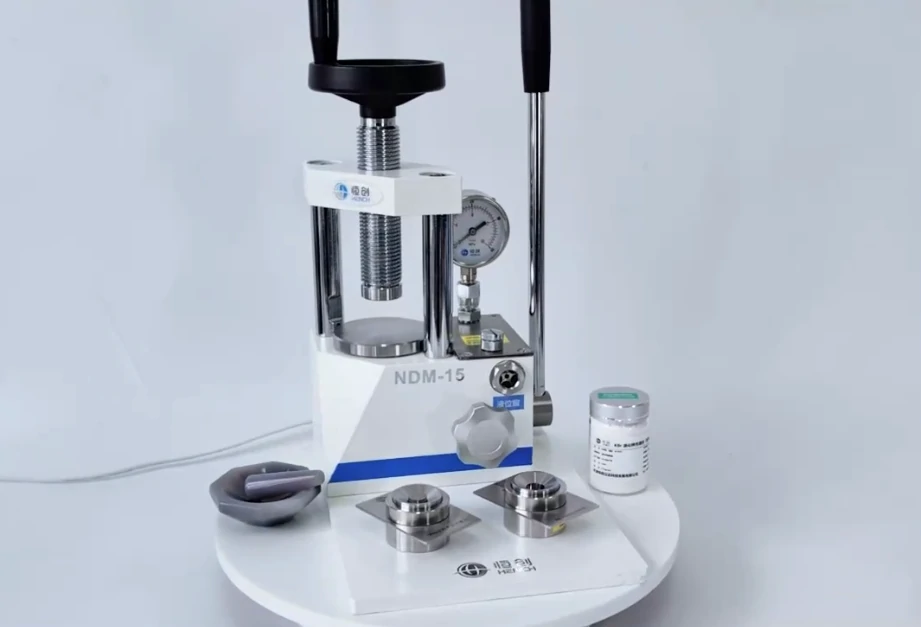
- KBr pellet preparation — mortar, KBr powder, 13 mm dies and presses
- ATR versus KBr pellet FTIR — how the two sampling routes compare
Frequently Asked Questions
Method Notes for Method Choice
Choose the technique from the sample and the question: FTIR answers what functional groups are present and is the routine choice for powders, films and liquids, while Raman is stronger for water-containing samples, inorganic fillers, packaging and in-situ measurement through glass or plastic. If a laboratory needs both, plan a shared sample preparation bench with a press, dies and drying equipment.
Can Raman replace FTIR?
For some samples yes, but not for all. Water and inorganics favour Raman; organic identification and library matching are usually easier with FTIR. Many laboratories keep both techniques for this reason.
Which technique needs less sample preparation?
Raman is generally faster to prepare, while FTIR often requires a pellet, a mull or ATR contact. The trade-off is described on this page and in the IR sample preparation guide.
Does Hench supply Raman instruments?
Hench focuses on FTIR spectrometers and laboratory sample preparation equipment; this page explains where FTIR fits relative to Raman so you can choose the right method.
Need a configuration for your laboratory? Send the sample type, target pellet size and throughput through the contact page and we will propose the equipment list.