Accelerating Research Efficiency: A Glovebox-Integrated Automatic Powder Press Case Study by Hench
March 27, 2026
Background
A leading materials science laboratory at a Malaysian university focuses on advanced research fields such as all-solid-state batteries and metal-organic frameworks (MOFs). Their experimental process requires compressing highly moisture- and oxygen-sensitive powders into dense pellets for performance testing.
Previously, the lab relied on a manual powder press inside a glovebox. While workable, this method created major limitations in efficiency, consistency, and data reliability. To overcome these challenges, the laboratory introduced a customized glovebox-compatible automatic powder press developed by Hench, enabling a complete upgrade of their experimental workflow.
Challenges: Manual Pressing Bottlenecks
The laboratory encountered several critical pain points:
- Unstable Pressure Control: Manual operation depended on user experience, leading to inconsistent pressure application.
- Sample Density Variability: Significant deviations within the same batch affected test accuracy.
- Poor Data Repeatability: High dispersion in results required repeated experiments.
- Low Efficiency: Each batch took approximately 1.5 hours to complete.
- Material Waste: Frequent rework increased raw material consumption and costs.
These issues directly slowed down research progress and reduced experimental reliability.
Solution: Hench Customized Automatic Powder Press for Glovebox Integration
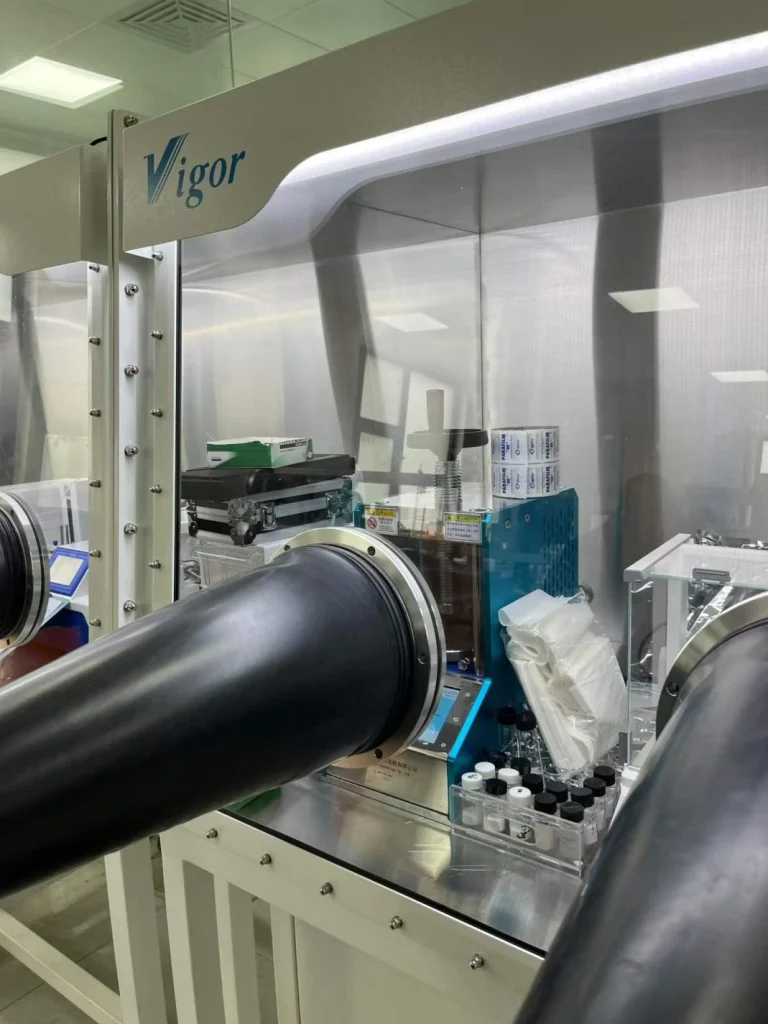
To address these challenges, Hench engineered a tailored solution based on the lab’s glovebox dimensions and application requirements.
Key features include:
- Seamless Glovebox Compatibility: Fully integrated with inert gas circulation systems to ensure zero exposure to moisture and oxygen.
- High-Precision Pressure Control: Automated system with accuracy up to ±0.1 ton.
- Programmable Multi-Stage Pressing: Supports up to 5 pressure stages for optimized sample formation.
- Simplified Operation: Reduces dependence on operator skill and minimizes human error.
Results: Measurable Improvements in Performance
After implementation, the laboratory achieved significant performance gains:
- Consistent Sample Quality: Density deviation controlled within ±1%.
- Reliable Experimental Data: Improved repeatability ensures accurate testing results.
- 80% Reduction in Rework: Fewer repeated experiments required.
- Faster Production Cycle: Processing time reduced from 1.5 hours to just 20 minutes per batch.
- Streamlined Workflow: Operators only handle loading and unloading tasks.
Designed for Controlled Environments
Hench equipment is purpose-built for demanding laboratory conditions:
- Sealed System Design: Ensures stable operation in oxygen- and moisture-free glovebox environments.
- Oxidation Prevention: Eliminates contamination risks for sensitive materials.
- Superior Pellet Quality: Smooth, dense, and crack-free samples suitable for high-precision analysis.
Maintenance and Cost Efficiency
- Low Maintenance: Only routine mold cleaning is required.
- Stable Long-Term Operation: Reduces downtime and operational interruptions.
- Cost Savings: Lower maintenance frequency and reduced material waste.
Conclusion: Hench Powers High-Efficiency Research
The successful deployment of the Hench glovebox-integrated automatic powder press has enabled this laboratory to achieve over 5× improvement in efficiency, significantly accelerating its R&D cycle.
This case highlights how Hench delivers precision-engineered solutions tailored to advanced material research, helping laboratories enhance data reliability, optimize workflows, and stay competitive in cutting-edge innovation.