ATR FTIR vs. KBr Pellet FTIR: Understanding the Key Differences
July 3, 2026
Fourier Transform Infrared (FTIR) spectroscopy offers multiple sampling techniques, each designed for different analytical objectives. Among the most widely used methods are Attenuated Total Reflection (ATR) and the traditional potassium bromide (KBr) pellet technique.
Although both methods operate on the same FTIR spectrometer, they differ significantly in sample preparation, analytical performance, testing efficiency, and application scope. Understanding these differences helps laboratories select the most appropriate workflow for research, quality control, and routine material identification.
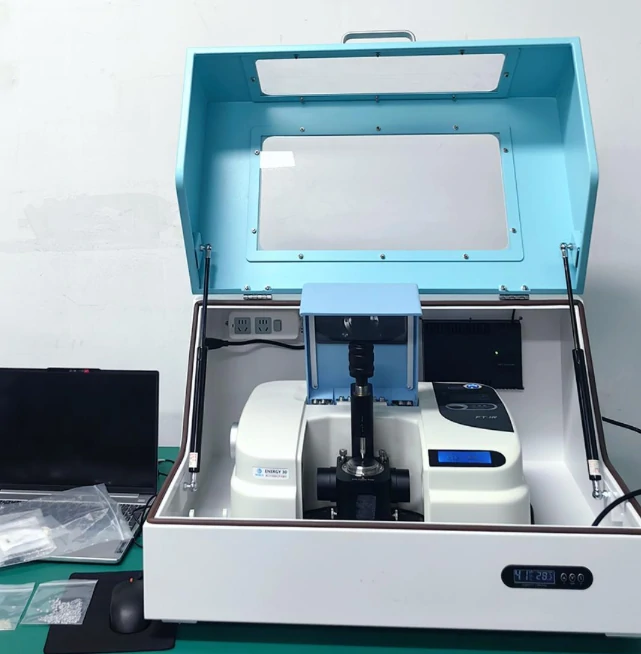
KBr Pellet FTIR: The Standard for High-Precision Analysis
The KBr pellet method remains one of the most established transmission techniques in infrared spectroscopy. Before analysis, a finely ground sample is thoroughly mixed with spectroscopic-grade potassium bromide and compressed into a transparent pellet using a dedicated hydraulic press. Infrared light passes directly through the pellet, producing a transmission spectrum with excellent spectral quality.
This technique offers several important advantages:
- High signal-to-noise ratio
- Stable absorption peak intensity
- Flat spectral baseline
- Excellent compatibility with standard spectral libraries
- High repeatability for quantitative analysis
Because the infrared beam passes through the entire sample, the resulting spectra are well suited for research applications, pharmaceutical analysis, polymer characterization, inorganic materials, and laboratory reports requiring high analytical accuracy.
For laboratories performing transmission FTIR analysis, a reliable hydraulic press is essential to produce transparent pellets with consistent thickness and density.
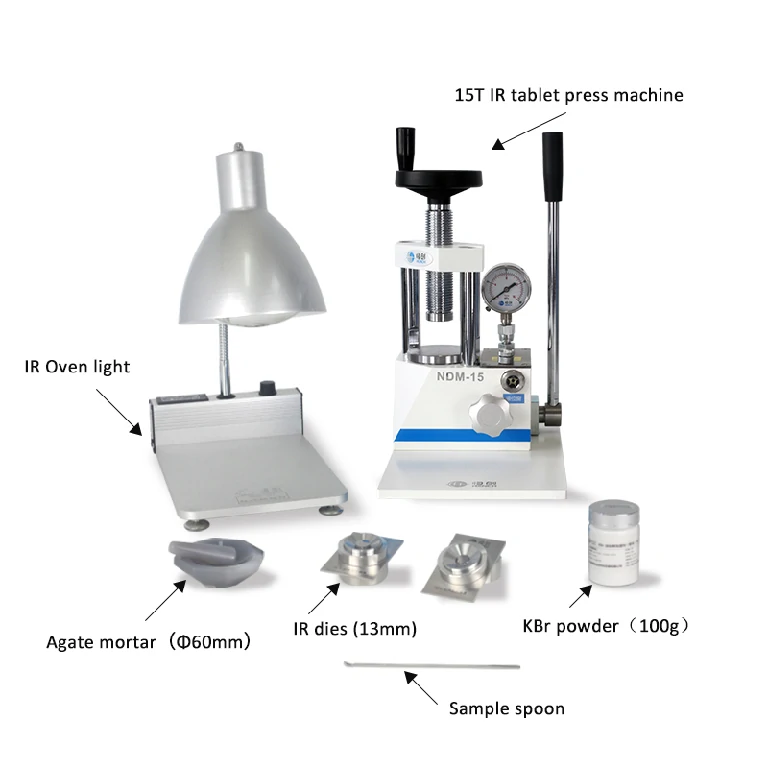
Limitations of the KBr Pellet Method
Despite its analytical advantages, transmission FTIR requires relatively complex sample preparation.
The procedure involves grinding, drying, mixing with potassium bromide, and pellet pressing before measurement can begin. This preparation increases testing time and requires trained operators.
Additional considerations include:
- Samples cannot be recovered after testing.
- Potassium bromide readily absorbs moisture, making humidity control important.
- Soft polymers, rubber, films, adhesives, and elastic materials are often difficult to grind into suitable powders.
- Routine incoming material inspection becomes less efficient due to preparation requirements.
For laboratories handling a large number of production samples each day, these factors can significantly reduce testing efficiency.
ATR FTIR: Fast Analysis with Minimal Sample Preparation
ATR FTIR has become the preferred technique for routine industrial inspection because it simplifies the entire testing process.
Instead of preparing pellets, the sample is placed directly onto an ATR crystal. Infrared light undergoes internal reflection within the crystal, allowing only a shallow penetration into the sample surface. The reflected signal is then collected to generate the infrared spectrum.
This approach offers several operational advantages:
- No grinding or pellet preparation
- Minimal operator training
- Rapid analysis within minutes
- No potassium bromide consumption
- Non-destructive testing for most samples
ATR performs well across a wide range of materials, including plastics, rubber, films, fibers, coatings, liquids, gels, adhesives, and cosmetic products.
These characteristics make ATR particularly suitable for production quality control, incoming material inspection, and rapid material verification.
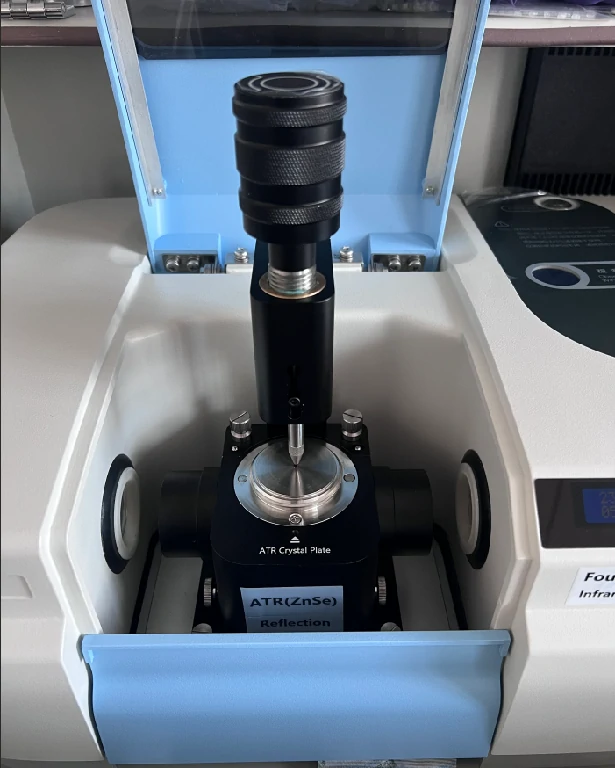
Understanding the Limitations of ATR
Although ATR greatly improves testing efficiency, it is important to recognize its analytical limitations.
Because the infrared signal only penetrates a few micrometers beneath the sample surface, the resulting spectrum primarily represents surface composition rather than the entire bulk material.
This characteristic can influence analytical accuracy when samples contain:
- Surface coatings
- Multi-layer structures
- Filled composite materials
- Surface contamination
In addition, absorption peak intensity is generally lower than that obtained using transmission FTIR, making ATR less suitable for highly accurate quantitative analysis of trace components.
Laboratories should also protect the ATR crystal during routine operation. Hard or abrasive particles may scratch the crystal surface over time, increasing maintenance costs.
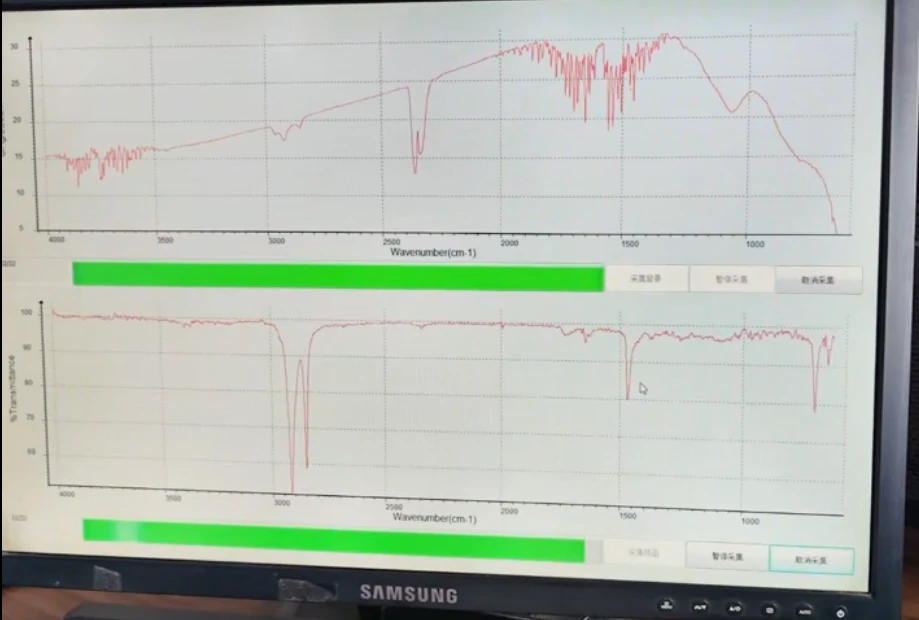
Which FTIR Method Is Right for Your Laboratory?
Rather than replacing one another, ATR and KBr pellet techniques complement different laboratory workflows.
The KBr pellet method remains the preferred choice when analytical precision, quantitative measurements, or publication-quality spectra are required.
ATR is better suited for laboratories that prioritize rapid turnaround, simplified operation, and high sample throughput during routine quality control.
For many research institutions and industrial laboratories, combining both techniques provides the greatest flexibility. Laboratories can perform high-accuracy transmission analysis when required while maintaining fast routine inspection through ATR, allowing a single FTIR platform to support applications across pharmaceuticals, polymers, chemicals, advanced materials, and industrial manufacturing.
Conclusion
ATR FTIR and KBr pellet FTIR each offer distinct advantages depending on analytical objectives.
Transmission FTIR delivers superior spectral quality and quantitative performance, while ATR significantly improves testing efficiency and operational convenience.
By understanding the strengths and limitations of each approach, laboratories can build a more flexible infrared analysis workflow that balances accuracy, speed, and long-term operating costs.