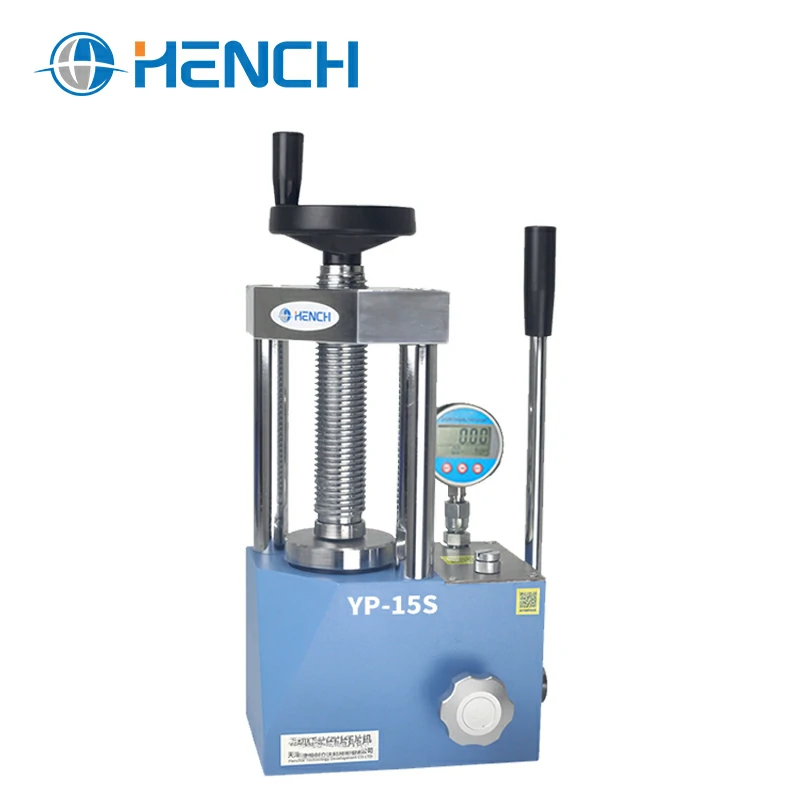
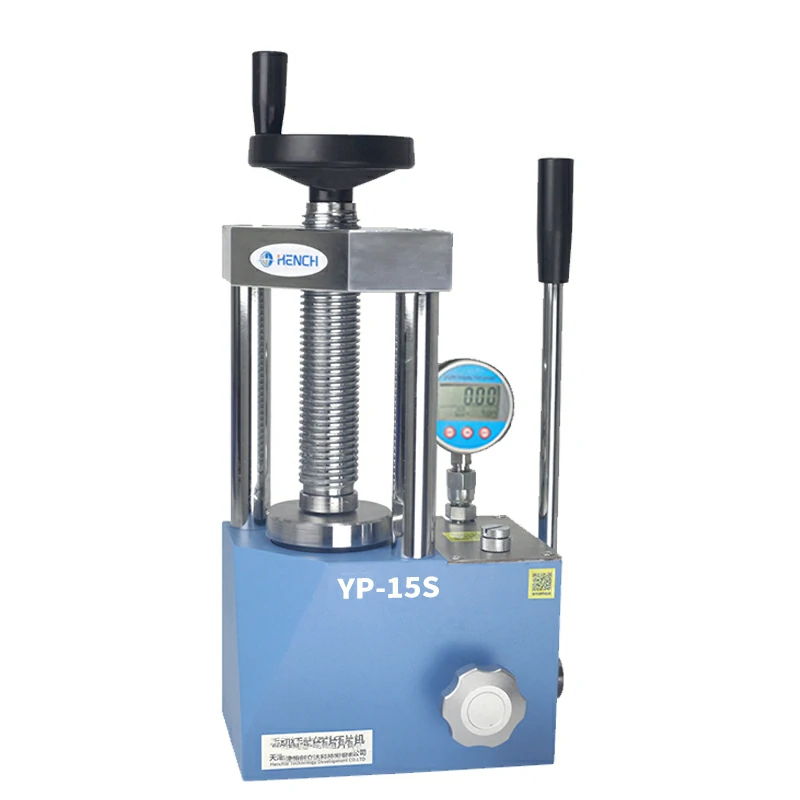
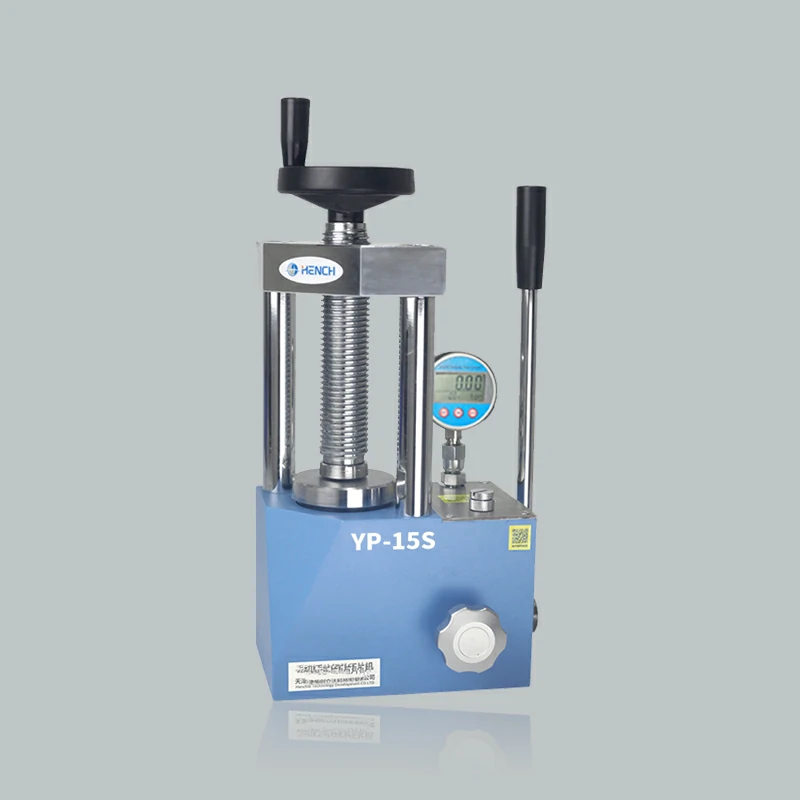
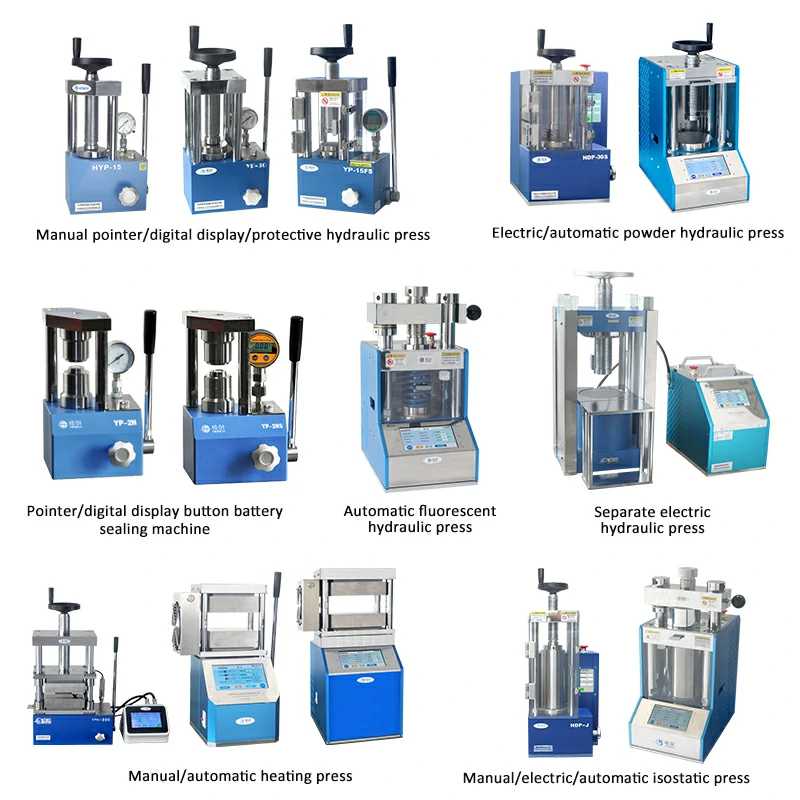
2/3/5/12/15-ton Manual Digital Hydraulic Laboratory Press YP-S
Manual Digital Hydraulic Laboratory Press
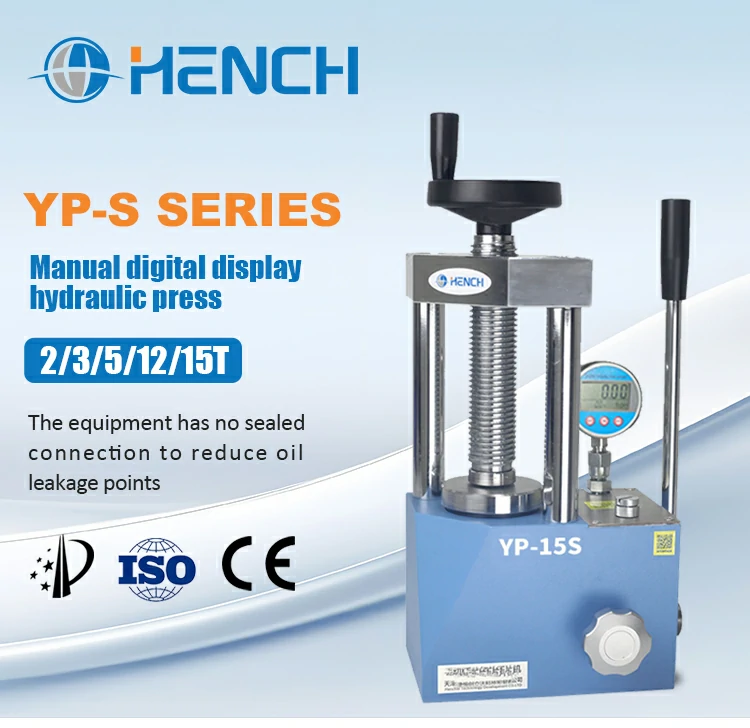
YP-S series manual digital display hydraulic press 2-15 tons, adopts double column design, suitable for small mold pressing or occasions with small tonnage requirements but strict pressure accuracy requirements.
Key Performance Features
-
Pressure range: 0–15 tons (0–33 MPa).
-
Cylinder diameter: 75 mm; piston travel: 32 mm.
-
Table diameter: Φ80 mm, with an effective workspace of 92 × 130 mm.
-
Pressure stability: ≤ 1 MPa over 10 minutes. Accurate readings through the DDNT digital sensor display, switching between tonnage (T) and MPa, resolution 0.01 T.
-
Compact footprint: 230 × 160 × 385 mm, weight approx 28 kg. Perfect for labs where space is limited.
Related Product Lines & Supplies
-
For other sizes or styles, we offer a broad range of hydraulic press machines that cover more tonnage and automated features.
-
To complete your laboratory workflow, see Hench’s selection of lab supplies including dies, sample prep tools, accessories.
-
For comparable presses with tablet-making functionality or manual/digital display control, our manual tablet press machines are designed for those needs.
Product Description
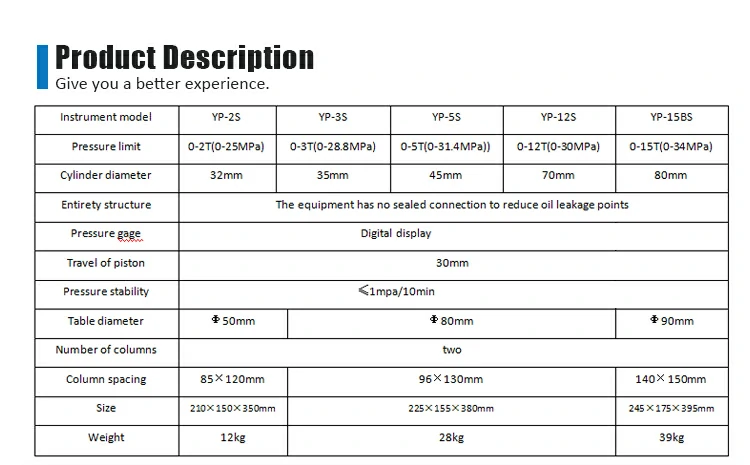
| Instrument model | YP-2S | YP-3S | YP-5S | YP-12S | YP-15BS |
| Pressure limit | 0-2T(0-25MPa) | 0-3T(0-28.8MPa) | 0-5T(0-31.4MPa) | 0-12T(0-30MPa) | 0-15T(0-34MPa) |
| Cylinder diameter | 32mm | 35mm | 45mm | 70mm | 80mm |
| Overall structure | The equipment has no sealed connection to reduce oil leakage points | ||||
| Pressure gage | Digital display | ||||
| Travel of piston | 30mm | ||||
| Pressure stability | ≤1mpa/10min | ||||
| Table diameter | Φ50mm | Φ80mm | Φ90mm | ||
| Number of columns | two | ||||
| Column spacing | 85×120mm | 96×130mm | 140×150mm | ||
| Size | 210×150×350mm | 225×155×380mm | 245×175×395mm | ||
| Weight | 12kg | 28kg | 39kg | ||
Operating Procedure
-
Place the mold in the center of the hydraulic press.
-
Tighten the oil release valve of the hydraulic press clockwise.
-
Tighten the lead screw to hold the mold in place.
-
Shake the lever back and forth until the desired pressure is reached.
-
Loosen the oil release valve counterclockwise to release the pressure.
-
Remove the pressed mold from the hydraulic press.
Pressure Conversion
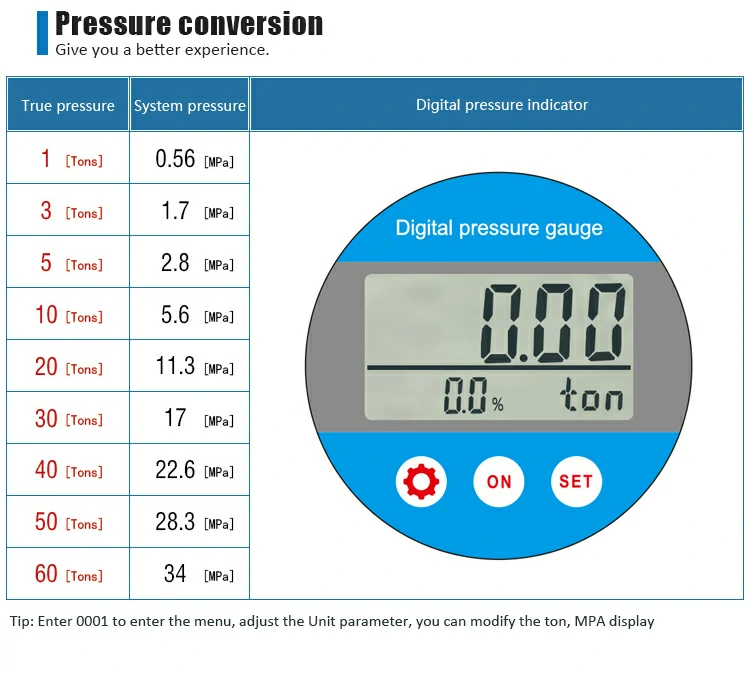
| True pressure | System pressure |
| 1 Tons | 0.56 MPa |
| 3 Tons | 1.7 MPa |
| 5 Tons | 2.8 MPa |
| 10 Tons | 5.6 MPa |
| 20 Tons | 11.3 MPa |
| 30 Tons | 17 MPa |
| 40 Tons | 22.6 MPa |
| 50 Tons | 28.3 MPa |
| 60 Tons | 34 MPa |
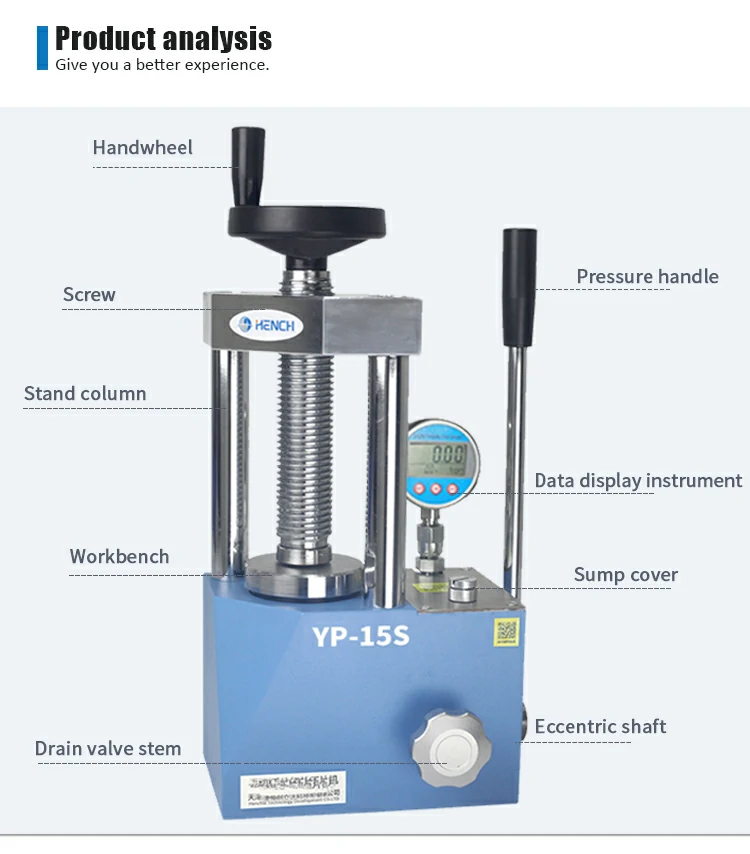
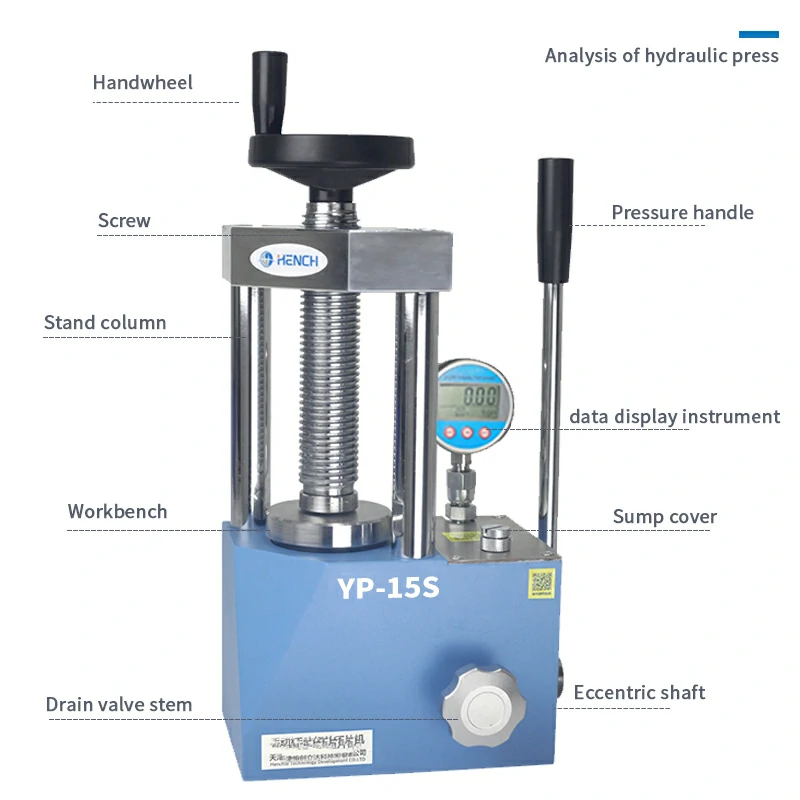
Product Architecture & Component Breakdown
-
Main Lead Screw: Precision-threaded vertical screw for stable mold positioning and secure clamping.
-
Top Handwheel: Ergonomic top handle for effortless manual adjustment of the lead screw.
-
Guidance Pillar: High-strength support columns ensuring structural rigidity and uniform force distribution.
-
Working Workspace (Workbench): Flat, heavy-duty pressing table designed to accommodate various laboratory sample molds.
-
Digital Pressure Indicator: High-precision LCD digital readout displaying real-time pressure values.
-
Hydraulic Operation Handle: Smooth manual lever pump for stable and controlled pressurization.
-
Reservoir Cover: Sealed cap for the internal hydraulic oil tank to prevent contamination.
-
Release Valve Stem: Precision rotary valve for safely venting and releasing system pressure.
-
Eccentric Shaft: Core internal drive mechanism for the hydraulic pumping system.
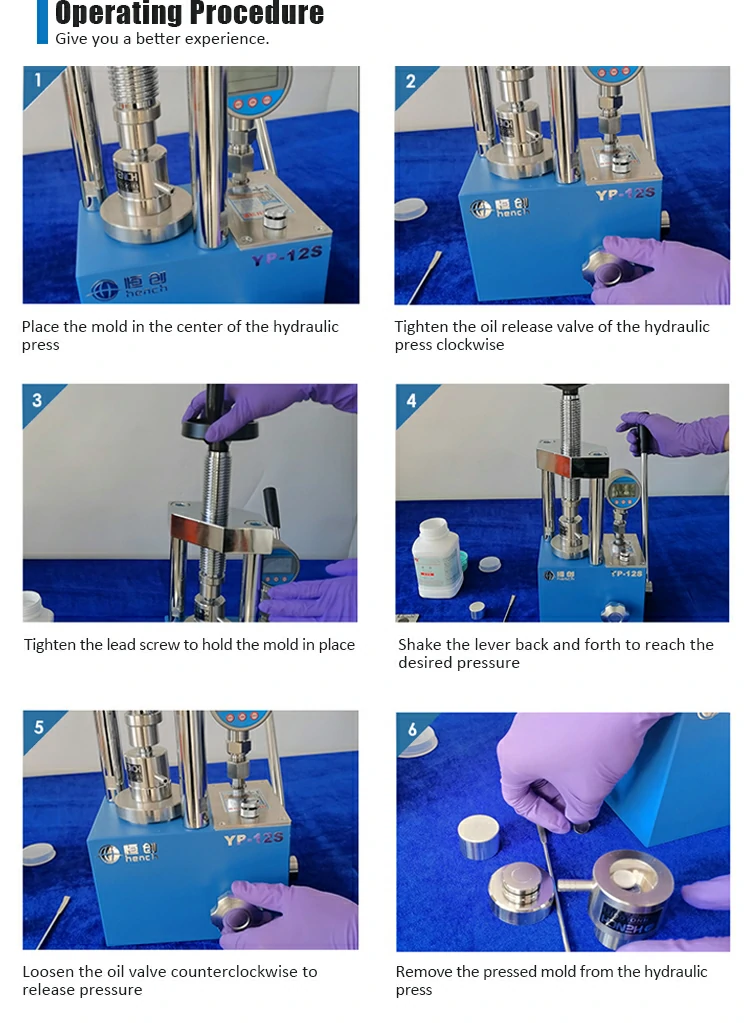
Step-by-Step Operating Guide
-
Step 1: Mold Positioning — Center the sample mold precisely onto the lower platen/workspace of the hydraulic press.
-
Step 2: Valve Sealing — Rotate the release valve stem clockwise to fully seal the hydraulic circuit.
-
Step 3: Screw Securement — Turn the top handwheel downward to lower the lead screw, securely clamping the mold in position.
-
Step 4: Pressurization — Pump the operation handle back and forth smoothly until the digital indicator reaches your target pressure.
-
Step 5: Pressure Release — Slowly turn the release valve stem counterclockwise to safely vent and release the system pressure.
-
Step 6: Sample Extraction — Retract the lead screw and carefully retrieve the processed mold for sample analysis.
| Actual Load (Tons) | Hydraulic Pressure (MPa) |
| 1 Tons | 0.56 MPa |
| 3 Tons | 1.7 MPa |
| 5 Tons | 2.8 MPa |
| 10 Tons | 5.6 MPa |
| 20 Tons | 11.3 MPa |
| 30 Tons | 17 MPa |
| 40 Tons | 22.6 MPa |
| 50 Tons | 28.3 MPa |
| 60 Tons | 34 MPa |
Pressure Conversion Matrix
Pro Tip: Input code 0001 to access the system menu, where you can easily configure and switch pressure units between Tons and MPa based on your testing requirements.
4. Core Internal Components
- Main Assembly & Base:
- Top Crossbeam (1 Top plate)
- Primary Hydraulic Cylinder (4 Oil cylinder)
- Return Spring (5 Pullback spring)
- Base Hydraulic Manifold (7 Mainboard)
- Pressure Release Valve Stem (8 Drain valve stem)
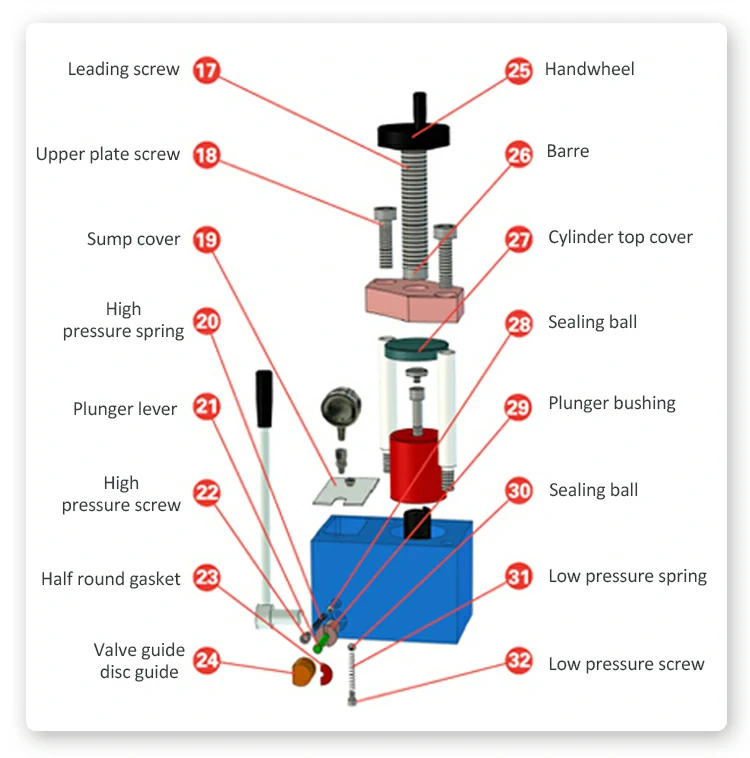
-
Precision Internal Mechanism:
- Main Lead Screw (17 Leading screw)
- Internal Guide Pin / Tie Rod
- Cylinder Head / Top Cover (27 Cylinder top cover)
- Plunger Guide Sleeve (29 Plunger bushing)
About Hench Technology Co., Ltd.
Hench is among the leading hydraulic press suppliers based in Tianjin, China, specializing in precision lab presses and related equipment. Hench combines strong engineering, rigorous quality control, and responsive service. Their equipment supports research labs, industrial testing, and academic institutions, offering both durability and accuracy across product lines.