



Operation of The Laboratory Electric Hydraulic Machine
December 9, 2025
Pressed powder machines are widely used in fields such as new materials, superconductivity, powder ceramics, new power sources, batteries, building materials, and metallurgical powders. They can be used in conjunction with calcium iron analysis, infrared spectroscopy (IR), and X-ray fluorescence (XRF) analysis instruments. This machine has a compact structure, is lightweight, has a fast pressure rise, is easy to operate, safe and convenient to use. By selecting specific pressing dies, potassium bromide (KBr), sodium chloride (NaCl), cement and other powder materials can be pressed into various test pieces, cylinders, irregular shapes or combinations for analysis and research. The typical model is: HDP-30S. At the same time, this machine is also applicable to other working environments that require corresponding pressure and can be used as a press machine to test the pressure resistance of various objects, etc.
The hydraulic machine has undergone comprehensive improvement and upgrade, achieving the dual functions of manual and electric operation; it adopts an imported pressure sensor sealing structure, with an integrated non-sealed technology for the oil tank, oil cylinder, main board, and piston, resulting in better sealing effect and eliminating the previous oil leakage phenomenon and the problem of insufficient upper pressure accuracy; it has a larger working space and more reliable pressure stability, among other advantages.
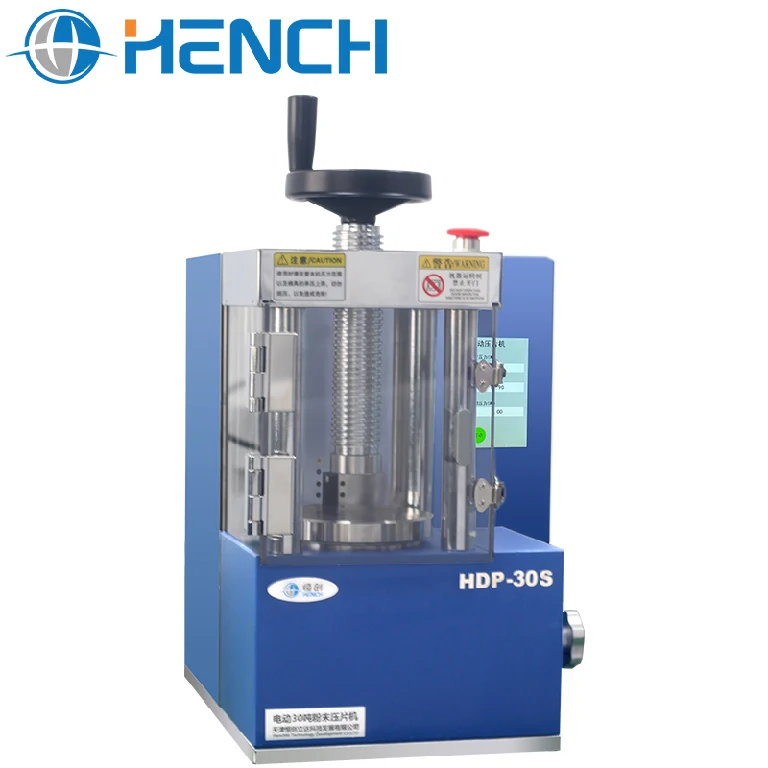
Compared with the manual tablet press, this hydraulic press significantly improves its working efficiency. The 4.3-inch touch LCD screen directly displays the pressure tonnage. Combined with specific dies, it can press various powder samples into test pieces for scientific research, analysis, and detection. It can also be used as a regular pressure machine and has extremely wide applications. The equipment adopts an operation mode combining electric pressure application and manual pressure release/replenishment. The overall structure design reduces the number of sealing points to enhance maintenance convenience.
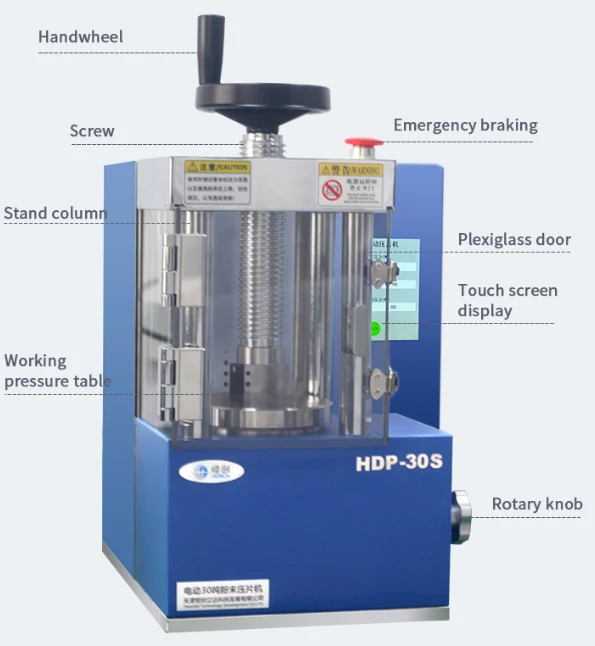
Parameter of apparatus
| Model | HDP-20S | HDP-30S | HDP-40S | HDP-60S |
| Pressure limit | 0.2-20.0T | 0.3-30.0T | 0.5-40.0T | 1.0-60.0T |
| Precision range | 0.1T | |||
| Oil cylinder | 95mm | 110mm | 130mm | 150mm |
| Travel of piston | 30mm | 40mm | 50mm | |
| Pressurization method | Electrically powered PCB program buffer pressurization, automatic pressure replenishment, manual pressure relief | |||
| OSD | 4.5-inch capacitive touch LCD screen / English interface can be set up | |||
| Pressure stability | ≤1Mpa/10min | |||
| Massive structure | Forging process, integrated structure (equipped with 68-grade wear-resistant hydraulic oil) with an overall integrated structure, no pressure loss, no oil leakage | |||
| Limiting function | The hydraulic cylinder automatically releases pressure when it exceeds the limit height. | |||
| Safety protection | / | Side-opening 5mm high-strength plexiglass protective door, sliding latch door lock, safe and convenient | ||
| Passive safety | Program pressure mechanical fault error stop function, leakage protection + emergency stop switch | |||
| Number of columns | Four pieces | |||
| Workbench diameter | Ф105mm | Φ128mm | Φ148mm | Φ168mm |
| Dwell time | No time limit (N seconds) | |||
| Way of setting up | Touchscreen allows direct modification of setting values (convenient and fast) | |||
| Device power supply | 220V(50Hz/60Hz)/Customizable110V | |||
| Equipment power | 550W | |||
| Effective space | 80x80x150mm | 104x104x160mm | 145x145x180mm | 185x185x200mm |
| Size | 240x390x565mm | 295x390x605mm | 350x390x625mm | 370x390x685mm |
| Weight | 70.5Kg | 73Kg | 111Kg | 142Kg |
| Explain | The press machine can be customized or improved according to user requirements. Various circular, square, irregular and battery molds within the pressure range can be optionally equipped. | |||
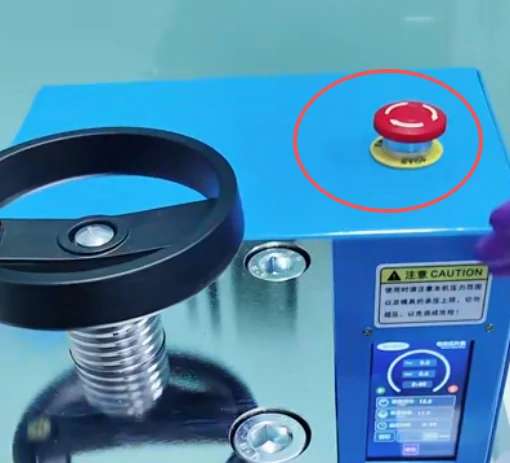
It is equipped with an emergency stop switch. When it is activated during transportation, it will not apply pressure when you receive it. You need to loosen and lift the emergency stop switch to the left. It has an electric leakage protection function. In case of emergencies, such as an emergency power cut in the laboratory or excessive load operation of the press machine, please press the red button. The hydraulic press is equipped with a program pressure mechanical fault error emergency stop function. If the set pressure exceeds the tonnage of the press machine, it will not work.
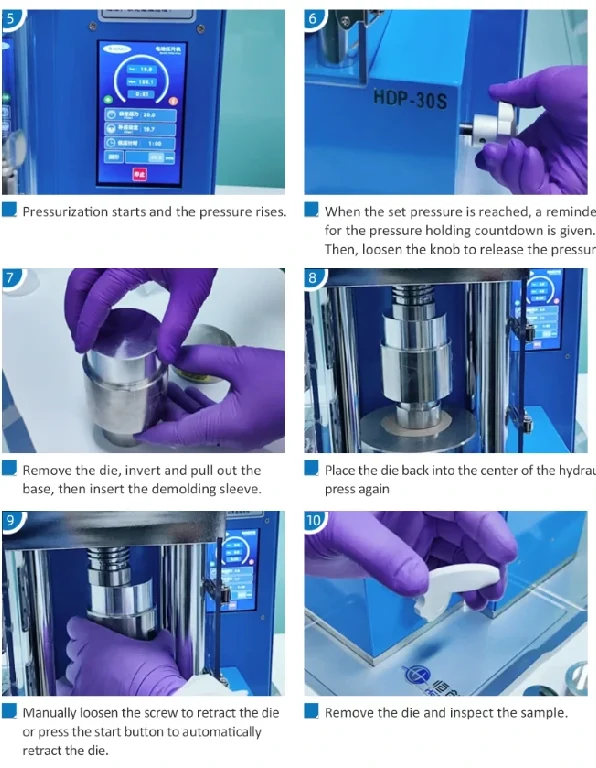
Operating steps
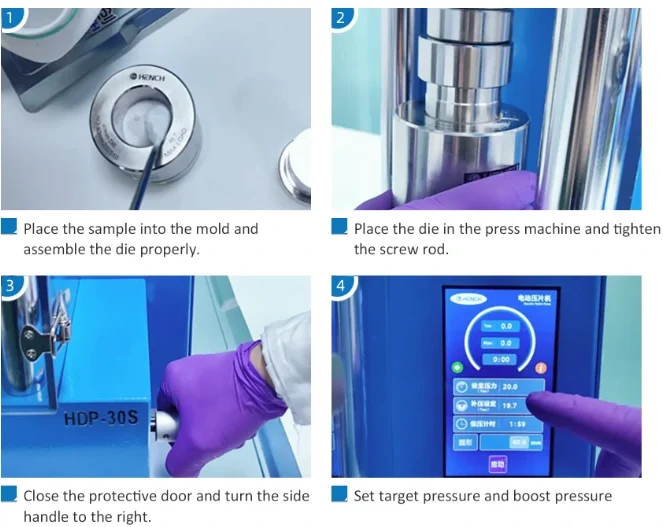
Safety Precautions for Hydraulic Press Usage
1. Check if the power cord is damaged or leaking electricity to ensure personal safety. It is recommended to cut off the power supply when not in use for a long time.
2. When applying pressure, place the mold at the center of the screw rod head, slightly rotate the screw rod, and press against the pressure rod cap.
3. When using, try not to exceed the maximum pressure range of the machine. Otherwise, it will affect the service life of the press machine and even cause danger.
4. Do not exceed the maximum stroke of the cylinder. Otherwise, it will cause the spring to deform and the cylinder to fail to return to the initial position.
5. It is recommended to use 68 anti-wear hydraulic oil [high-pressure resistant] type for the hydraulic press.
6. After each test, promptly clean the residual substances on the machine surface. Regularly add lubricating oil or vaseline to the screw rod to prevent the screw rod from rusting and affecting usage.
7. If there are any problems during use, you can call the service hotline below. Engineers will provide telephone or video guidance for operation.
Tianjin HENCH specializes in the research and production of Fourier infrared spectrometers, infrared accessories and other infrared analysis equipment, laboratory powder/electric/automatic hydraulic presses, manual/automatic heating hydraulic presses, isostatic/fluorescent hydraulic presses, button battery sealing machines, circular/square/solid battery/irregular pressure plate dies and other laboratory equipment. These are widely used in industries such as catalysis, silicate, batteries, ceramics, cement and powder metallurgy.