



FTIR Accessories
Hench delivers high-performance Fourier Transform Infrared (FTIR) spectroscopy solutions for research, industrial analysis, and quality control. As a trusted infrared spectrometer manufacturer, we provide reliable laboratory instruments designed for accuracy, efficiency, and long-term use. Contact us to get the latest FTIR accessories prices.
-
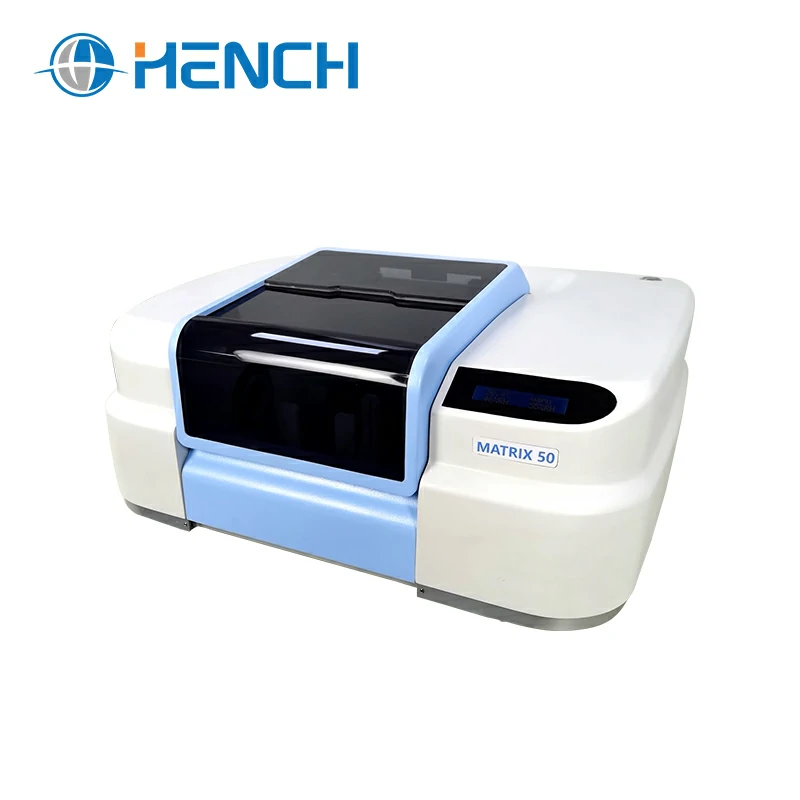
MATRIX-50 Fourier Transform Infrared FTIR Spectrometers
Product Description
Spectral region:7800~-350 cm-1
Resolution ratio:Thanl.0cm-1
Wavenumber accuracy:≤0.01cm-1
SNR:40000:1
Beam splitter:Germanium plating on KBr substrate
light source:High energy, high efficiency,long life ceramic light source
Interferometer:Non-orthogonal Michelson
Acceptor:High sensitivity DLATGSreceiverwith moisture-proof film
Support system:Windows system
-
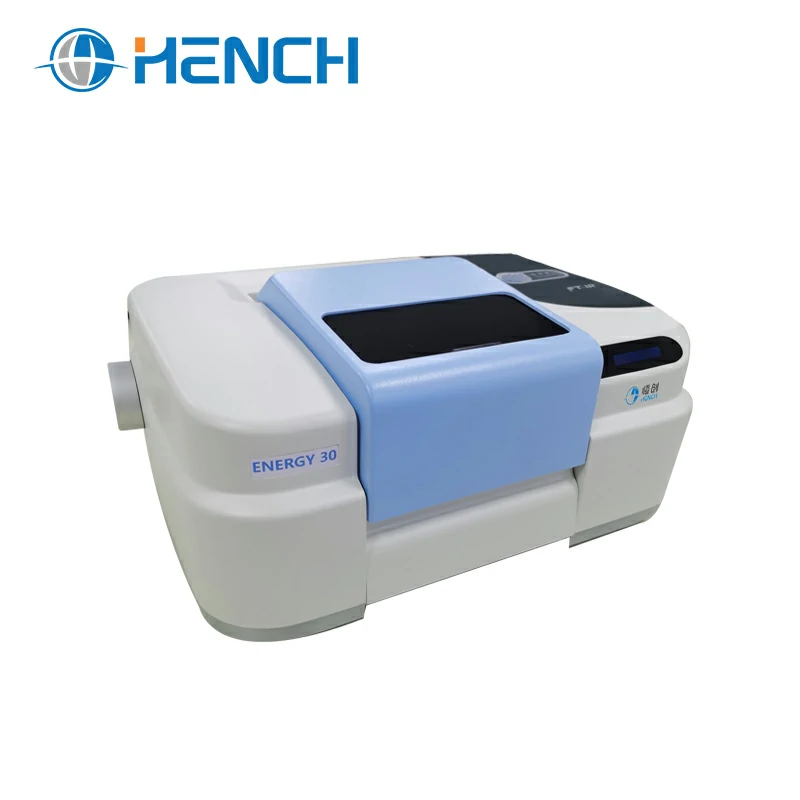
ENERGY 30 Fourier Transform Infrared Spectrometers FTIR
Product Description
Spectral region:7800~350cm-1
Resolution ratio:Than1.0cm-1
Wavenumber accuracy:≤0.01cm-1
SNR:40000:1
Beam splitter:Germanium plating on KBr substrate
light source:High energy, high efficiency, long life ceramic light source
Interferometer:Non-orthogonal Michelson
Aeeeptor:High sensitivity DLATGS receiver with moisture-proof film
Size:450mmx350mmx210mm
Weight:13kg
Data transfer:USB2.0/3.0
Support system:Windows XP/Vista/7/8/8.1/10
-
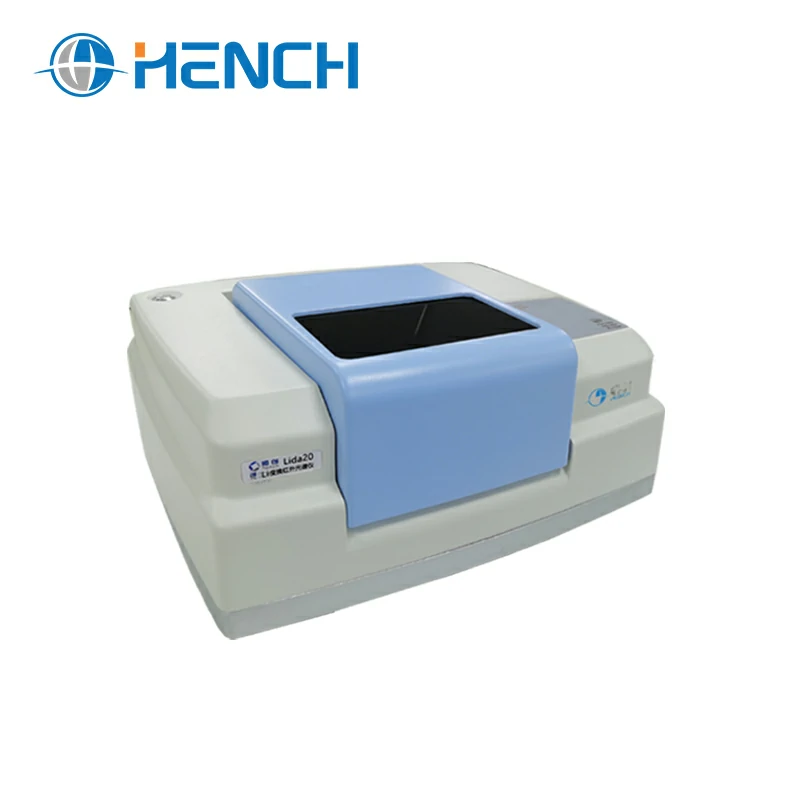
LIDA-20 Fourier Infrared Spectrometer
Spectral region:800~350cm-1
Resolution ratio:Than1.0cm-1
SNR:15000:1
Beam splitter:Germanium plating on kBr substrate
Light source:High energy,high efficiency, long lifeceramic light source
Interferometer:Michelson interferometex at 30 degreesincidence
Accentor:High sensitivity DLATGS receiverwithmoisture-proof film
Size:450mmx350mmx235mm
Weight:14. 2kg
Datatransfer:USB2.0/3.0
Support system:WindowsXP/7/8/Vista
Why Choose Hench FTIR Spectrometers?
Achieving a high-quality spectrum in Fourier Transform Infrared (FTIR) spectroscopy begins with perfect sample preparation. Our 30 Ton Electric Laboratory Press is engineered to deliver the precision and stability required for creating flawless KBr pellets and powder samples.
Unlike traditional manual presses, this automatic hydraulic press utilizes a micro-processed control system to eliminate human error. The precision screw and stand column design ensure that force is applied perfectly perpendicular to the pellet die, preventing sample cracking and ensuring maximum spectral clarity. With its compact benchtop footprint, it is the ideal powerhouse for pharmaceutical R&D, polymer testing, and materials science laboratories.
Key Advantages of Hench FTIR Instruments
-
Intelligent Pressure Control: Equipped with a digital touch-screen interface, allowing users to set and monitor exact pressure loads up to 30 Tons with high repeatability.
-
Optimized for FTIR/XRF: Specifically designed to produce high-quality, transparent KBr pellets and uniform powder discs for spectroscopic analysis.
-
Automatic Dwell & Release: Features a programmable pressure-holding timer to ensure sample density consistency and automatic pressure release for efficient workflow.
-
Enhanced Lab Safety: A built-in high-impact Plexiglass safety shield and an Emergency Brake button provide multi-layer protection for laboratory personnel.
| Feature | Specification |
| Maximum Pressure | 30 Tons (Adjustable from 1-30T) |
| Operation Mode | Electric / Automatic |
| Display | High-Resolution Digital Touch Screen |
| Safety Guard | High-Transparency Plexiglass Door |
| Emergency Stop | Instant-Response Braking System |
| Compatibility | Standard 13mm KBr Die Sets, XRF Dies |
| Power Supply | 110V/220V AC, 50/60Hz |
Core Applications of FTIR Spectroscopy
FTIR spectroscopy is one of the most widely adopted analytical techniques across industries due to its flexibility, speed, and ability to provide both qualitative and quantitative data. Below are key application areas where Hench FTIR instruments excel.
Materials Science & Polymer Characterization
FTIR spectroscopy is essential for characterizing polymers, composites, coatings, and advanced materials. The technique identifies functional groups, monitors chemical changes during processing, detects additives or contaminants, and supports research into material modification and performance.
Typical uses include:
- Polymer identification and comparison
- Monitoring curing processes
- Detecting degradation products
- Evaluating surface treatments
Chemical and Petrochemical Industry
Chemical manufacturers rely on FTIR for verifying raw materials, intermediates, and finished products. It enables rapid identification of functional groups, confirmation of synthesis pathways, and quality assurance throughout production. FTIR also supports process monitoring and troubleshooting.
Key applications:
- Functional group analysis
- Reaction monitoring
- Contaminant detection
- Batch verification
Pharmaceutical Research and Quality Control
In pharmaceutical laboratories, FTIR plays a crucial role in raw material authentication, formulation analysis, and quality control. It confirms the chemical identity of active pharmaceutical ingredients (APIs), excipients, and polymorphs, ensuring compliance with regulatory standards.
Use cases include:
- API and excipient screening
- Polymorph characterization
- Tablet coating evaluation
- Residual solvent checks
Environmental Monitoring and Air Quality
FTIR enables the detection and quantification of air pollutants, greenhouse gases, and volatile organic compounds (VOCs). It can monitor emissions, track changes in atmospheric composition, and analyze environmental samples with minimal sample preparation.Typical environmental uses:
- Air quality monitoring
- Stack gas analysis
- Greenhouse gas quantification
- Water quality evaluation
Food and Agriculture
FTIR spectroscopy is increasingly applied in food science to rapidly assess nutritional content, detect adulterants, and ensure product authenticity. For agricultural products, it helps monitor composition, detect contaminants, and support quality certification. Applications include:
- Fat, protein, and carbohydrate profiling
- Detection of adulterants like melamine
- Monitoring food processing consistency
Forensics and Criminal Investigations
Forensic laboratories use FTIR to analyze evidence with minimal sample destruction. It identifies polymers, paints, fibers, body fluids, and trace residues, providing critical data for crime scene reconstruction and legal proceedings.Examples:
- Paint chip identification
- Fiber analysis
- Drug residue detection
Research and Academia
FTIR spectroscopy supports fundamental research in chemistry, physics, and biology. Its ability to provide molecular information makes it a staple in studies of chemical reactions, biomolecules, and structural analysis.
Hench FTIR Product Line
Below is a representative table outlining common models within the Hench FTIR series, designed to meet different analytical and budgetary needs. Actual configurations may vary and can be customized based on user requirements.
| Model | Description | Key Features | Recommended Use Cases |
| HC-FTIR-E30 | Entry-Level Benchtop FTIR | Standard spectral range, easy user interface | Teaching labs, basic analysis |
| HC-FTIR-P45 | MidRange Production FTIR | Higher sensitivity, extended dynamic range | Quality control, materials testing |
| HC-FTIR-L60 | Research-Grade FTIR | Advanced software & accessories | R&D labs, polymer analysis |
| HC-FTIR-R90 | Industrial FTIR with Custom Options | Modular sampling, enhanced detectors | Process monitoring, industrial QC |
Installation, Training, and Support
Hench Technology offers comprehensive support for FTIR installations, including system setup, user training, and ongoing technical assistance. Customized method development and advanced analytical workflows are available to ensure optimal performance and application success.