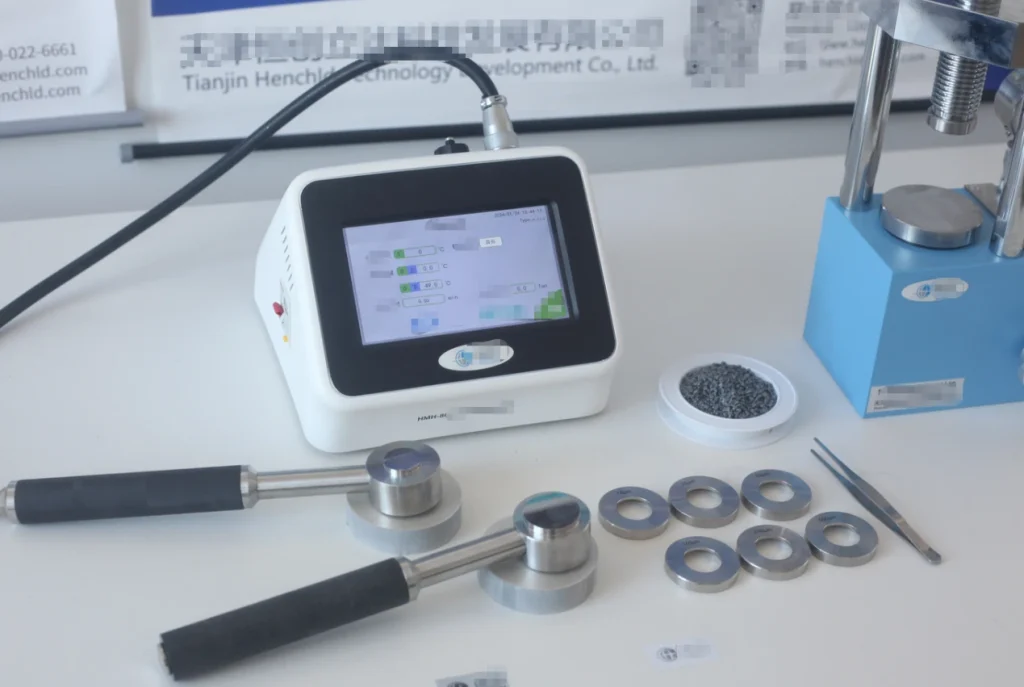
How many methods of sample preparation for infrared spectroscopy do you know?
November 20, 2025
Infrared spectroscopy analysis is one of the bases for qualitative identification. To obtain a high-quality spectrum, the correct sample preparation method must be used. When choosing a sample preparation method, the following two aspects should be considered.
Actual situation of the tested sample
For liquid samples, the sample preparation method can be selected based on factors such as boiling point, viscosity, transparency, hygroscopicity, volatility, and solubility. For example, if the boiling point is low and the volatility is high, only a fixed liquid cell can be used for sample preparation. For liquid samples with good transparency, no hygroscopicity, and appropriate viscosity, the liquid film method can be chosen. This method is simple, easy to succeed, and is the most commonly used method for general liquids. Liquid samples that can be dissolved in common infrared solvents can be prepared using detachable liquid cells. For viscous liquids, they can be heated (using an infrared heating mold) and pressed into a film between two wafers, or dissolved in a solution and applied to the wafer surface. After volatilization to form a film, the test can be conducted.
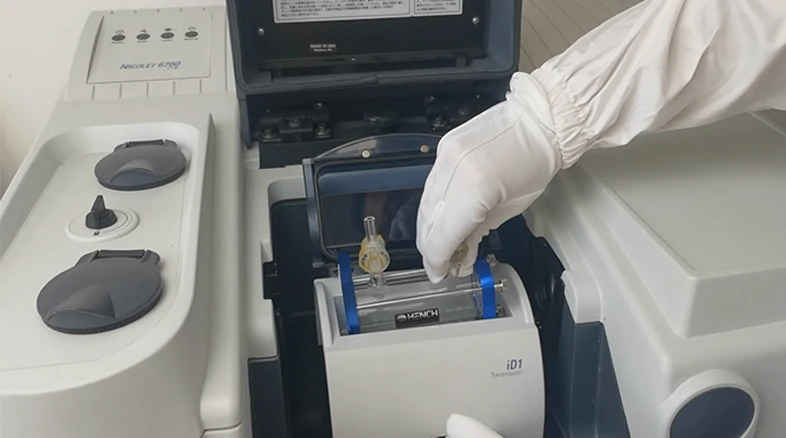
The commonly used sample preparation methods for solid samples are the pressing method and the paste method. Any sample that can be ground finely and has a light color can be prepared using these two methods. If there is a suitable solvent, the solution preparation method can also be selected, but it is not commonly used because the resulting spectra have interference from the solvent’s absorption, and the sample preparation is more troublesome. Low-melting-point solid samples can be prepared by heating them into a film between two wafers. Gas samples are usually prepared using the conventional gas sample preparation method. Long-path gas absorption cells are suitable for situations where the concentration is low but there is sufficient gas sample. The following is a 100mm path gas cell:
Experimental Objectives
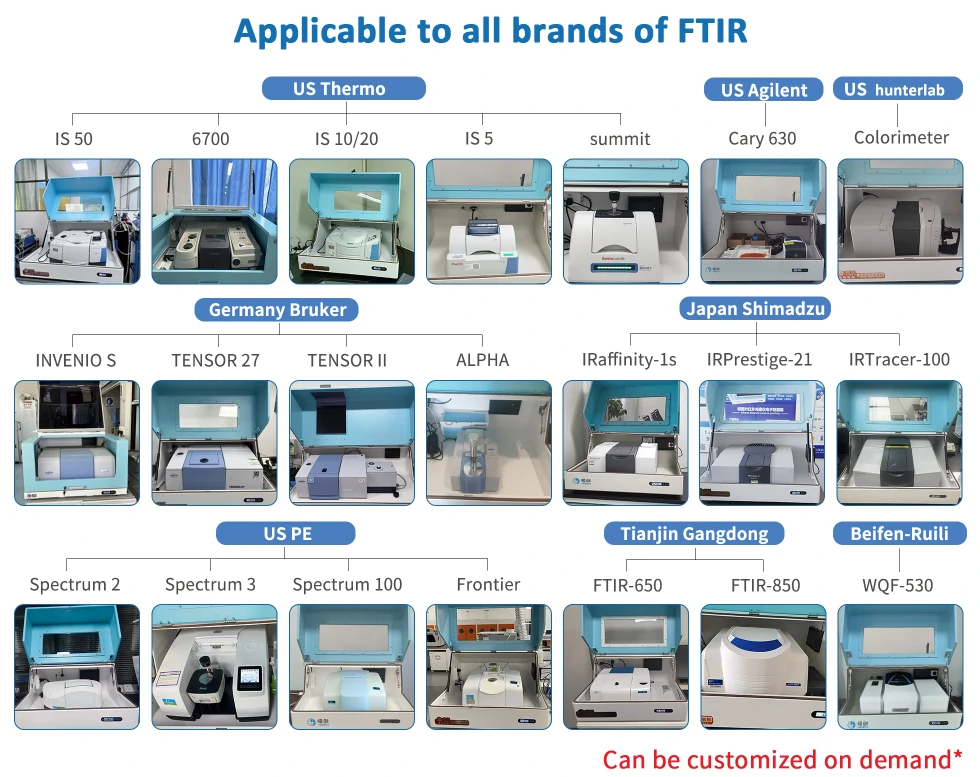
For example, in an infrared spectroscopy experiment, when one desires to obtain carbon-hydrogen information, the paraffin oil paste method must never be used. If there are hydroxyl groups in the sample (with a water peak), the pressing method should not be employed. If the observation of inter-conformational phenomena, or the study of the bonding degree of inter- and intramolecular hydrogen bonds is required, generally, the solution-based sample preparation method should be adopted. Some solid samples that are prone to moisture absorption can use the paste method, and the sample should be prepared under dry conditions. The purpose is to wrap the sample particles with paraffin oil to isolate the moisture in the atmosphere, achieving the goal of preventing moisture absorption. To prevent the preparation of samples and the instruments and their accessories from getting damp, our company has specially developed a moisture-proof box (MRD series) that is compatible with global infrared spectrometers.
- Potassium bromide tablet pressing method
This is the most commonly used method. Since potassium bromide is transparent and has no absorption in the mid-infrared region, it is the best carrier. However, in reality, some batches of analytical-grade potassium bromide do have impurity absorption in the mid-infrared region. To prevent impurities from interfering, when purchasing chromatographically pure potassium bromide is not available, one can buy some crushed potassium bromide single crystals or analytical-grade potassium bromide, perform recrystallization, and test its absorption in the mid-infrared region before using it.
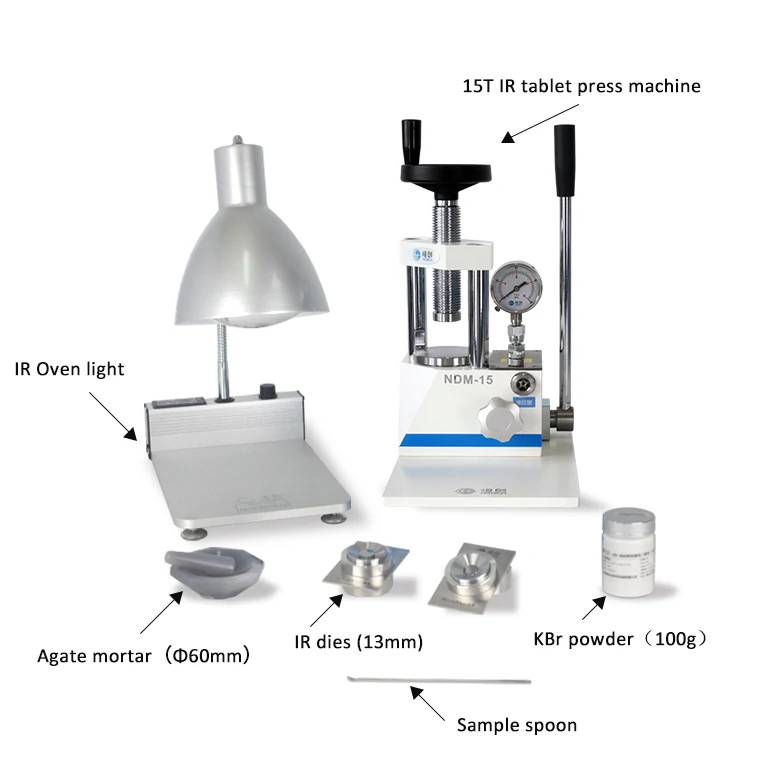
The potassium bromide tabletting method is simple to operate and is suitable for solid powder samples. Without the need for common tools, a set of small files should also be prepared. Solid powder can be directly mixed with potassium bromide powder for grinding. For already formed polymer materials, small files can be used to scrape them into fine powder and then grind. Generally, 1-2 mg of the sample is added to 100-200 mg of potassium bromide, and it is ground in a agate mortar to form a fine powder of 1-2 g. During grinding, a small stainless steel spatula is used to scrape the sample to the center of the mortar to ensure finer grinding and avoid uneven particles causing scattering, resulting in an uneven baseline.
Solid samples can generally be pressed into tablets within 5-15 minutes. The pressure of the oil press is usually 6-12 tons, and the press time should be maintained for at least 1 minute to obtain transparent tablets. Since potassium bromide is highly prone to absorbing moisture, it should be fully dried under an infrared lamp before tabletting. Otherwise, absorption peaks of water will appear at 3300 cm-1 and 1640 cm-1. Some tabletting machines have a vacuum function, but the operation is more complex. If the high-molecular material is not powder and cannot be directly tabletted, then the plasticizer can be extracted to make it lose elasticity and become harder, or low-temperature grinding can be used to prepare the powder sample in advance. For example, rubber cannot be hot-pressed, and this method is often adopted.
When identifying trace samples, such as certain small amounts of dye samples, tabletting is impossible. At this time, a hard paper sheet can be cut into the size of the sample ring, with a small hole in the center, and the ground potassium bromide powder mixed with the sample is placed in the small hole for tabletting. This method has two advantages. One is that it saves samples, especially for the identification of separated and purified trace samples; the other is that the paper sheet comes into direct contact with the stainless steel mold, and the paper sheet fibers are relatively coarse, making it less likely to fall off during tabletting.
Some samples are sticky, and the potassium bromide tablets stick to the stainless steel mold during tabletting, making it difficult to remove. Without the ability to perform spectral scanning, only a small amount of ground potassium bromide is placed in the mold again for tabletting. The resulting tablets are slightly thicker, resulting in an uneven baseline or a higher background absorption in the obtained spectral graph, but only technical processing is required to obtain a better spectral graph. For example, for certain colorant samples, this sample preparation method can be adopted. Some emulsion samples can be smeared on a glass slide after demulsification, dried, and then ground with a scraper.
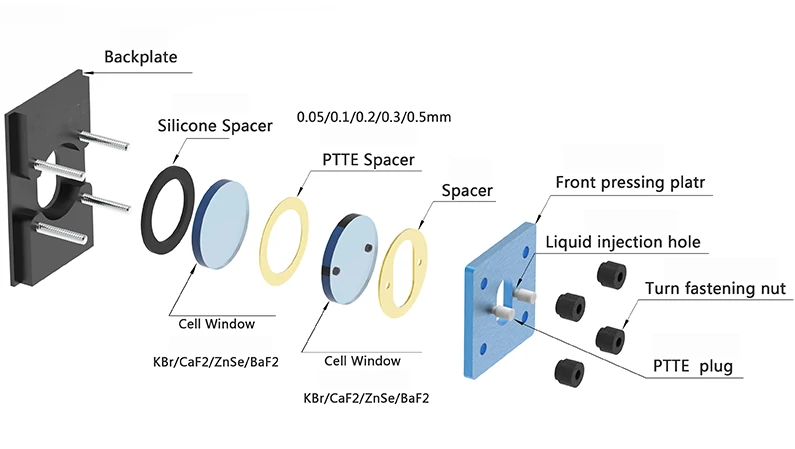
- Window Film Method
A thin liquid film is applied onto a halide crystal plate, and the sample can be directly analyzed in an infrared spectrometer. If the viscosity of the liquid sample is very low or the volatility of the solvent is not significant, it can be measured between two halide crystal plates. Volatile liquids can be measured using a fixed liquid cell. The most commonly used halide crystal plate is sodium chloride. The fixtures are liquid cell window plates and cell window fixtures. The application range is 700 – 5000 cm-1. For samples that require the observation of absorption peaks at 350 – 700 cm-1, the bromide potassium crystal plate method can be used. The thickness of the film should not be too thick, otherwise, a head-on peak will occur. For unconsolidated viscous resins, inks, plastics or rubbers, or the extract of plasticizers and the pyrolysis liquid of thermosetting resins, this method is suitable. The window plates of the liquid cell can be KRS-5 or CaF2. KRS-5 can be used from 250 cm-1 to 5000 cm-1, but KRS-5 is toxic and should not be touched by hand. CaF2 is cheaper, but its transmittance limit is 1200 cm-1, and the range below 1200 cm-1 cannot be used.
Most of the crystals are prone to deliquescence. They should be stored in a desiccator when not in use. When using, the fixing screws should be tightened diagonally to avoid uneven stress and damage to the crystal. After use, the crystal should be cleaned with a low-boiling-point solvent and then stored in a desiccator. The window film method is rarely used for polymer samples because most organic solvents have strong absorption. Only a few solvents have less absorption, such as carbon tetrachloride suitable for 1350 – 4000 cm-1, and carbon disulfide suitable for 200 – 1350 cm-1. However, only a few non-polar polymers can dissolve in these two solvents. To eliminate the absorption bands of the solvent in the sample solution, compensation technology can be used. A pure solvent should be placed in the reference cell, and the amount of solvent in the reference cell should be the same as that in the sample cell, but the operation is more difficult. In Fourier infrared spectrometers, the difference spectrum technique can be used to solve the problem of solvent absorption bands.
- Reflection Method
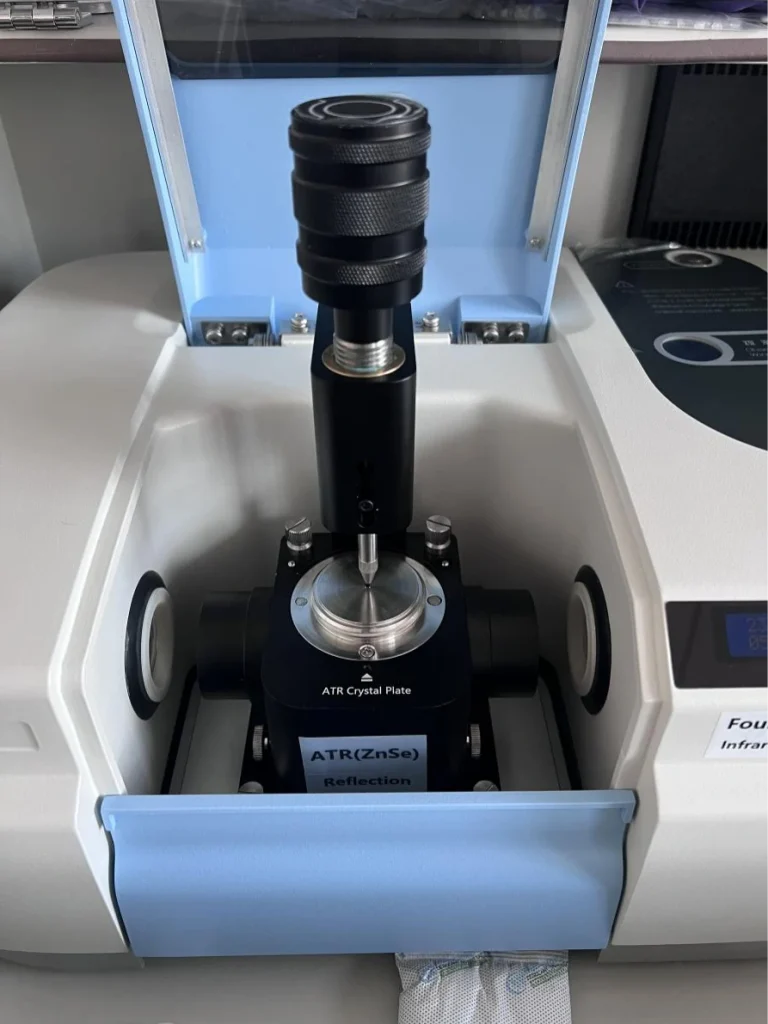
Some of the sample coatings are very thin and thus not suitable for the above-mentioned method. In such cases, the best approach is to use the Attenuated Total Reflection (ATR) method. This method is widely used and does not require complex separation during application. It does not damage the sample and allows for direct infrared spectroscopy analysis. We have used this method multiple times to analyze the surface and back layers of inkjet-printed materials, and the results were quite satisfactory. For example, tapes, certain smooth-textured textiles, paint on metals, and sheet-like rubber can all be analyzed using the ATR method. The main used crystals include KRS-5 and ZnSe. KRS-5 is a compound of thallium. Safety precautions should be taken when using it. Powder samples can be stuck to the crystal surface with tape for testing. Additionally, powder samples can also be ground after being added with liquid paraffin.
- Hot pressing method
When studying the changes in crystallinity of certain polymers using infrared spectroscopy, the hot-pressing film-forming method is often employed. During the melt hot-pressing film-forming process, two stainless steel molds with smooth surfaces are used. Mica sheets or aluminum foil sheets are used as support materials to control the film thickness. During the operation, first, the mica sheets or aluminum foil sheets with the required thickness are placed around the pressing surface of the mold, with the sample placed in the middle, and then all are placed on an electric furnace for heating until softening or melting. Next, the other half of the mold is pressed onto the sample, and the mold is carefully clamped onto the oil press machine using tongs for pressure application. After cooling, the film can be removed directly for testing.
Choosing the appropriate experimental accessories has a direct impact on the success and accuracy of the experiment. When making the selection, a comprehensive consideration is necessary to ensure that the chosen materials can meet the actual requirements. If you have any technical questions, contact us for professional consultation.