Background Interference in FTIR Analysis: Sources and Effective Elimination Methods
enero 12, 2026
In Accesorios FTIR, background interference has a direct impact on baseline flatness, peak shape accuracy, and the reliability of both qualitative and quantitative analysis. Uncontrolled interference can obscure weak absorption bands, distort spectral features, and compromise reproducibility, particularly in trace or high-precision measurements.
To support routine laboratory operation and troubleshooting, the most common sources of background interference and their corresponding mitigation strategies are summarized below.
Table 1. Common FTIR Background Interference and Practical Countermeasures
| Interference Category | Typical Spectral Features | Primary Cause | Recommended Action |
|---|---|---|---|
| Atmospheric H₂O | Broad band near 3400 cm⁻¹; peak at 1640 cm⁻¹ | High ambient humidity | Background scan synchronization; dry gas purging; humidity control |
| Atmospheric CO₂ | Peaks at 2360, 2340, 667 cm⁻¹ | CO₂ concentration fluctuations | Background subtraction under identical conditions |
| Impure or moist KBr | Water and carbonate absorption | Undried or low-purity KBr | Use ≥99.9% KBr; drying and desiccated storage |
| Window contamination | Residual or random peaks | Sample residue on windows | Thorough cleaning and proper storage |
| Sample impurities | Additional absorption bands | Moisture, solvents, additives | Sample purification and drying |
| Particle scattering | Baseline elevation, peak broadening | Oversized particles | Fine grinding or mull method |
| Instrument instability | Baseline drift, noise | Aging source or detector issues | Maintenance, calibration, parameter optimization |
This table is intended as a quick diagnostic reference for FTIR users encountering abnormal baselines or unexpected absorption features.
1. Atmospheric Component Interference (Most Common)
Source of Interference
Atmospheric water vapor (H₂O) and carbon dioxide (CO₂) exhibit strong and characteristic infrared absorption bands:
- H₂O: Broad absorption near 3400 cm⁻¹ and a bending vibration around 1640 cm⁻¹
- CO₂: Strong absorption bands at 2360 cm⁻¹, 2340 cm⁻¹, and 667 cm⁻¹
These absorption features frequently overlap with sample peaks, significantly affecting the analysis of low-concentration or moisture-sensitive samples.
Soluciones
Synchronized Background and Sample Scanning
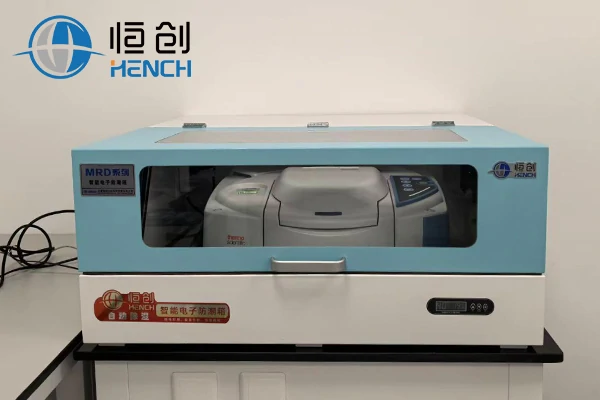
Before each sample measurement, a background scan should be collected under identical environmental conditions using an empty optical path or a blank substrate. FTIR software then subtracts atmospheric H₂O and CO₂ contributions from the sample spectrum.
Purification of the Infrared Optical Path
- Continuously purge the optical path with dry, high-purity nitrogen or dry air
- Install desiccants such as anhydrous calcium chloride or molecular sieves and replace them regularly
Laboratory Environmental Control
- Maintain laboratory relative humidity below 50%
- Prevent moisture exposure of samples and optical components
- Minimize personnel movement near the instrument to reduce short-term CO₂ concentration fluctuations
2. Sample Carrier or Diluent Interference
Source of Interference
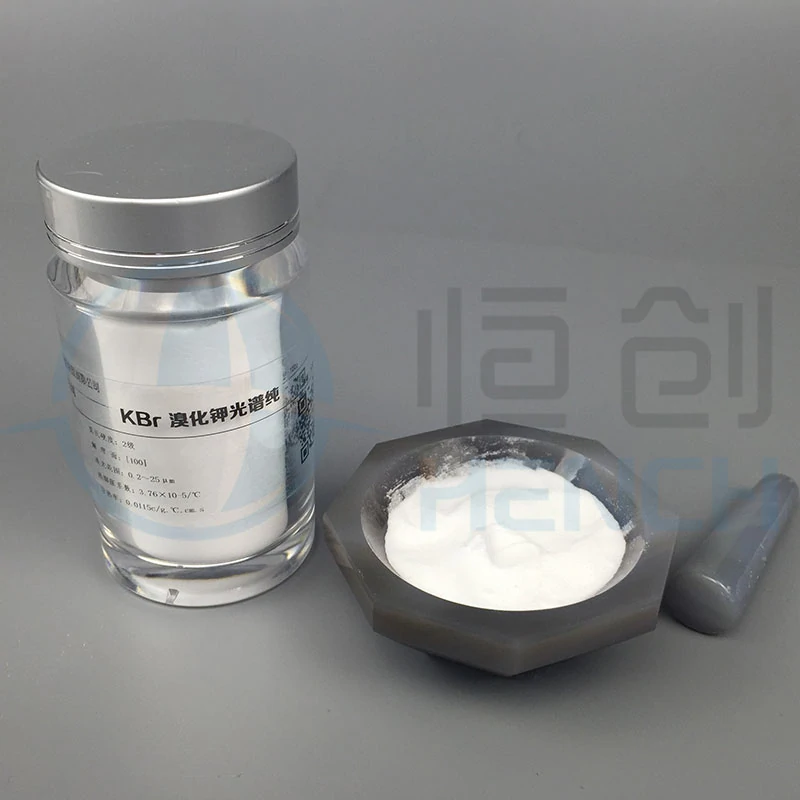
For solid samples analyzed using the KBr pellet method, insufficiently pure or moisture-contaminated KBr introduces unwanted absorption bands, particularly from water and carbonate impurities.
For liquid samples, poorly cleaned KBr or NaCl window plates may retain residues from previous samples, resulting in spectral contamination.
Soluciones
Selection of High-Purity Carrier Materials
- Use spectroscopy-grade KBr with a purity of ≥ 99.9%
- Dry KBr powder at 110 °C for at least 24 hours prior to pellet preparation
- For liquid cells, select window materials such as KBr, NaCl, or ZnSe based on sample polarity and solvent compatibility
Carrier Pre-treatment
- Grind dried KBr to a particle size below 2 μm to reduce scattering effects
- Clean window plates with anhydrous ethanol or acetone, dry thoroughly, and store in a desiccator
Blank Subtraction Method
Collect a background spectrum using a pure KBr pellet or a clean blank window plate to subtract the intrinsic absorption of the carrier material.
3. Interference Originating from the Sample Itself
Source of Interference
Sample Impurities
Moisture, residual solvents, plasticizers, or additives present in the sample can generate additional absorption peaks that interfere with functional group identification.
Light Scattering Effects
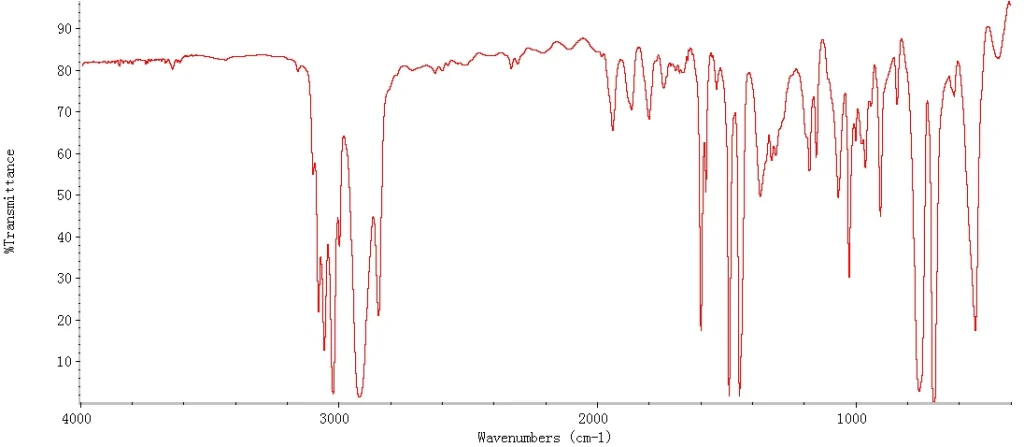
If solid sample particles are larger than the infrared wavelength, scattering occurs, leading to baseline elevation and peak broadening, particularly in the high-wavenumber region.
Soluciones
Sample Pretreatment and Purification
- Solid samples: Remove impurities via recrystallization, extraction, or distillation
- Liquid samples: Eliminate solvents using vacuum evaporation or dry with anhydrous sodium sulfate
- For water-containing samples, differential spectroscopy may be applied when analyzing regions outside water absorption bands
Reduction of Sample Particle Size
- Grind solid samples to particle sizes below 2 μm
- Alternatively, use the mull method with paraffin oil to minimize scattering
4. Instrument System Interference
Source of Interference
- Aging infrared light sources or power supply fluctuations causing baseline drift
- Detector noise due to temperature instability or contamination, particularly for MCT detectors
- Dust or residues on mirrors and beam splitters affecting optical transmission
Soluciones
Routine Instrument Maintenance and Calibration
- Regularly inspect and replace aging light sources
- Ensure stable power supply conditions
- Maintain detectors at specified operating temperatures; MCT detectors require liquid nitrogen cooling
- Clean optical components using lint-free wipes and absolute ethanol
Optimization of Measurement Parameters
- Increase the number of scans (e.g., 64 or 128) to improve signal-to-noise ratio
- Use a resolution of 4 cm⁻¹ for routine measurements to balance noise and peak clarity
Practical Takeaway
From an application perspective, effective control of FTIR background interference relies on a structured workflow:
Environmental control → Sample and carrier preparation → Background synchronization → Instrument optimization
Applying these measures systematically allows FTIR users to obtain stable baselines, well-defined absorption peaks, and reproducible spectra suitable for routine analysis and advanced research.