How to choose the right FTIR spectrometer?
November 17, 2025
Selecting the appropriate fourier transform infrared spectrometer requires a comprehensive consideration of multiple factors, including application requirements, technical parameters, budget, and subsequent maintenance, etc. The following are detailed steps and suggestions:
Clarify the sample type:
a. Sample types: Mainly divided into solid, liquid, gas, and special samples.
Solid samples usually require the pellet method (KBr) and ATR (attenuated total reflection) accessory.
Liquid samples need fixed or detachable liquid cells and ATR (suitable for high-viscosity liquids).
Gas samples require infrared gas cells (50/100 optical path).
b. Test purpose: Qualitative analysis of the sample (Fourier Transform Infrared Spectroscopy) is sufficient.
Technical parameter range:
Fourier Transform Infrared Spectrometer (FTIR): The mainstream choice, with high resolution (down to 0.5 cm⁻¹ or less), suitable for most laboratory applications. It is ideal for complex samples and wide-band analysis (such as 4000-400 cm⁻¹).
The main product of our company is ENERGY-30 FTIR. Its parameters are as follows (adjustable according to customer requirements):
| spectral region | 7800~350 cm-1 |
| resolution ratio | be superior to 0.5 cm-1 |
| Wave number accuracy | ≤0.01cm-1 |
| SNR | be superior to 40000:1 |
| beam splitter | KBr substrate coated with germanium |
| light source | Non-orthogonal Michelson interferometer high-energy, high-efficiency, long-life ceramic light source |
| interferometer | Non-orthogonal Michelson Interferometer |
| acceptor | High-sensitivity DLATGS receiver with moisture-proof film |
| data transmission interface | USB2.0(compatibility3.0) |
| support system | Windows |
| size | 450mm×360mm×230 mm |
| weight | 13Kg |
| equipment power | 39W |
Purchase Considerations
a. Examine the supplier:
By comparing the operating periods of different infrared spectrometer manufacturers, we can observe that the longer the operation period, the more frequent the research and updates, and the more complete the equipment will be. Therefore, the stability of their infrared spectrometers will be higher.
b. User evaluations and feedback:
By analyzing the after-sales services of different manufacturers and the comprehensive comments from users, we can provide reference for users to choose infrared spectrometer equipment.
Other Considerations
Maintenance and Operation: Does the instrument require regular calibration? How high are the costs of consumables? How fast is the software running? Does it support data export/third-party analysis, etc.? How fast is the after-sales service response and what is the warranty period? Also, does the product comply with industry standards?
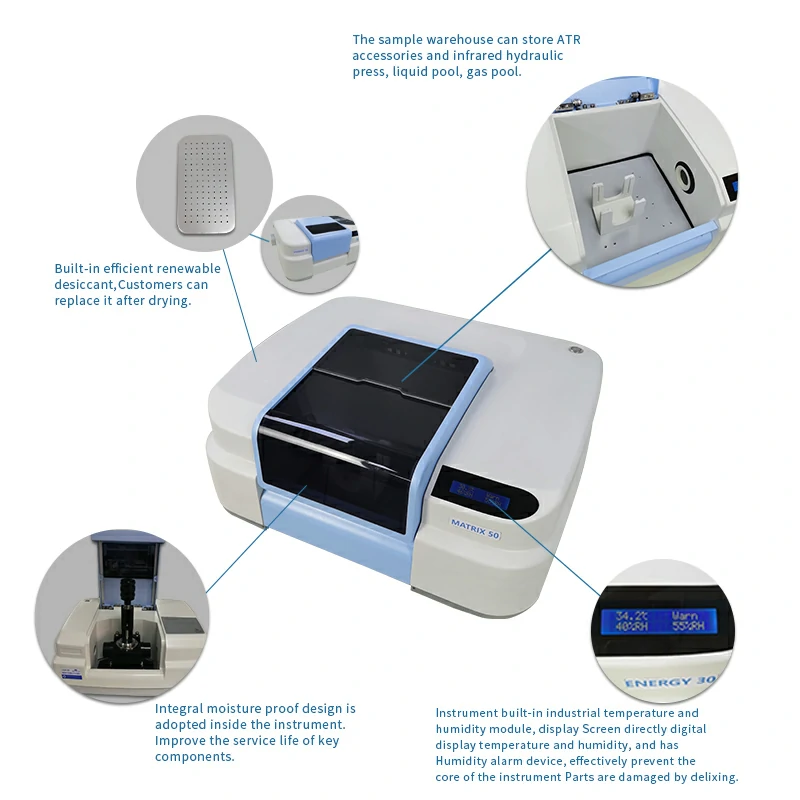
Introduction to our ENERGY-30 FTIR instrument:
The ENERGY 30 Fourier Transform Infrared Spectrometer is a product independently developed by Tianjin Hench Technology Co., Ltd. It features easy installation, simple operation, and convenient maintenance. It is an indispensable spectroscopic analysis instrument for industries such as materials science, biomedicine, petrochemicals, and food safety. At the same time, it is also a necessary laboratory analysis instrument for relevant professional fields in universities, research institutes, etc. Since its launch, it has dominated the domestic market and has won the support and trust of a wide range of users.
Experimental principle:
By utilizing the interference modulation working principle of the interferometer, the light emitted by the source is transformed into interference light through the Michelson interferometer. Then, this interference light is directed towards the sample. The receiver receives the interference light containing information about the sample, and through computer software and Fourier transformation, the spectral graph of the sample can be obtained.
Application industries:
- Testing of food and pharmaceutical products, including their packaging materials
- Identification and characterization of plastics, rubber, nylon, resins, and other high-molecular materials
- Traceability analysis of asphalt and determination of SBS content
- Determination of fatty acid methyl ester (FAME) content
- Structural analysis of mineral insulating oils and lubricating oils
- Identification and quantification of unconventional additives in automotive gasoline
- Measurement of carbon-oxygen content in silicon crystals
- Textile fiber identification and classification
- Determination of the Q-value of crystals
- Measurement of key parameters of architectural glass